
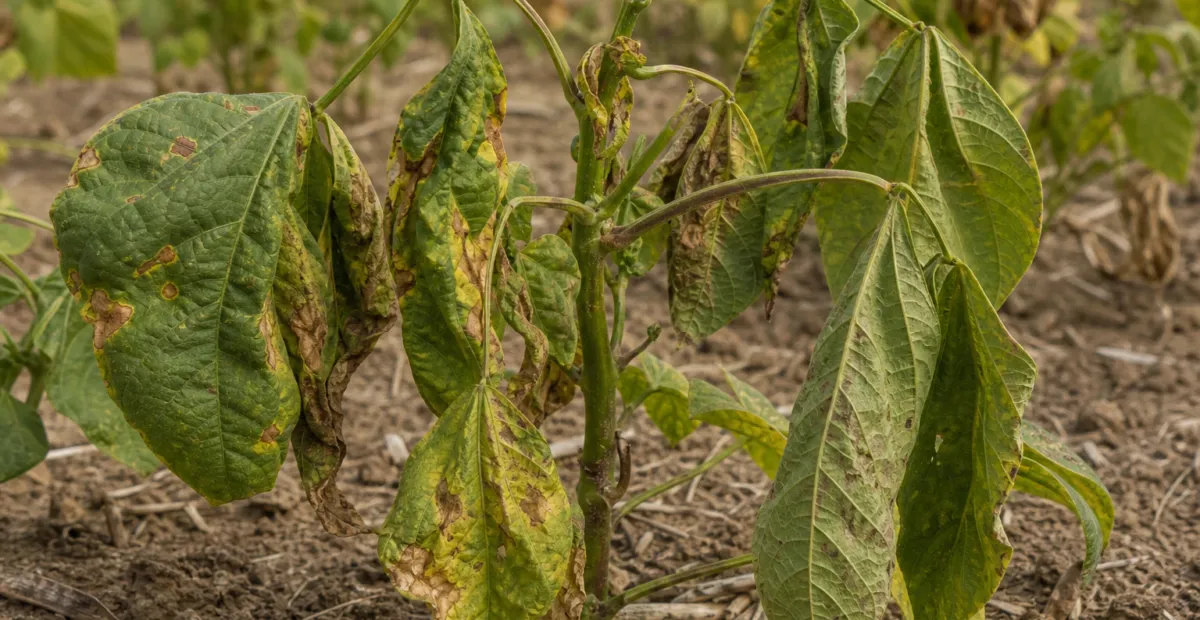
Bacterial Wilt of Dry Bean
Curtobacterium flaccumfaciens pv. flaccumfaciensBacterial Wilt of Dry Bean overview
Bacterial wilt of dry bean is a seed-borne vascular disease caused by Curtobacterium flaccumfaciens pv. flaccumfaciens. It is most important in common bean production and can cause heat-related leaf wilt, interveinal necrosis, premature plant death, yield loss, and discolored seed. Disease spread is favored by infected seed, crop debris, splash, irrigation water, storms, and field operations when foliage is wet.
Typical conditions
Overview
Bacterial wilt of dry bean is caused by the gram-positive, aerobic bacterium Curtobacterium flaccumfaciens pv. flaccumfaciens. In the United States, the disease is most closely associated with common bean (Phaseolus vulgaris), including dry edible bean market classes such as pinto, Great Northern, navy, kidney, black, pink, small red, cranberry, and yellow bean.
The pathogen moves systemically through the xylem. Under favorable conditions, disease can range from scattered wilted plants to severe stand loss. Affected plants may temporarily recover during cooler evening conditions and wilt again during hot afternoons.
Visual diagnosis is not definitive. Interveinal lesions may be confused with common bacterial blight, while wilt may resemble Fusarium or other root diseases. Submit representative plants and seed to a plant diagnostic laboratory when the disease is suspected.
Symptoms and identification
- Leaf wilt that becomes most obvious during hot, dry weather or moisture stress.
- Interveinal brown to tan necrotic lesions, sometimes bordered by a bright yellow or wavy yellow margin.
- Leaf-edge scorching, flaccid foliage, premature defoliation, and progressive stem wilt.
- Young seedlings may collapse and die; older plants may show slower, less severe wilt.
- Surviving infected plants can produce shriveled or discolored seed, especially yellow, orange, pink, or purple staining in some seed types.
- Unlike some common bacterial blight lesions, bacterial-wilt lesions are often irregular or wavy and generally lack a conspicuous water-soaked appearance.
Symptom expression varies with cultivar, bacterial strain, plant age, temperature, and water stress.
Causes and spread
The principal long-distance pathway is infected or contaminated seed. Seed produced on infected plants may carry the bacterium internally or on the seed surface and can establish primary infection in the next crop.
Within and between fields, spread may occur through rain splash, wind-driven rain, sprinkler irrigation, contaminated irrigation water, infected plant debris, volunteer bean plants, soil carried on equipment, and workers or machinery moving through wet foliage. Hail and violent storms can increase wounding and bacterial movement.
Infected crop residue and volunteer beans can maintain inoculum between bean crops. The disease is especially likely to become noticeable when infected plants experience heat, drought stress, or other conditions that increase demand on the vascular system.
Life cycle and persistence
The bacterium survives between crops in infected seed, dried bean tissues, crop residue, and occasionally volunteer plants. When infected seed germinates, the pathogen can enter the emerging plant and move into vascular tissue. It then multiplies in xylem vessels, restricting water transport and producing wilt and foliar injury.
Bacteria released from infected tissue can colonize plant surfaces and spread by water, equipment, or contact. New infections are favored by wounds, wet weather, storms, and field operations in wet crops. Warm conditions above about 90°F favor disease development, with rapid pathogen growth reported near 100°F, particularly when humidity or plant stress is also high.
Seed infection and disease severity are not identical in every cultivar or environment. A laboratory diagnosis and seed testing are therefore preferable to relying on seed discoloration or field symptoms alone.
Treatment and control
There is no dependable curative treatment for plants already systemically infected. Rogue and destroy severely affected plants when practical, especially in small plantings, while minimizing contact with healthy plants and avoiding work during wet conditions.
After harvest, remove or properly incorporate infected bean residue and control volunteer beans. Do not use harvested seed from a suspect field for planting. For commercial production, arrange laboratory testing of symptomatic plants and seed, and follow state seed-certification or quarantine guidance if applicable.
For the next crop, the most effective approach is an integrated program based on clean seed, rotation, sanitation, resistant cultivars, and management of irrigation and field traffic. Copper or other bactericide products are not a substitute for clean seed and sanitation, and their usefulness against a vascular infection is limited.
Low-impact and biological control
- Use organically produced certified seed that has been tested or certified under an appropriate seed-health program.
- Select cultivars with documented resistance or improved tolerance where available.
- Rotate with non-bean crops and eliminate volunteer beans.
- Sanitize seed-contact surfaces and field equipment to reduce mechanical spread.
- Use drip or carefully managed irrigation to reduce splash and leaf wetness when compatible with the production system.
- Maintain balanced irrigation and fertility to reduce severe water stress, while recognizing that improved plant vigor does not eliminate seed-borne infection.
- Do not compost visibly diseased bean material unless the composting process is managed to reliably achieve pathogen-killing temperatures and conditions.
No organic input should be assumed effective against established vascular infection without local, crop-specific evidence and legal label approval.
Prevention
- Plant certified, pathogen-tested seed from a reputable supplier; do not save seed from fields with unexplained wilt or discolored seed.
- Use resistant or tolerant cultivars when suitable varieties are available for the local dry bean market class and production region.
- Rotate out of beans for at least two to three years where bacterial wilt has occurred; use non-host crops during the rotation.
- Remove volunteer beans and avoid carrying bean straw or contaminated soil into clean fields.
- Incorporate or manage infected residue promptly after harvest according to local soil-conservation and production practices.
- Clean soil and plant debris from tillage, planting, cultivation, and harvest equipment before entering uninfested fields.
- Avoid working or cultivating when bean foliage is wet, and limit activities that cause plant-to-plant contact or wounding.
- Use irrigation water responsibly and avoid reusing water that has passed through an infected bean field.
- Where practical, use irrigation methods that minimize splash and prolonged leaf wetness.
Interesting facts
- The disease was first recognized in the United States near Redfield, South Dakota, after the 1921 growing season.
- The pathogen is a short, irregular or club-shaped, gram-positive bacterium that may produce yellow, orange, or purple pigments depending on the strain.
- Seed discoloration can be a useful warning sign, but symptomless infected seed and variable pigment expression mean that appearance alone is not a reliable diagnostic test.
- Common bean seedlings are often more vulnerable than mature plants, and infection at an early stage can result in rapid death.
- Reported host range extends beyond common bean, but susceptibility and strain relationships vary; documented reports should not be treated as proof that every cultivar of every listed species is equally susceptible.
- The disease can re-emerge after many years when contaminated seed, residue, volunteers, or favorable weather reintroduce the pathogen.
No pesticide program should be used as a substitute for clean seed, crop rotation, and sanitation. In the United States, use only products legally authorized and currently labeled for the specific crop, disease, and application site in your state; follow the current label exactly, including rate, timing, personal protective equipment, reentry interval, and preharvest interval. Check with your state Extension service and pesticide regulatory agency because registrations and labels can change.
Affected plants
The plants below are linked to this problem by structured host-plant data. The list updates automatically as new plant profiles are added.
 Moth Bean (Vigna aconitifolia) care guideVigna aconitifolia
 Azuki Bean (Vigna angularis) care guideVigna angularis
 Black Gram (Vigna mungo) care guideVigna mungo
 Mung Bean (Vigna radiata) care guideVigna radiata
 Creole-bean (Vigna reflexopilosa) care guideVigna reflexopilosa
 Rice Bean (Vigna umbellata) care guideVigna umbellata
 He tepary bea (Phaseolus acutifolius) care guidePhaseolus acutifolius
 Snap bean (Phaseolus coccineus) care guidePhaseolus coccineus
 Butter bea (Phaseolus lunatus) care guidePhaseolus lunatus
 String Bean (Phaseolus vulgaris) care guidePhaseolus vulgaris
 Vigna subterranea care guideVigna subterranea
 Cowpea (Vigna unguiculata) care guideVigna unguiculata