
 Source:
 Tomato leaf mold
Passalora fulvaTomato leaf mold overview
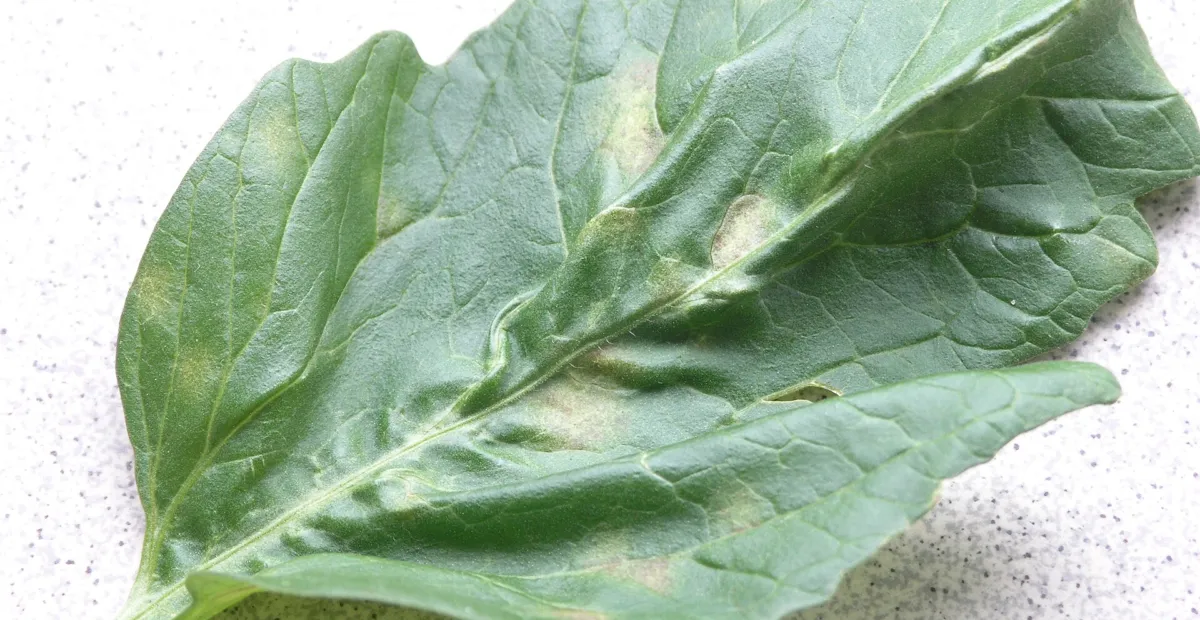
Tomato leaf mold is a fungal disease caused by Passalora fulva, most often seen on greenhouse and high-tunnel tomatoes when relative humidity remains above about 85%. Small pale green or yellow spots develop on older upper leaf surfaces, while the undersides develop a characteristic olive, tan, or brown velvety mold. Severe infection causes leaf death, premature defoliation, reduced yield, and occasionally blossom or fruit injury.
Typical conditions
Overview
Tomato leaf mold is primarily a disease of protected tomato production in the United States, especially greenhouses and high tunnels. Field-grown tomatoes are less commonly affected but can develop the disease during prolonged humid, wet weather.
The most diagnostic feature is the combination of relatively discrete yellow or pale-green lesions on the upper leaf surface and a corresponding fuzzy, olive-colored mold on the underside. The pathogen mainly colonizes living tomato foliage; severe leaf loss reduces photosynthetic capacity and may reduce fruit production.
Symptoms and identification
Symptoms commonly begin on the oldest or lower leaves as small, pale green to yellow, irregular or poorly defined spots on the upper surface. The corresponding underside develops olive-green, tan, grayish, or brown velvety fungal growth that may be visible without magnification.
- Lesions enlarge and may merge, becoming yellow-brown or necrotic.
- Leaves curl, wither, die, and may remain attached or drop prematurely.
- Severe infections progress upward and can cause major defoliation.
- Infected blossoms may blacken and fall.
- Fruit symptoms are uncommon or inconsistently reported; when present, dark, sunken, dry, leathery stem-end lesions may develop.
Magnesium deficiency, early blight, Septoria leaf spot, bacterial diseases, and other leaf-mold fungi can resemble parts of this symptom pattern. Inspect the underside of affected leaves before making a management decision.
Causes and spread
The disease spreads when spores produced on infected tomato leaves are released into humid air or moved by water, workers, tools, clothing, and plant contact. Dense canopies, poor ventilation, condensation, overhead irrigation, and prolonged leaf wetness increase the chance of infection and repeated cycles.
Infected crop residue can provide carryover between tomato crops. Seed may also carry or introduce the pathogen. Moving plants, tools, or debris from an infected greenhouse or high tunnel to a clean one can start new outbreaks.
Life cycle and persistence
Passalora fulva produces airborne conidia on infected leaf undersides. Spores can move with air currents, splashing water, workers, clothing, tools, and plant handling. Infection occurs through stomata when the leaf surface remains humid or wet; symptoms may become visible after approximately one to two weeks under favorable conditions.
The pathogen can persist between crops in infected tomato residue and may survive for months to about a year under suitable conditions. Dark resting structures in debris and contaminated or infected seed can provide carryover or introduce the disease. Several pathogen races occur, which helps explain why resistance in a cultivar may not be complete or durable.
Treatment and control
At the first confirmed symptoms, reduce humidity and remove the most heavily infected leaves without shaking them through the canopy. Work from healthy areas toward diseased areas, place removed material directly into a bag or covered container, and sanitize tools afterward.
Improve air movement, open vents when weather permits, correct irrigation practices, and avoid handling plants while foliage is wet. If disease is spreading or the crop is high value, consult the current state extension vegetable guide or a licensed crop adviser for products registered in your state and production system. Protective fungicides generally provide better suppression when started before severe defoliation; they cannot restore dead tissue. Rotate fungicide modes of action according to the current label and resistance-management guidance.
Low-impact and biological control
For organically managed tomatoes, begin with environmental and sanitation measures rather than relying on sprays.
- Choose tomato cultivars described by the seed supplier as resistant to leaf mold, while recognizing that resistance may not cover every pathogen race.
- Ventilate greenhouses and high tunnels early, use horizontal airflow where appropriate, and avoid allowing nighttime condensation to persist.
- Use drip irrigation or another method that keeps foliage dry; irrigate early enough for unavoidable moisture to dry quickly.
- Prune and stake plants carefully to open the canopy, avoiding excessive pruning that can sunscald fruit or stress plants.
- Remove badly infected leaves and plants promptly, bagging or otherwise containing debris rather than shaking spores through the structure.
- Disinfect tools between plants and clean greenhouse surfaces, stakes, clips, and benches between crop cycles.
- Use only biological or mineral products that are currently labeled for the crop and disease and permitted by the applicable organic certification program.
Prevention
Prevention is most effective when humidity is managed before symptoms appear.
- Start with clean, reputable seed and transplants; avoid bringing visibly diseased plants into a greenhouse or high tunnel.
- Select cultivars with documented leaf-mold resistance appropriate to the intended market and production system.
- Maintain good spacing, stake or trellis plants, prune judiciously, and keep foliage from forming a continuously wet, crowded canopy.
- Ventilate and use fans to reduce relative humidity and condensation, particularly overnight and after irrigation.
- Prefer drip irrigation and avoid routine overhead watering.
- Scout lower and inner leaves weekly, examining both surfaces.
- Remove and destroy infected plant residue at crop termination and sanitize the structure and reusable equipment before replanting.
- Where practical, rotate away from tomato or allow a sufficient break between tomato crops; rotation alone may not eliminate inoculum in protected structures.
Interesting facts
- The former names Cladosporium fulvum and Fulvia fulva are still common in older tomato disease references.
- The underside of the leaf is often more diagnostically useful than the upper surface because sporulation is concentrated there.
- Leaf mold is strongly associated with protected culture because enclosed structures can maintain high humidity even when the growing medium is not excessively wet.
- Resistance is available in many tomato cultivars, but pathogen races can overcome individual resistance genes.
Use fungicides only when the product is currently legally authorized and labeled for tomato leaf mold on tomatoes in the United States and in your production setting. Follow the current EPA-approved label for rate, timing, personal protective equipment, reentry interval, preharvest interval, resistance-management group, and worker or pollinator precautions. Product registrations and labels can change; do not rely on a product name or program from an older publication. Fungicides work best preventively and should support, not replace, humidity control, sanitation, resistant cultivars, and improved airflow.