
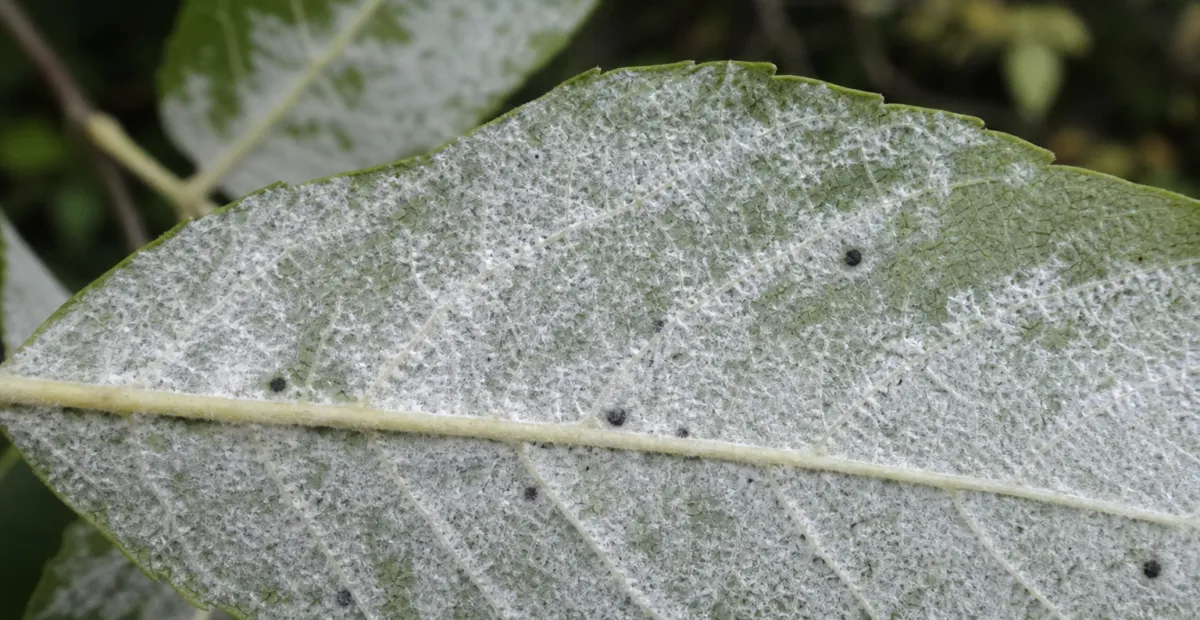
Ash Powdery Mildew
Phyllactinia fraxini (DC.) FussAsh Powdery Mildew overview
Ash powdery mildew is a fungal disease of ash trees caused by Phyllactinia fraxini. It produces conspicuous white, powdery growth mainly on the undersides of leaves, often becoming more noticeable from late summer into fall. Established trees usually tolerate infection, but severe disease can reduce photosynthesis and cause premature leaf drop, especially where foliage is dense, shaded or poorly ventilated.
Typical conditions
Overview
Phyllactinia fraxini is an ascomycete fungus in the powdery mildew family Erysiphaceae. It is documented primarily on ash trees (Fraxinus spp.), with records from Europe and other regions. The disease is generally a foliage problem rather than a vascular or root disease. Mature landscape trees commonly remain viable, although repeated or heavy infection can reduce leaf function and contribute to premature defoliation.
Taxonomy within ash-infecting Phyllactinia is more complex than older field references suggest. Several closely related species show strong host specificity, and North American ash records should not automatically be assigned to P. fraxini without suitable diagnostic evidence.
Symptoms and identification
- Thin to dense white, felt-like or powdery fungal growth, most often on the underside of ash leaves and sometimes concentrated along veins.
- Infected leaves may show pale green to yellow areas, slight curling or reduced vigor, although conspicuous surface discoloration is not always present.
- Late in the season, small yellow-brown to black spherical chasmothecia may develop within the mildew colonies.
- Severe infections can cause premature leaf yellowing and leaf drop, but major branch dieback is not typical of this disease alone.
Do not confuse the mildew with ash yellows, anthracnose, rust, or eriophyid mite galls. A hand lens can reveal the characteristic dark fruiting bodies, but laboratory confirmation is preferable when the identification has regulatory, nursery or diagnostic significance.
Causes and spread
The disease is caused by the obligate biotrophic fungus Phyllactinia fraxini. It spreads primarily by airborne conidia produced on actively infected leaf colonies. Sexual fruiting bodies formed late in the growing season can mature on infected foliage and fallen leaves, providing a potential source of overwintering inoculum.
Spread and disease development are favored by dense crowns, shading, restricted air circulation and humid periods. Unlike many leaf-spot fungi, powdery mildews do not require prolonged leaf wetness for infection; dry-to-moderately humid conditions with cool nights and shaded foliage can still support disease. Local outbreaks may also reflect susceptible ash selections, unusually lush growth or stress that reduces canopy ventilation.
Life cycle and persistence
In spring and summer, spores landing on susceptible ash leaves germinate and the fungus develops superficially on the leaf surface, obtaining nutrients through specialized feeding structures that enter epidermal cells. White colonies produce additional conidia, allowing repeated secondary spread during the season.
As leaves mature, the fungus may form dark chasmothecia. In documented material, these structures have a bulbous base and acicular appendages. After overwintering and suitable moisture conditions, they can release sexual spores, although the relative importance of this phase varies with climate and local conditions. The exact field cycle in the United States is not well established for every ash host and regional population.
Treatment and control
For most established ash trees, treatment is unnecessary unless infection is severe, recurring or affecting a high-value specimen. Begin with confirmation of the diagnosis and assessment of tree vigor. Improve canopy ventilation, correct irrigation or site stress, and remove badly affected leaves or selected congested shoots where this can be done without excessive pruning.
Fungicides, when justified, work best as protectants applied early in disease development and may require thorough coverage of leaf surfaces. They generally cannot restore tissue already colonized by the fungus. Large trees should be evaluated and treated by a certified arborist, and any product choice must account for the specific ash species, site and label restrictions.
Low-impact and biological control
Use an integrated, low-risk approach: improve airflow, reduce shade where feasible, avoid excessive nitrogen that promotes dense succulent growth, irrigate during drought, and remove heavily infected leaf litter. On small accessible trees, selective removal of badly colonized leaves may reduce visible inoculum but is not a stand-alone cure.
Products marketed as organic, including certain horticultural oils, soaps or biological fungicides, should be considered only when the label specifically permits use on the crop or ornamental situation and the timing is appropriate. Test sprays on a small area first when phytotoxicity is a concern, and never apply oils during heat, drought stress or incompatible spray intervals.
Prevention
- Plant ash trees only where the species and site are appropriate, with enough room for the mature crown.
- Maintain sunlight and airflow by avoiding unnecessary crowding and by using qualified pruning practices to remove selected crossing or congested branches.
- Water trees deeply during drought, applying water to the root zone rather than routinely wetting foliage; maintain mulch without piling it against the trunk.
- Rake and remove heavily infected fallen leaves where practical, especially around young specimen trees or nursery stock.
- Monitor lower leaf surfaces from midsummer through fall, particularly after a history of mildew or during prolonged humid weather.
Interesting facts
- Phyllactinia species often form conspicuous dark chasmothecia with stiff, needle-like appendages, a useful microscopic and hand-lens clue.
- Modern taxonomic studies indicate strong host specificity among powdery mildews occurring on Fraxinus, with several closely related species separated by host association, morphology and DNA data.
- The common name “ash powdery mildew” can describe similar-looking infections caused by different Phyllactinia species, so host and geographic context matter.
- Unlike vascular ash diseases such as ash yellows, this pathogen is principally associated with superficial leaf colonies.
Use only fungicides legally authorized for ash, the diagnosed powdery mildew problem and the intended site in the United States. Follow the current product label exactly, including permitted crops or ornamentals, rate, timing, protective equipment, reentry interval and environmental restrictions. Do not infer that a product labeled for another powdery mildew or another crop is legal or effective for this disease.