
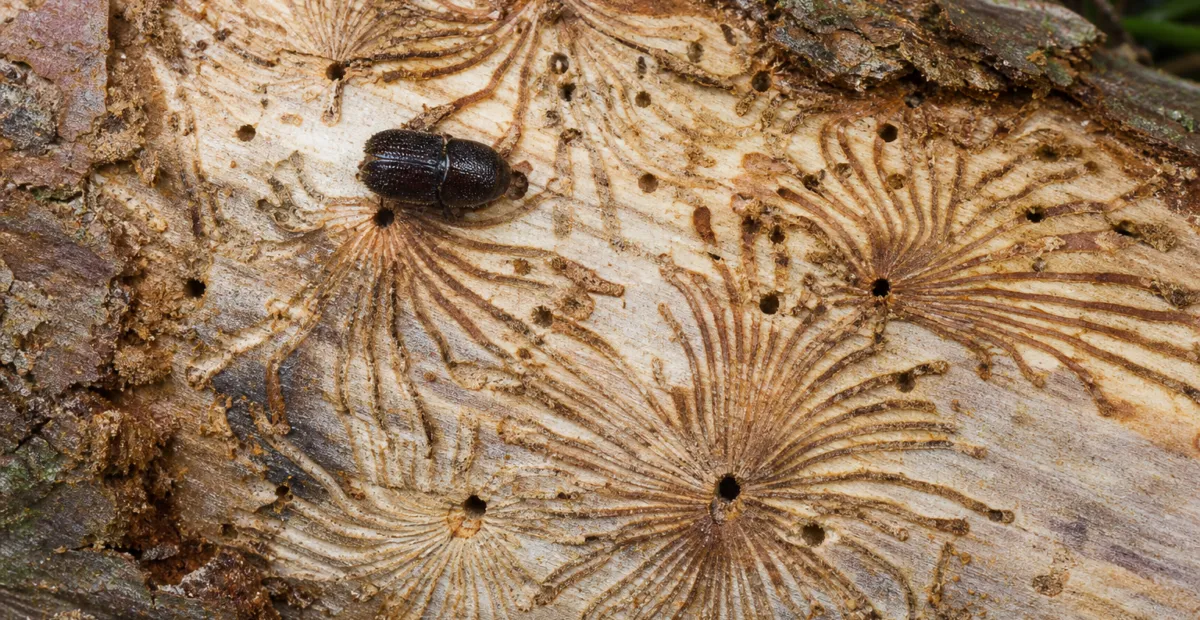
Six-toothed spruce bark beetle
Pityogenes chalcographus (Linnaeus)Six-toothed spruce bark beetle overview
The six-toothed spruce bark beetle, Pityogenes chalcographus, is a tiny bark beetle associated mainly with Norway spruce and other conifers. It usually colonizes wind-damaged, drought-stressed, snow-broken or freshly cut material, especially thin-barked upper stems, branches and logging debris. Heavy infestations can kill young spruce and contribute to decline in weakened trees, but identification should distinguish it from other bark beetles.
Typical conditions
Overview
The six-toothed spruce bark beetle is a 0.06–0.11 inch long bark beetle that develops in the phloem and inner bark rather than feeding on foliage. Adults commonly colonize thin-barked upper trunks, branches, tops, stumps and slash. Norway spruce is the preferred host, but documented associations include several genera of Pinaceae.
It is usually a secondary or opportunistic pest. Windthrow, snow breakage, drought, heat, logging injury, defoliation and fresh cutting can reduce tree defenses and create breeding material. In young or severely weakened spruce, dense attacks may cause crown discoloration and tree death. On large mature trees, mortality is less likely from this species alone and may involve other bark beetles or stress factors.
Symptoms and identification
Early external signs may be subtle because galleries are hidden beneath the bark. Look for small round entrance holes, reddish-brown boring dust or frass in bark crevices, and fine sawdust around branch bases or on the ground. Removing bark reveals a central nuptial chamber with several radiating maternal galleries and branching larval galleries.
Infested young spruce may develop fading, yellowing or red needles, thinning crowns and branch mortality. In larger trees, symptoms often begin high in the crown or upper stem. Peeling bark can expose larvae, pupae or newly formed adults. These signs are not diagnostic alone: Ips, Polygraphus, Pityophthorus and other bark beetles can produce similar damage, so gallery pattern and adult identification are important.
Causes and spread
Population increases are most strongly associated with abundant stressed or recently killed conifer material. Windthrow, snow breakage, drought, heat, defoliation and logging operations can weaken living trees or produce suitable breeding sites. Fresh tops, branches, stumps and slash left after cutting may support larval development.
Adults disperse from infested material to nearby susceptible trees, especially where spruce is exposed, drought-stressed or concentrated in young stands. High populations may attack less-stressed trees, but large mature spruce are generally harder for this small bark beetle to kill without additional stress or attack by other bark beetles.
Life cycle and persistence
Adults overwinter under bark or in forest-floor litter and emerge during spring warming. Males initiate attacks and construct a mating chamber in the phloem, releasing aggregation pheromones that attract females. Females excavate several radiating egg galleries and lay eggs along them.
Larvae feed in the inner bark for roughly 4–6 weeks, then pupate in chambers beneath the bark. New adults mature in the surrounding phloem before boring out and dispersing. Depending on latitude, elevation and weather, the species may complete one generation annually or commonly two generations in warmer parts of its European range; an additional late generation can occur under especially favorable conditions. Larvae, pupae and adults may overwinter.
Treatment and control
Once adults and larvae are established beneath bark, treatment of an individual tree is difficult and often unsuccessful. Mark suspected trees, confirm the beetle where possible, and assess whether the tree is structurally hazardous or part of a regulated forest-health situation.
- For recently infested branches, tops or small trees, cut and promptly remove or destroy the material before new adults emerge.
- Debark, chip or otherwise process infested logs and slash so larvae and pupae cannot complete development.
- Do not move infested spruce firewood, logs or nursery material to uninfested areas.
- For valuable landscape trees, consult an ISA-certified arborist and state or university extension specialist about tree vigor, structural safety and any legally labeled bark-protection option.
- Remove dead or high-risk trees only with appropriate professional assistance; sanitation is most effective when coordinated across nearby breeding material.
Low-impact and biological control
There is no dependable home-garden biological treatment that reaches larvae protected beneath intact bark. Conservation of naturally occurring predators and parasitoids is beneficial, but their population effects are variable and commercial releases are not a proven stand-level solution.
- Inspect spruce after storms, drought and major pruning, concentrating on thin-barked upper stems, branches and tops.
- Promptly remove and destroy infested branches, tops, windthrown trees and slash before adult emergence; chip, debark, burn where legally permitted, or remove material according to local forestry guidance.
- Do not store fresh spruce firewood, logs or slash beside healthy spruce during the beetle flight season.
- Use pheromone traps only for professional monitoring or detection and place them under guidance, because traps can attract non-target insects and catches do not directly measure tree-killing risk.
- Maintain tree vigor with appropriate irrigation during drought, protect roots and bark from mechanical injury, and avoid unnecessary pruning during periods of stress.
Prevention
Prevention focuses on reducing breeding material and maintaining conifer vigor rather than routine pesticide use.
- Survey spruce and other susceptible conifers after storms, prolonged drought and construction or logging injury.
- Remove windthrown, snow-broken and freshly cut spruce material promptly, before the next warm flight period.
- Process slash by chipping, debarking, removal or another locally approved method that prevents brood completion.
- Use site-appropriate spruce species and avoid planting Norway spruce where heat, drought or poor drainage routinely cause chronic stress.
- Water established landscape trees deeply during extended drought where permitted, while avoiding saturated soil and trunk wetting.
- Protect roots, trunks and lower branches from equipment, string trimmers, staking injuries and soil compaction.
- Have suspicious infestations confirmed by a state forestry agency, Cooperative Extension office, certified arborist or diagnostic laboratory, particularly because this beetle is not known to be established in the United States.
Interesting facts
- The species is also called the spruce wood engraver or six-toothed bark beetle.
- Its name refers to the three tooth-like projections on each side of the male’s wing-cover tip.
- Norway spruce is the best-documented and most suitable host for larval development.
- The beetle usually occupies thinner bark than larger spruce bark beetles and may occur in the upper crown while other species occupy lower stem sections.
- Its aggregation signal includes chalcogran, a pheromone produced mainly by feeding males.
- Although associated fungi occur in its galleries, no single fungus is consistently recognized as causing widespread tree mortality from this beetle alone.
Use insecticides only when a product is legally authorized and specifically labeled for the crop, site and bark-beetle problem in the United States. Follow the current label exactly, including rates, timing, personal protective equipment, re-entry restrictions and environmental precautions. Preventive sprays are generally impractical for hidden brood beneath bark; consult a state forestry agency, arborist or extension specialist before treating valuable trees.