
 Source:
 Large White Butterfly
Pieris brassicaeLarge White Butterfly overview
The large white butterfly, Pieris brassicae, is a destructive caterpillar pest of cabbage-family crops rather than a plant disease. Its gregarious, yellow-striped larvae chew leaves from the underside outward, often leaving only thick veins, frass, and damaged heads. In the United States it is primarily a regulated invasive-pest concern and may be confused with the much more common imported cabbageworm, Pieris rapae.
Typical conditions
Overview
Pieris brassicae, commonly called the large white or large cabbage white, is a butterfly in the family Pieridae. The damaging stage is the caterpillar, not the adult. Larvae commonly feed in groups when young and can later disperse across cabbage-family plants. Heavy infestations may skeletonize leaves, contaminate produce with frass, and occasionally enter developing cabbage or cauliflower heads.
This species is widespread in Europe, Asia and North Africa but is not the routine “cabbage white” encountered in most U.S. gardens. Suspected finds in the United States should be documented and reported to the state plant-health authority or USDA APHIS because several native and established white butterflies look similar.
Symptoms and identification
- Young larvae scrape or window-feed on leaf surfaces, often in groups.
- Older larvae make irregular holes and may leave only thick veins, producing a skeletonized appearance.
- Yellow longitudinal stripes, dark patches and dense short hairs distinguish the larvae from the smoother green imported cabbageworm in many cases.
- Frass may accumulate on leaves or inside developing cabbage and cauliflower heads.
- Severe feeding can stunt young plants, reduce market quality and cause extensive defoliation.
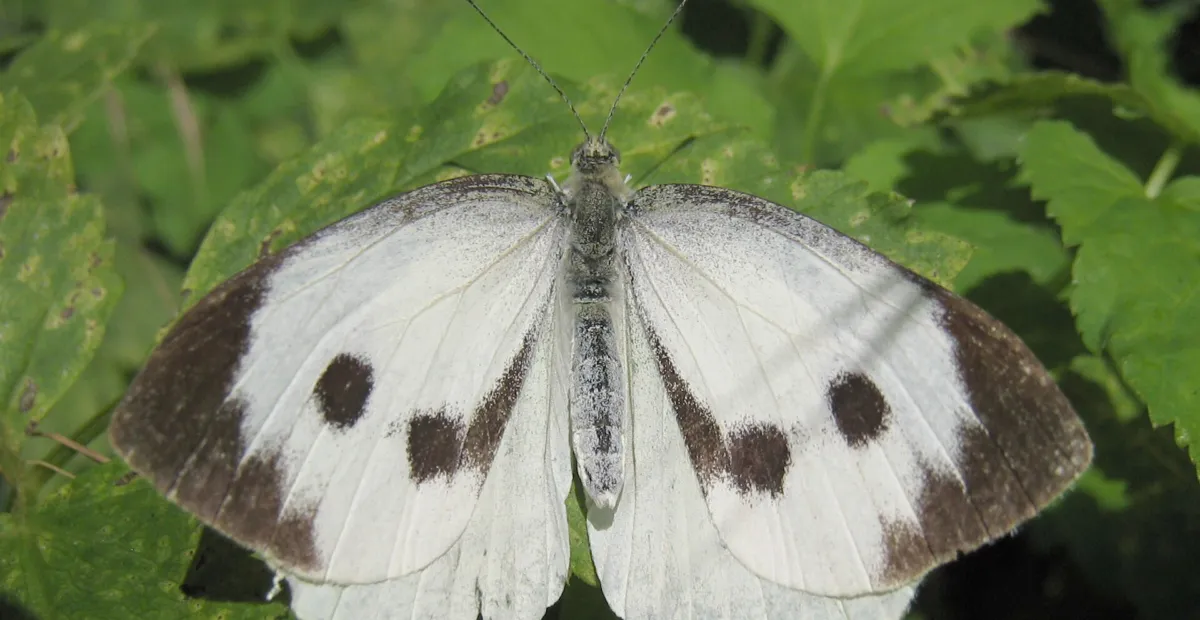
Adults are large, creamy white butterflies with dark forewing tips extending down the wing margin. This pattern and the larger size help separate them from Pieris rapae, but field identification can still be uncertain.
Causes and spread
Damage is caused by caterpillars hatching from eggs laid on host foliage. Females commonly lay batches of yellow eggs on the underside of leaves, and young larvae remain aggregated before becoming more solitary. Adults are strong fliers and can disperse to new plantings; movement of infested plant material, produce, containers or attached pupae can also assist spread.
Brassica crops and related weeds provide a continuous host supply. The pest is favored where unmanaged cruciferous weeds, volunteer crops and successive brassica plantings overlap.
Life cycle and persistence
Eggs are laid on leaf undersides, often in batches ranging from a few eggs to more than 100. Depending on temperature, hatching may occur in roughly 4 days to more than 2 weeks. Larvae pass through five instars and feed externally on leaves. Mature caterpillars may travel more than 300 feet while seeking a pupation site.
The naked chrysalis is attached to vegetation, plant debris or nearby structures. Warm-weather pupation may last about 10 days, whereas cool conditions can prolong it to several weeks. The species commonly overwinters in the pupal stage, and reported generation numbers vary by climate—from about two in parts of northern Europe to several generations in warmer regions.
Treatment and control
Begin with confirmation and monitoring rather than treating every white butterfly. Inspect undersides of leaves, growing points and developing heads. Hand-pick and destroy eggs or larvae when infestations are limited. Remove badly infested outer leaves when this will not compromise the crop, and wash or trim harvested produce according to food-safety practice.
For larger plantings, combine exclusion, frequent scouting and targeted treatment of small larvae. Biological products based on Bacillus thuringiensis var. kurstaki can be effective when larvae are young, but coverage and repeated monitoring are important. Avoid broad-spectrum applications that unnecessarily kill parasitoids, predators and pollinators.
Low-impact and biological control
- Hand-pick egg masses and caterpillars and place them in soapy water or a sealed disposal container.
- Use tightly secured row cover to prevent adult butterflies from laying eggs.
- Apply a properly labeled microbial caterpillar control such as Bt kurstaki to young larvae, following the product label.
- Encourage paper wasps, predatory bugs, ground beetles, lacewings, spiders and parasitoid wasps by reducing unnecessary insecticide use and providing nectar resources.
- Interplanting brassicas with unrelated flowering plants may increase natural-enemy activity, but it should supplement—not replace—exclusion and scouting.
Prevention
- Use insect-exclusion mesh or floating row cover immediately after planting, securing edges tightly against the soil.
- Inspect transplants before planting and reject material carrying eggs, larvae or pupae.
- Scout leaf undersides and inner foliage at least weekly during warm weather; increase checks after observing large white butterflies.
- Remove volunteer brassicas and manage nearby cruciferous weeds where practical.
- Remove crop debris after harvest and avoid leaving infested plant material near new brassica plantings.
- Planting early or choosing early-maturing cultivars can help plants outgrow peak feeding periods in some U.S. climates, although timing varies by region.
- Preserve flowering plants and habitat that support predatory insects and parasitoid wasps.
Interesting facts
- Pieris brassicae is generally larger than the common U.S. imported cabbageworm, Pieris rapae.
- Young larvae are notably gregarious and may rest together on a silken pad between feeding periods.
- Larvae can consume all leaf tissues except major veins, producing rapid skeletonization at high density.
- The species has a broad documented host association centered on the mustard family, with additional records in several other plant families.
- Because it is migratory and potentially damaging to vegetable production, it is included in U.S. invasive-pest screening resources.
Use only pesticide products legally authorized for Pieris brassicae or the applicable caterpillar pest on the specific crop in the United States and in your state. Follow the current label exactly, including crop, rate, preharvest interval, protective-equipment, pollinator and reentry requirements. Do not assume a product labeled for Pieris rapae is automatically labeled for Pieris brassicae.