
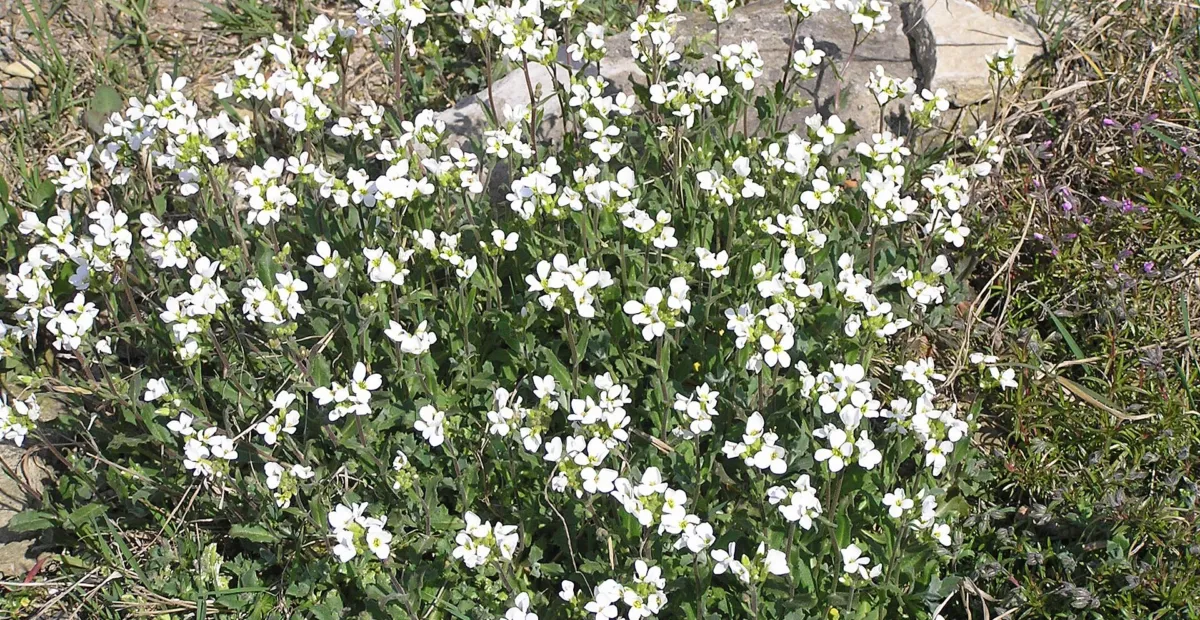
 Source:
 Garden Arabis (Arabis caucasica) short overview
Garden Arabis is a low, evergreen perennial that forms spreading mats of gray-green, toothed rosettes. In spring, short upright stems carry clusters of small, four-petaled white flowers, sometimes showing a soft pink tint in cultivated forms. It suits sunny rock gardens, gravel beds, walls, slopes, borders, and containers where drainage is sharp. Cutting it back after flowering helps keep the foliage dense and compact.
Taxonomic classification
Garden Arabis (Arabis caucasica) care guide
Light and placement
Plant in full sun with at least 6 hours of direct light, ideally on a south-, east-, or west-facing slope, wall, raised bed, or gravel garden. A little afternoon shade is acceptable in hot climates. Sparse flowering, elongated stems, and open mats suggest insufficient light; scorched foliage or rapid wilting indicates excessive reflected heat combined with inadequate moisture.
Watering and humidity
Water deeply after planting, then allow the upper soil to dry before watering again. Once established, it generally needs only occasional irrigation during prolonged drought, with more frequent watering during the first growing season and in containers. Avoid frequent shallow watering and winter wetness, which can cause root and crown problems.
Soil and growing medium
Use a lean, gritty substrate that drains rapidly but holds enough moisture for establishment. Mix heavy clay with coarse mineral material and organic matter rather than planting into a waterlogged pocket. Limestone-derived or alkaline soils are well suited, but the plant can tolerate neutral or mildly acidic soil when drainage remains excellent.
Feeding
Garden Arabis usually performs well without heavy fertilization. Apply a thin layer of compost in spring or use a balanced slow-release fertilizer at label strength as growth begins. Avoid high-nitrogen feeding, which can produce loose foliage and weaker stems. Do not fertilize drought-stressed, newly divided, or waterlogged plants.
Growth and habit
This perennial spreads by branching stems and forms a low, mounded to mat-like cover. Flowering stems rise above the foliage in spring. Older mats may become bare in the center or leggy after flowering, so timely trimming encourages denser regrowth and helps prevent an untidy, woody-looking spread.
Planting and repotting
Set plants into gritty, well-drained soil at the same depth they were growing in their containers. Water thoroughly after planting and keep evenly but not constantly moist while roots establish. Space plants about 12–18 inches apart, allowing room for the mats to join without creating prolonged crown wetness.
Container-grown plants need a sharply draining potting mix containing grit, perlite, or other mineral material. Repot in spring only when roots have filled the container or drainage has declined. Transplant at the original depth and water sparingly until recovery.
Propagation and pruning
Propagation
Propagate by softwood cuttings in summer, by division after flowering or in early fall, or from seed. Division and cuttings preserve the characteristics of a selected plant. Handle established mats carefully because the plant dislikes repeated root disturbance.
Pruning
Trim or shear lightly after flowering to remove spent stems and encourage compact, leafy regrowth. If the mat becomes open or bare, cut back more firmly after bloom, but avoid removing all foliage from a severely stressed plant. Remove damaged material at any time.
Overwintering
Outdoor plants generally overwinter without special protection in suitable USDA zones. The main winter risk is saturated soil, not cold alone. In colder or exposed sites, use a very free-draining position and avoid heavy organic mulch over the crown. Containers may need protection from repeated freeze-thaw cycles.
Uses
Useful for rock gardens, gravel beds, dry walls, slopes, banks, borders, edging, containers, and low-maintenance pollinator plantings. Its cascading foliage softens masonry and raised edges. Some extension references describe the leaves as edible, but culinary use should be limited to correctly identified, pesticide-free plants and is not a primary ornamental reason to grow it.
Appearance
The plant has loose basal rosettes of obovate to spatulate, toothed, gray-green leaves, often with a softly hairy or whitish appearance. Multiple slender stems carry racemes of four-petaled flowers. Its cascading habit is distinctive on walls, banks, and rockery edges.
Flowering
Flowers are produced in fairly dense racemes on short upright stems. The typical species has white, four-petaled blooms; pink or rose shades are common among cultivated selections. Flowering is usually concentrated in spring, with the exact timing shifting earlier in warm regions and later in colder areas.
Pollination and visitors
The open, nectar-bearing spring flowers are visited by bees, including specialized bees and bumblebees, and by butterflies. Plantings can provide an early-season floral resource, although visitor numbers vary with weather, surrounding habitat, and the presence of other blooming plants.
Arabis caucasica photos
Click any photo for a larger view. Source, author and license are shown separately.
Diseases and pests
Diseases
Poor drainage can contribute to crown or root decline. Downy mildew, white blister, and virus diseases are reported concerns. Reduce risk with good air circulation, clean propagation material, careful watering at the soil line, prompt removal of diseased foliage, and avoidance of planting in persistently wet soil.
Pests
Flea beetles, aphids, and arabis midge may occur. Inspect young foliage and flower stems regularly. Use strong water sprays for light aphid infestations, remove badly damaged material, and reserve insecticides for significant, confirmed problems while protecting visiting pollinators.
Related diseases and pests
Only Plant Doctor profiles whose host data indicate this plant may be affected are shown here.
 PestLarge White ButterflyPieris brassicae
 PestCabbage Stem Flea BeetlePsylliodes chrysocephala
 DiseaseCucurbit Downy MildewPseudoperonospora cubensis (Berk. & M.A. Curtis) Rostovzev
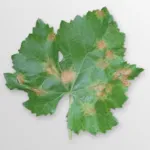 DiseaseGrape Downy MildewPlasmopara viticola
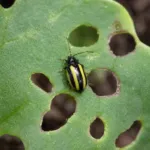 PestTurnip flea beetlePhyllotreta nemorum (Linnaeus, 1758)
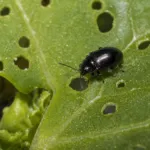 PestTurnip Flea BeetlePhyllotreta atra (Fabricius, 1775)
 DiseaseOnion downy mildewPeronospora destructor
 DiseaseLettuce Downy MildewBremia lactucae Regel
Toxicity and pollen
Authoritative horticultural sources reviewed for this profile do not establish a dependable human or pet toxicity classification for the species. Some extension material reports the leaves as edible, but that is not equivalent to verified safety for all people or animals. Do not ingest ornamental plants treated with pesticides, and seek professional advice after a significant exposure.
- Typical season
- Spring, during flowering
- Pollination / pollen
- Insect-carried pollen released from open spring flowers
The plant produces pollen from insect-pollinated flowers, but dependable species-specific airborne pollen and clinical allergy data were not located. Because pollen is primarily presented within open flowers and transported by visitors, exposure may be lower than for strongly wind-pollinated plants, but it should not be assumed to be zero.
Native habitat
In its native range, this species occurs in limestone rock crevices, screes, cliffs, streamside sites, and calcareous alpine meadows. These habitats are generally sunny, exposed, mineral-rich, and rapidly drained, which explains its preference for gritty soils and its poor performance in persistently wet ground.
Interesting fact
It is closely allied to and often confused with Arabis alpina in horticultural literature. The species can spread well beyond the size expected of a small rock-garden plant. Double-flowered and variegated cultivated forms are available, but they are not the same as the straight species.
Similar plants
 Azure Monkshood (Aconitum carmichaelii) care guideAconitum carmichaelii
 Monkshood (Aconitum ‘Stainless Steel’)Aconitum 'Stainless Steel'
 Monkshood (Aconitum ‘Bressingham Spire’)Aconitum 'Bressingham Spire'
 Golden full moon maple (Acer shirasawanum ‘Aureum’)Acer shirasawanum 'Aureum'
 Globosum (Acer platanoides ‘Globosum’)Acer platanoides 'Globosum'
 Striped maple (Acer pensylvanicum) care guideAcer pensylvanicum