
 Source:
 Grape Downy Mildew
Plasmopara viticolaGrape Downy Mildew overview
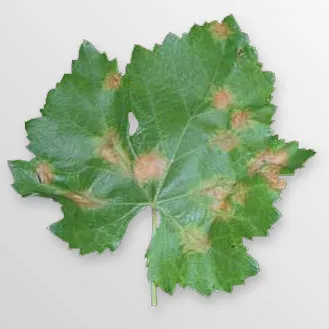
Grape downy mildew is a destructive disease of grapevines caused by the oomycete Plasmopara viticola. It favors warm, rainy or persistently humid weather and can damage leaves, shoots, flower clusters, rachises and young berries. Look for yellow, oily or angular leaf spots and white, cottony sporulation on the undersides of leaves and other actively growing tissues.
Typical conditions
Overview
Grape downy mildew is caused by Plasmopara viticola, a plant-pathogenic oomycete, sometimes called a water mold. It infects green grapevine tissues, especially expanding leaves, shoot tips, inflorescences, rachises and young berries.
Early foliage lesions are often pale yellow, yellow-green, reddish or brown and may have an oily appearance. Because veins restrict lesion expansion, spots are frequently angular. Under humid conditions, the lower leaf surface may develop dense white to gray, cottony sporulation.
Severe disease can cause premature leaf loss, shoot-tip death, flower and cluster drop, poor fruit set and losses in berry yield and quality. Powdery mildew can also produce pale surface growth, but it generally lacks the characteristic oily leaf spots and vein-limited lesions of downy mildew.
Symptoms and identification
- Leaves: yellow, yellow-green, reddish or brown oily spots on the upper surface, often angular and vein-bounded.
- Leaf undersides: white to gray, cottony sporangiophores and sporangia, most conspicuous after nights with prolonged leaf wetness.
- Shoots and tendrils: thickening, curling or shepherd’s-crook distortion, followed by browning and death when infection is severe.
- Flowers and clusters: infected young inflorescences, pedicels or rachises may brown, dry and drop.
- Berries: young berries may become grayish and covered with downy growth; later infections through rachises can cause brown rot without obvious external sporulation.
Causes and spread
The pathogen survives primarily as sexual oospores in infected grape tissue and vineyard leaf litter or near-surface soil, although the relative importance of sexual and asexual survival can vary by climate and vineyard population. Spring rain can trigger oospore germination, producing sporangia and motile zoospores.
Zoospores move in free water and commonly enter grapevine tissue through stomata. New lesions produce additional sporangia, which are dispersed by wind, rain splash and canopy contact. Repeated cycles of secondary infection can drive rapid epidemics.
Spread is favored by susceptible young tissue, prolonged leaf wetness, frequent rain or overhead irrigation, poor air movement and dense canopies. Disease pressure is generally greater in humid or rainy regions of the United States, including the Southeast, Pacific Northwest and other areas with regular spring and summer moisture.
Life cycle and persistence
Plasmopara viticola has both sexual and asexual phases. Oospores formed in infected tissues overwinter and may germinate in spring when moisture, temperature and grapevine growth are suitable. Germination produces a sporangium that releases motile zoospores in water.
Zoospores encyst near stomata, germinate and penetrate green grapevine tissue. The pathogen grows between host cells and forms haustoria that extract nutrients from living cells. After an incubation period commonly around 5–10 days, lesions become visible.
During humid nights, sporangiophores emerge through stomata, especially on leaf undersides, and bear sporangia. These release zoospores or germinate directly, creating secondary infections. The cycle may repeat many times during a wet growing season. In autumn, sexual reproduction can produce overwintering oospores.
Treatment and control
Inspect vines promptly when symptoms are first noticed. Improve canopy ventilation, stop unnecessary overhead irrigation and remove badly diseased leaves, shoots or clusters when this can be done without spreading wet plant material through the canopy. These measures reduce humidity and inoculum but usually cannot cure established systemic infections.
For commercial or high-value vines, disease management is primarily preventive because fungicides are most effective before infection or very early in the disease cycle. Select products and intervals using the current grape disease-management recommendations for your state, crop use and production system. Rotate fungicide modes of action and follow resistance-management guidance; repeated use of a single mode of action can select resistant pathogen populations.
Continue scouting after treatment because new growth remains susceptible and secondary infection cycles can occur whenever wet conditions return. Diagnosis can be confirmed by an extension plant clinic or qualified diagnostician when symptoms are atypical or mixed with powdery mildew, black rot or other grape diseases.
Low-impact and biological control
Organic management should emphasize resistant or less-susceptible cultivars, open canopy training, rapid foliage drying, drip irrigation, sanitation and weather-based scouting. Copper-based products and other organically permitted materials may be useful protectants in some systems, but performance, phytotoxicity risk and label status vary by formulation, crop, state and production standard.
Some biological or resistance-inducing materials, including products based on microbial antagonists or chitosan, have been studied against grape downy mildew, but field performance is variable and not every research material is registered or reliably effective in US vineyards. Use only products listed for the crop and disease under the applicable organic program, and integrate them with cultural practices rather than treating them as stand-alone cures.
Prevention
- Choose grape cultivars with useful downy mildew resistance when they are suited to the site, while recognizing that resistance is often partial and varies among cultivars.
- Train and prune vines to improve sunlight penetration and air movement. Timely shoot positioning, leaf removal around clusters and weed control can shorten drying time.
- Use drip irrigation where practical and avoid wetting foliage late in the day. If overhead irrigation is unavoidable, irrigate early enough for leaves to dry.
- Scout new leaves, shoot tips and clusters frequently, especially after rainy periods. Pay particular attention to the undersides of leaves.
- Remove severely infected fallen leaves and prunings where feasible, and manage the canopy so infected tissue dries rapidly.
- Use local weather information, vineyard disease-forecasting tools and crop stage to time protective measures rather than relying on a fixed calendar alone.
Interesting facts
- Plasmopara viticola is an oomycete rather than a true fungus, although it is managed with many of the same disease-forecasting and protective strategies used for fungal diseases.
- The pathogen is an obligate biotroph: it depends on living grapevine tissue for active growth and nutrient uptake.
- Its motile zoospores require free water, helping explain why rain, irrigation and persistent dew are central drivers of infection.
- Young grape berries are particularly vulnerable. As berries mature, their susceptibility usually declines, but infected rachises can continue to damage clusters.
- Grapevine cultivars differ substantially in susceptibility, and resistance is often incomplete; a resistant cultivar may still develop disease under highly favorable conditions.
- Because the pathogen can produce abundant secondary inoculum in repeated wet-weather cycles, it has a high risk of developing fungicide resistance when products are overused or modes of action are not rotated.
Use only pesticide products legally authorized for grapevines and grape downy mildew in your state and country. Read and follow the current label for crop, disease, rate, protective equipment, reentry interval, preharvest interval, application timing and environmental restrictions. Do not apply an off-label or unverified pesticide program. Rotate effective modes of action according to current FRAC and state-extension guidance, and observe copper-use limits where applicable.