
Turnip Flea Beetle
Phyllotreta atra (Fabricius, 1775)Turnip Flea Beetle overview
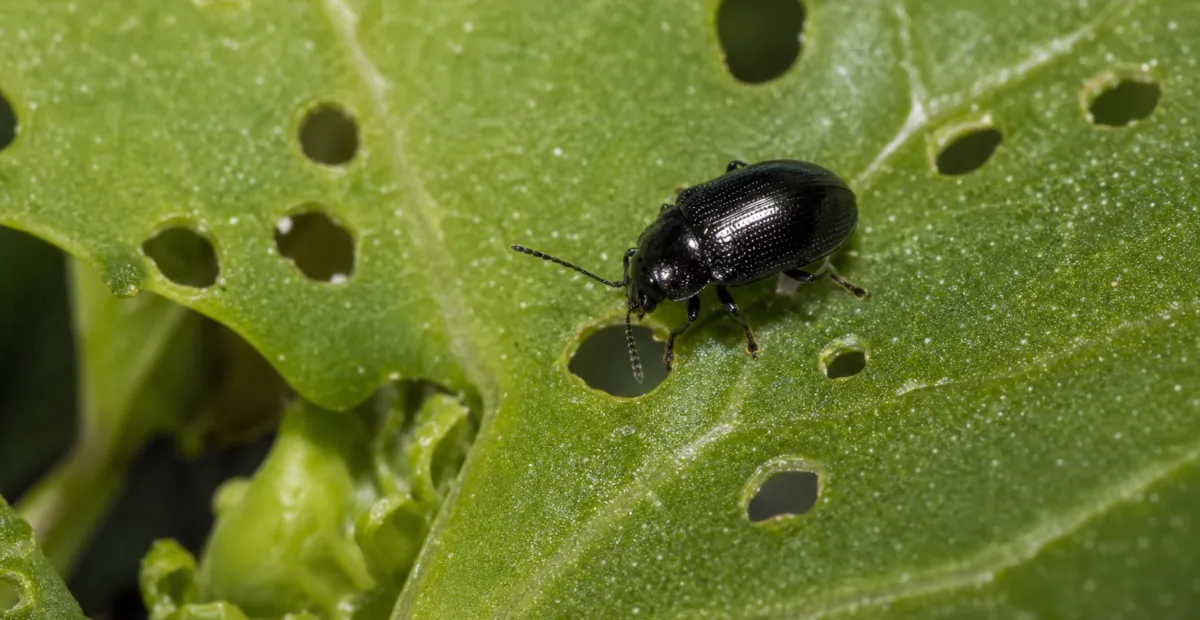
The turnip flea beetle, Phyllotreta atra, is a small, shiny black flea beetle that feeds mainly on cruciferous plants. Adults chew numerous pinprick “shot holes” in young leaves and may severely reduce establishment of seedlings. The species is documented chiefly from Brassicaceae and is easily confused with other black Phyllotreta species, so precise identification may require an expert or diagnostic laboratory.
Typical conditions
Overview
Phyllotreta atra is a flea beetle in the leaf-beetle family Chrysomelidae. Adults are typically about 0.07–0.09 inch long (1.8–2.4 mm), shiny black and capable of jumping when disturbed. The documented host association is principally with cruciferous plants, including cultivated brassicas and wild members of the mustard family.
Although the accepted English common name is turnip flea beetle, names such as cabbage flea beetle and black flea beetle may also appear in references. These names are not always used consistently, and visual separation from related species can be difficult without examining body structure or using a specialist identification service.
Symptoms and identification
Adults chew small, round to irregular holes through young leaves, creating the characteristic “shot-hole” appearance. Damage is often concentrated on cotyledons and the first true leaves, where even moderate feeding can slow growth or kill small seedlings.
- Numerous pinprick holes in turnip, cabbage, broccoli, kale, mustard or related foliage
- Skeletonized or ragged young leaves when feeding is intense
- Wilting, stunting or stand loss in very small seedlings
- Adults that jump rapidly from the foliage when approached
Older, vigorously growing plants generally tolerate some injury better than seedlings. Root feeding by larvae is less conspicuous and is not usually diagnosed from above-ground symptoms alone.
Causes and spread
Damage is caused primarily by adult beetles feeding on leaf tissue. Adults may move into plantings from overwintering sites, nearby cruciferous weeds, volunteer brassicas and harvested crop residues. Females lay eggs in soil near host plants; larvae then feed on roots or root hairs.
Risk increases when susceptible seedlings emerge before they are well established, especially where cruciferous weeds or volunteer crops maintain beetle populations. Because several flea beetle species can occur together, the presence of shot holes does not by itself confirm P. atra.
Life cycle and persistence
Adults overwinter in protected vegetation, grass or crop-residue habitats and become active during suitable spring weather. They feed, mate and lay eggs in the soil close to host plants. Larvae hatch underground and feed on secondary roots or root hairs before pupating in the soil. New adults emerge later in the season, feed on brassica foliage and eventually seek protected overwintering sites.
Generation time varies with temperature, latitude, host availability and species. In U.S. gardens, activity commonly overlaps the spring establishment period of brassica seedlings, but local timing should be confirmed through scouting because P. atra is not the only flea beetle affecting brassicas.
Treatment and control
Inspect the undersides and upper surfaces of young leaves, especially during warm, sunny periods. For small plantings, hand removal, tapping beetles onto a sheet or using a carefully placed vacuum can reduce adults, although jumping beetles may escape.
Prioritize exclusion and plant vigor. If injury is progressing rapidly on seedlings, consult current recommendations from your state Extension service and identify the beetle as accurately as possible before selecting a product. Treating an established plant with minor injury is usually less justified than protecting newly emerged seedlings.
Low-impact and biological control
- Keep floating row covers in place during the vulnerable seedling stage.
- Use insect exclusion netting or fine mesh that does not contact foliage excessively.
- Maintain consistent soil moisture so seedlings outgrow early feeding injury.
- Remove cruciferous weeds and volunteer brassicas that can sustain adults between crops.
- Encourage general biological control by avoiding unnecessary broad-spectrum insecticide use; natural enemies and insect pathogens may attack flea beetles, but dependable suppression of P. atra in home gardens is not assured.
- Kaolin or other organically accepted protectants may reduce feeding in some systems, but effectiveness and crop labeling vary and should be verified before use.
Prevention
- Use floating row cover immediately after seeding or transplanting, sealing edges so adult beetles cannot enter. Remove covers when pollination is needed or when the crop begins flowering.
- Start with vigorous transplants where practical, and maintain even irrigation and adequate fertility without excessive nitrogen.
- Control cruciferous weeds such as wild mustard, shepherd’s-purse and volunteer brassicas around beds before beetles become active.
- Remove or promptly incorporate crop residues after harvest, while recognizing that beetles may also overwinter outside the cultivated bed.
- Scout seedlings several times per week and record beetle presence and percentage of leaf area damaged rather than treating by calendar date alone.
Interesting facts
- The name “flea beetle” refers to enlarged hind legs that allow adults to jump like fleas.
- Phyllotreta atra is associated mainly with Brassicaceae and is considered oligophagous rather than a generalist feeder.
- Adults and larvae use different plant parts: adults feed above ground, while larvae are associated with roots.
- Black, shiny flea beetles in North American gardens are not automatically P. atra; species such as the crucifer flea beetle and other regional flea beetles can look similar.
- Some records outside Brassicaceae are isolated or uncertain, so host lists should be treated as evidence-based rather than exhaustive.
Use pesticides only when scouting shows economically or horticulturally significant injury and only if the product is currently legally authorized and labeled for the specific crop and flea-beetle use in your state and country. Follow the current label exactly, including crop restrictions, application rate, personal protective equipment, re-entry interval, preharvest interval and pollinator precautions. Do not infer legality from a product being labeled for another crop or another flea beetle species.