
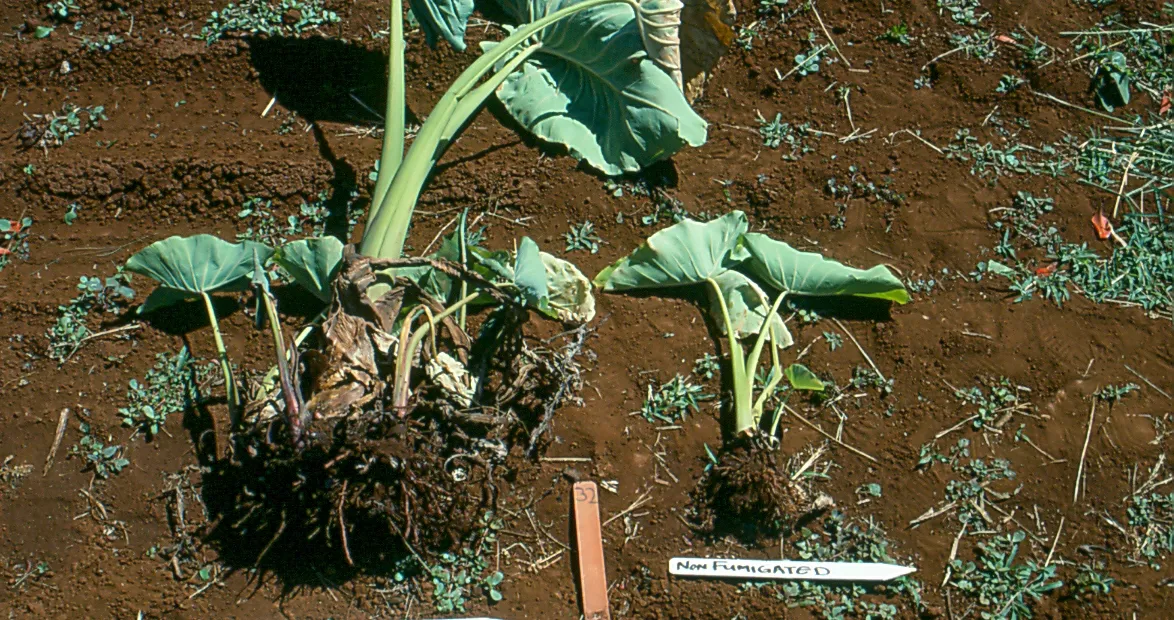
 Source:
 Javanese Root-Knot Nematode
Meloidogyne javanicaJavanese Root-Knot Nematode overview
Meloidogyne javanica is a microscopic, soil-dwelling plant-parasitic nematode that invades roots and induces characteristic galls. It has a very broad host range and is most damaging in warm, irrigated, sandy or sandy-loam soils. Infected plants may be stunted, pale, wilt during hot weather, and produce fewer or smaller crops. Confirmation requires examining roots and, when species identification matters, laboratory testing.
Typical conditions
Overview
Meloidogyne javanica is one of the major root-knot nematodes affecting crops, ornamentals and other plants in warm regions of the United States. It is especially important where soil remains warm and moist, including parts of the Southeast, Florida, California and other irrigated production areas.
The most recognizable sign is a swollen, knotted root system. Aboveground symptoms are nonspecific and can resemble drought, nutrient deficiency, vascular disease or poor soil conditions. Root examination is therefore essential, and species-level confirmation should be performed by a qualified nematology laboratory when management decisions depend on distinguishing M. javanica from other Meloidogyne species.
Symptoms and identification
- Irregular swellings or galls on young and mature roots; heavily infected roots may be shortened, branched poorly or covered with coalesced galls.
- Stunting, weak growth, pale or yellow foliage, premature leaf loss, poor establishment and reduced yield.
- Wilting during the hottest part of the day despite adequate soil moisture.
- Patchy symptoms within a bed or field because nematodes are unevenly distributed in soil.
- Greater damage during heat, drought or other stress because the compromised root system cannot supply sufficient water and nutrients.
Root galls distinguish root-knot nematode injury from many foliar disorders, but galls alone usually do not identify the species. Wash roots carefully and submit representative soil and root samples if confirmation is needed.
Causes and spread
Damage begins when infective second-stage juveniles hatch from eggs in soil and penetrate susceptible roots. Feeding stimulates the plant to form enlarged multinucleate cells that act as permanent nutrient sinks; surrounding tissue enlarges into a gall.
The nematode spreads mainly in infested soil and planting material. Movement of contaminated transplants, bare-root plants, tools, cultivation equipment, shoes, animals, floodwater, irrigation runoff and wind- or water-eroded soil can establish new infestations. Many weeds can maintain populations between crops, so an apparently unused or fallow bed may still be infested.
Life cycle and persistence
Eggs are deposited in a gelatinous matrix on or near the root surface. The first juvenile molts inside the egg; the second-stage juvenile hatches, moves through moist soil and enters a root, usually near the root tip. It migrates to the vascular cylinder and induces a permanent feeding site.
After establishing the feeding site, the juvenile becomes sedentary and molts through the third and fourth juvenile stages before developing into an adult, usually a swollen female. Reproduction is commonly by mitotic parthenogenesis, so males are not generally required. Under warm, favorable conditions, an egg-to-egg generation may be completed in roughly three to five weeks, allowing several generations during a long growing season.
Treatment and control
There is no reliable rescue treatment that removes established nematodes from the roots of a growing landscape plant. First confirm the diagnosis, because similar symptoms can result from drought, salinity, compaction, root rots and nutrient problems.
- For annual crops, remove severely affected plants and as much of their root system as practical; do not compost infested roots unless the composting process is demonstrably adequate.
- For beds or production areas, combine sanitation, host-free intervals where practical, weed control, rotation and resistant cultivars.
- In small beds or container media, properly conducted soil or media solarization can reduce root-knot nematodes, but effectiveness depends on treatment depth, tight plastic coverage, sunlight and duration.
- For perennial plants that decline severely, replacement with a documented tolerant or resistant plant from a different genus may be more practical than repeated treatment.
- In commercial production, use soil testing and crop-specific recommendations from the state Extension nematologist or crop adviser before selecting any nematicide or fumigation option.
Low-impact and biological control
Organic and reduced-input management is based on suppressing populations rather than curing infected roots. Use clean planting material, remove infested roots, control host weeds and rotate with carefully selected poor hosts. Organic amendments may improve soil structure and plant tolerance, but they should not be treated as a guaranteed nematode cure.
Where appropriate for the crop and climate, solarize moist soil beneath clear plastic during the hottest part of summer. Brassica cover crops, marigolds and other biofumigation or antagonistic-plant strategies can reduce some nematode populations under specific conditions, but results vary with species, cultivar, incorporation timing and soil temperature. Beneficial microbial products may provide suppression in some systems; use them as one part of IPM, not as a substitute for sanitation, host selection and rotation.
Prevention
- Use nematode-free transplants, certified planting material and clean soilless media from reputable suppliers.
- Obtain a soil and root nematode assay before establishing high-value crops or replanting a problem area.
- Rotate susceptible crops with locally validated nonhost or poor-host crops, recognizing that M. javanica has a broad host range and that crop response varies by cultivar and nematode population.
- Select cultivars or rootstocks with documented resistance to the specific root-knot species present. Tomato Mi-gene resistance can include M. javanica, but resistance may be weakened by high temperatures or different nematode species.
- Remove crop roots promptly after harvest and control weeds, including weeds in row middles and fallow areas.
- Prevent soil transfer: clean tools, tillage equipment, containers, shoes and hands before moving from infested to clean areas.
- Do not move infested soil or allow runoff from affected beds to flow into uninfested soil. Maintain even irrigation and good fertility so plants tolerate moderate root injury.
Interesting facts
- Meloidogyne javanica has been reported from a very broad host range, with hundreds of plant species recorded, including crops and weeds.
- In California, it is associated with crops and perennial plants such as beet, citrus, tomato, olive, potato, grape and peach, while Florida and other warm U.S. regions may have several root-knot species in the same production area.
- A plant resistant to one root-knot species may remain susceptible to another, so species identification can materially improve cultivar and rotation decisions.
- Root galls are not the same as nitrogen-fixing nodules on legumes: nodules are often easily rubbed off, whereas nematode galls are true root swellings.
- Root injury can increase susceptibility to secondary fungal, oomycete and bacterial root problems.
Use only nematicides or soil-fumigant products legally authorized for the specific crop, site and Meloidogyne problem in the United States. Follow the current product label exactly, including personal protective equipment, application restrictions, reentry and preharvest intervals. Product availability, registration and permitted uses vary by state and crop; consult current state Extension guidance and a licensed professional before treatment.