
Nutrient lockout
Nutrient lockout overview
Nutrient lockout is an abiotic uptake disorder in which essential nutrients are present in the soil, potting mix, irrigation water, or hydroponic solution but roots cannot absorb them effectively. The most common triggers are unsuitable pH, excessive salts, nutrient antagonism, poor root-zone moisture or oxygen, and precipitation of unavailable mineral forms. Symptoms often resemble true deficiencies, so testing is essential.
Typical conditions
Overview
Nutrients must be dissolved in a chemically suitable root-zone solution before roots can absorb them. When pH, salt concentration, moisture, oxygen, or nutrient ratios move outside the plant's tolerance range, a nutrient may become insoluble, chemically bound, osmotically difficult to absorb, or physiologically unavailable. The plant can therefore show deficiency-like symptoms even when a soil test reports adequate total nutrient content.
In soil, most fruits and vegetables perform well in a slightly acidic to near-neutral range, but the correct target is crop-specific. Blueberries require much more acidic soil than tomatoes or grapes. In hydroponics and soilless media, pH and electrical conductivity must be managed together because there is less buffering than in mineral soil.
Symptoms and identification
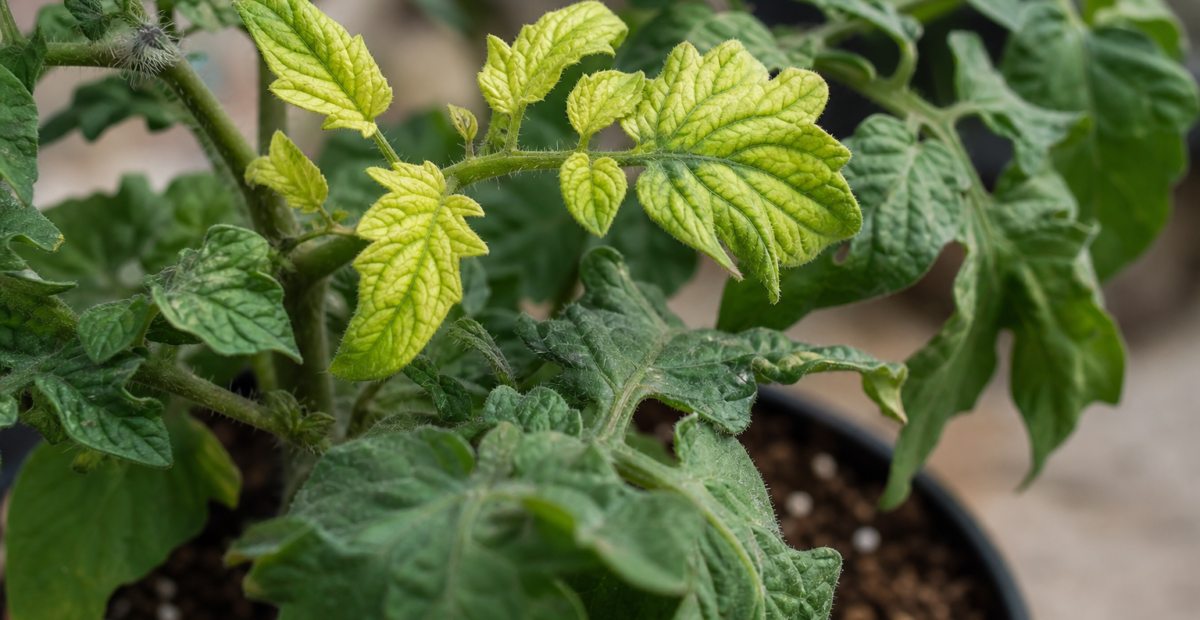
- Interveinal chlorosis, especially on young leaves when iron or manganese availability is restricted.
- Uniform yellowing of older leaves, weak growth, purpling, marginal scorch, or poor fruit development when nitrogen, phosphorus, potassium, or magnesium uptake is impaired.
- Stunting, leaf curling, root browning, wilting despite moist media, or symptoms of fertilizer burn when salts damage roots.
- White crusts on the media surface, container rim, or irrigation equipment, indicating possible mineral or fertilizer accumulation.
- In hydroponics, unstable pH, unusually high EC, precipitation or cloudy solution, slow growth, and several deficiency symptoms appearing together.
Symptoms are not diagnostic by themselves. Drought, waterlogging, root disease, cold soil, compaction, pests, and true nutrient deficiency can look similar.
Causes and spread
- Unsuitable pH: high pH can reduce iron, manganese, zinc, copper, and sometimes phosphorus availability; very low pH can restrict roots and increase aluminum or manganese toxicity.
- Excess soluble salts: overfertilization, poor-quality irrigation water, softened water, or inadequate drainage can create osmotic stress and nutrient imbalance.
- Nutrient antagonism and precipitation: excessive calcium, magnesium, potassium, phosphorus, or sodium can interfere with other ions, while incompatible fertilizer concentrates can form unavailable compounds.
- Root-zone stress: drought, waterlogging, compaction, low oxygen, cold media, root injury, and root pathogens reduce active uptake.
- Hydroponic management errors: incorrect mixing order, unmonitored EC, alkalinity in source water, and allowing an old recirculating solution to drift can change nutrient ratios.
Lockout does not spread biologically. It becomes more extensive when the same irrigation water, fertilizer, contaminated media, or poorly drained bed affects additional plants.
Life cycle and persistence
Nutrient lockout has no pathogen, insect, or biological lifecycle. It develops whenever root-zone conditions make one or more nutrients unavailable or roots unable to function normally. The disorder may appear rapidly after overfertilization, a pH correction error, drought, flooding, or hydroponic solution drift. Recovery depends on the severity and duration of root injury; new growth is the best indicator after conditions are corrected, while older damaged leaves may remain discolored.
Treatment and control
- Confirm the problem. Record symptoms and test soil or media pH, EC, moisture, drainage, and nutrient levels. In hydroponics, test both source water and the nutrient solution.
- Correct the primary constraint rather than adding a broad fertilizer mix. Adjust pH gradually using a soil-test recommendation or crop-specific production guide.
- Where salt accumulation is confirmed, stop fertilizer temporarily and leach well-drained containers with several pot volumes of clean water, allowing complete drainage. Severely affected plants may need fresh media.
- Improve drainage and aeration, correct irrigation frequency, and address compaction or root damage. Do not keep adding fertilizer to a plant whose roots are unable to function.
- After the root zone stabilizes, apply only the nutrient shown to be deficient and use a crop-appropriate, fully soluble source. New growth should be monitored over the following weeks.
- For blueberries, persistent high pH usually requires planned acidification and may be impractical to correct quickly in native soil. For hydroponics, replacing an imbalanced solution is often safer than repeatedly making large pH or fertilizer adjustments.
Low-impact and biological control
Organic management is based on restoring root-zone conditions rather than treating a pathogen. Incorporate mature compost or other suitable organic matter where recommended, use organic mulches that fit the crop, and improve structure and drainage without burying crowns. For acid-loving blueberries, pine bark, acidic organic amendments, and sulfur-based soil correction may help when supported by a soil test. Use compost, manure, fish-based fertilizers, or other organic nutrient sources conservatively because they can add salts and nutrients as well as organic matter. Leach container media with clean water when salt buildup is present, and remove badly contaminated media. Biological inoculants should not be relied upon to overcome severe pH, salt, oxygen, or drainage problems.
Prevention
- Test soil before planting and use the crop-specific pH target rather than a universal value. For example, blueberries generally need about pH 4.5–5.5, while tomatoes commonly perform near pH 6.2–6.8.
- Use a laboratory soil test for pH, phosphorus, potassium, and other nutrients; use tissue testing when symptoms persist or several nutrients appear affected.
- Test irrigation water for pH, alkalinity, EC, sodium, calcium, and magnesium when using wells, softened water, or recirculating systems.
- Apply fertilizer from test recommendations, distribute it across the root zone, and never pile concentrated fertilizer against stems or crowns.
- Maintain drainage, avoid saturated media, irrigate deeply enough to wet the root zone, and allow containers to drain freely.
- In hydroponics, monitor pH and EC consistently, mix products according to the manufacturer’s order, prevent precipitation, and replace or rebalance solution according to the crop and system.
- Use clean containers and fresh, appropriately buffered growing media; remove severely salt-contaminated media when flushing cannot restore it.
Interesting facts
- The term “lockout” can be misleading: the nutrient may be present in the soil but unavailable in the chemical form or root-zone conditions required for uptake.
- High soil pH is a common reason blueberries develop iron chlorosis even when the soil contains iron.
- Very high fertilizer concentration can reduce water uptake by roots through osmotic stress, so adding more fertilizer may intensify deficiency-like symptoms.
- pH effects are crop-specific: a range suitable for tomatoes can be unsuitable for blueberries.
- In hydroponics, electrical conductivity estimates total dissolved salts but does not reveal whether the nutrient ratios are correct; pH and EC must be interpreted together.
No pesticide controls nutrient lockout. Use lime, elemental sulfur, acidifying materials, chelated micronutrients, or fertilizers only when supported by a soil, water, media, or tissue diagnosis. Products must be legally authorized for the specific crop and use in the United States; follow the current label, application rate, personal-protection requirements, and local restrictions. Avoid routine foliar feeding or repeated acid additions without confirmation, because incorrect concentration can burn foliage, damage roots, or worsen nutrient imbalance.
Affected plants
The plants below are linked to this problem by structured host-plant data. The list updates automatically as new plant profiles are added.
 Solanum aethiopicum care guideSolanum aethiopicum
 Solanum macrocarpon care guideSolanum macrocarpon
 Eggplant (Solanum melongena) care guideSolanum melongena
 Garden Huckleberry (Solanum scabrum) care guideSolanum scabrum
 Uddha bamboo and Buddha Belly Bamboo (Bambusa ventricosa) care guideBambusa ventricosa
 Calamus (Acorus calamus) care guideAcorus calamus
 Five-leaf Akebia (Akebia quinata) care guideAkebia quinata
 Chusquea culeou care guideChusquea culeou
 Breynia androgyna care guideBreynia androgyna
 Crimson Pygmy (Berberis thunbergii ‘Crimson Pygmy’)Berberis thunbergii 'Crimson Pygmy'