
 Source:
 Calamus (Acorus calamus) short overview
Calamus (Acorus calamus) is a hardy, rhizomatous wetland perennial valued for its upright fans of aromatic, sword-shaped leaves and distinctive greenish flower spikes. In the United States it is best grown at the edge of a pond, rain garden, marshy bed or consistently wet container. It spreads by creeping rhizomes, tolerates sun to partial shade, and provides cover for wetland wildlife, but its rhizomes should not be eaten.
Taxonomic classification
Calamus (Acorus calamus) care guide
Light and placement
Grow in full sun to partial shade. Full morning or afternoon sun gives the strongest, most upright growth when the root zone stays saturated; partial shade suits hot sites. Too little light can produce thinner, floppier leaves and fewer flowering spikes, while intense sun combined with drying soil causes scorched leaf tips and premature browning.
Watering and humidity
Keep the soil continuously wet; this is not a dry-border perennial. Water deeply whenever the planting surface begins to dry, and maintain shallow standing water at the pond edge if appropriate. Container plants may need frequent checks in hot weather. Reduce watering only during winter dormancy if natural precipitation keeps the rhizomes moist; never allow them to dry completely.
Soil and growing medium
Use rich, moisture-retentive loam or clay amended with organic matter. Calamus tolerates saturated soil and shallow standing water, so drainage is less important than constant moisture in the planting zone. Reported suitable pH is approximately 5–7, with broader wetland records extending into mildly alkaline conditions. Avoid letting container media dry out.
Feeding
In rich wet soil, little fertilizer is needed. Apply a thin layer of mature compost in spring, or use a slow-release fertilizer formulated for aquatic or bog plants at the label rate. Do not overfeed ponds or saturated beds, because excess nutrients encourage algae and weak, lush growth. Skip feeding newly divided rhizomes until they resume growth.
Growth and habit
This perennial forms expanding clumps from thick, creeping rhizomes. New shoots arise along the underground stems, allowing a planting to fill a wet margin over time. Contain the rhizomes with a broad pot or a defined pond edge where spread is undesirable; divide crowded clumps to maintain vigor.
Planting and repotting
Plant firm rhizome sections in spring or fall, covering them with about 4–6 inches of rich wet soil. Space divisions about 12 inches apart for a continuous clump. Set plants at the pond margin or in shallow water with the crown near the soil surface; keep newly planted divisions steadily wet while they establish.
Repot or divide container-grown clumps in spring or fall when growth is dormant or just beginning. Use a wide, heavy container with no drainage holes for a water-garden setup, or a standard pot placed inside a water-holding tray. Refresh crowded rhizomes rather than moving the entire mature clump into a much larger pot.
Propagation and pruning
Propagation
Divide established clumps or cut healthy rhizomes into 2–4 inch sections in spring or fall. Plant divisions immediately in rich wet soil. Seed propagation is possible but less dependable because fruiting and viable seed production may be uncommon in some populations.
Pruning
Cut browned or frost-damaged leaves back to the crown in late winter or early spring before new shoots emerge. Remove individual damaged leaves during the growing season. Avoid aggressive cutting while flowering spikes are developing if you want to retain the inflorescences and associated wildlife value.
Overwintering
Leave the dormant rhizomes in place outdoors in USDA Zones 3–9 where the planting remains wet and the rhizomes are below the local freeze depth. Remove only collapsed foliage if desired. In colder exposed containers, sink the pot into the ground or move it to an unheated, frost-protected location; keep the medium damp, not dry.
Uses
Useful as an ornamental vertical accent for pond margins, bog gardens, rain gardens and wetland restoration plantings. Dense clumps can provide cover for waterfowl and other wetland wildlife. Although historically used as a flavoring and traditional plant, the U.S. FDA prohibits calamus for direct addition to human food; do not use it culinarily or medicinally.
Appearance
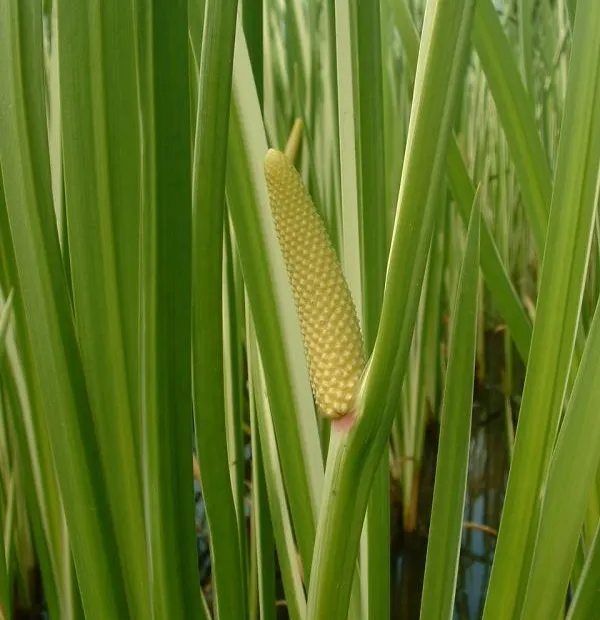
The plant forms upright fans of narrow, sharply pointed, sword-like leaves from pinkish bases. Leaves may have a slightly off-center midrib and release a sweet, citrus-like or tangerine-like aroma when bruised. The flowering stalk is triangular in cross-section and carries a conspicuous cylindrical spike alongside a long, leaf-like bract.
Flowering
The flowering stalk is triangular and carries a single cylindrical, slightly curved spike enclosed at its base by a long bract. Numerous tiny yellowish-green to brown flowers are crowded on the spike. Flowering is generally reported from May through July in the United States, with timing varying by region.
Pollination and visitors
The flowers are insect-pollinated rather than purely wind-pollinated. A Japanese study found beetles, especially Platamartus jakowlewi and Sibirhelus corpulentus, carrying pollen and visiting the inflorescences; flies and other small arthropods were also recorded. The documented specialist interaction may not occur in every United States planting.
Acorus calamus photos
Click any photo for a larger view. Source, author and license are shown separately.
Diseases and pests
Diseases
Generally trouble-free in suitable wetland conditions. Remove badly damaged foliage, improve air movement where practical, and avoid stagnant, nutrient-rich water around container plants. Rhizome rot is more likely when plants are kept in poorly oxygenated, decaying media rather than clean wet soil.
Pests
Monitor for aphids, leaf-chewing insects and rhizome-feeding damage, especially in stressed or overcrowded containers. Rinse minor infestations from foliage, remove heavily damaged leaves, and divide congested clumps. Avoid broad-spectrum insecticides near pond water and documented insect visitors.
Toxicity and pollen
The rhizomes and preparations made from them contain constituents of toxicological concern, including beta-asarone in some chemotypes. The U.S. FDA lists calamus as prohibited for direct use in human food. Do not ingest rhizomes, oils or homemade preparations; wear gloves when handling damaged plant material and keep plant parts away from children and pets.
- Typical season
- Late spring to summer
- Pollination / pollen
- Insect-associated pollen; not typically wind-dispersed in large quantities
Calamus produces pollen in its small, insect-visited flowers, but reliable evidence for significant airborne allergen exposure in the United States is limited. Its pollen is not generally treated as a major seasonal tree, grass or ragweed allergen. People with strong sensitivities should still avoid rubbing flowering spikes and monitor individual reactions.
Native habitat
It grows in marshes, swamps, pond margins, ditches, shallow water and wet river edges. Natural and introduced-status records vary by region, and North American plants have sometimes been separated taxonomically from Eurasian material. The species favors wet, low-salt soils and climates ranging from cool temperate regions to warmer parts of the United States.
Interesting fact
Acorus is one of the earliest-diverging living monocot lineages. Its inflorescence is a spadix rather than a showy petal display. Research in Japan documented specialized kateretid beetles visiting the spikes, feeding on pollen and using mature inflorescences as breeding sites. Most garden spread occurs through rhizomes rather than abundant seed.
Frequently asked questions (FAQ)
The most relevant questions about this plant, with short and direct answers.
🌱Quick care
How do you care for Calamus (Acorus calamus)?⌄
Grow Calamus in full sun to partial shade and keep the soil consistently very moist or shallowly submerged. It performs best in rich, moisture-retentive soil along pond edges, streams, rain gardens, or other wet areas.
Is Calamus hardy in the United States?⌄
Calamus is a hardy outdoor perennial across much of the United States and is commonly listed for USDA Zones 4 through 10. Local performance still depends on adequate winter moisture and the plant’s specific regional form.
How big does Calamus get?⌄
Calamus typically reaches about 2 to 2½ feet tall and spreads about 1½ to 2 feet. Its creeping rhizomes can gradually form broader colonies than the initial planting suggests.
Is Calamus the same plant as American sweet flag?⌄
No, Calamus is Acorus calamus, while American sweet flag is generally identified as Acorus americanus. They are closely related and can look similar, so plant labels and scientific names should be checked carefully.
🌤️Environment and placement
How much sun does Calamus need?⌄
Calamus grows well in full sun to partial shade. In hot summer climates, afternoon shade or filtered light can help prevent leaf-tip scorch.
Can Calamus grow in shade?⌄
Calamus can tolerate partial shade and even fairly heavy shade, but growth is usually stronger in brighter light. Avoid letting the soil dry out, especially where shade does not provide enough moisture.
What soil is best for Calamus?⌄
Use rich, wet, moisture-retentive soil, including loam or clayey soil that stays damp. Calamus generally prefers mildly acidic to neutral conditions, roughly pH 5.0 to 7.2.
Can Calamus grow in ordinary garden soil?⌄
Calamus can grow in ordinary garden soil only if it remains consistently moist to wet. It is a poor choice for dry or freely draining beds because drought causes leaf scorch and weak growth.
Where should Calamus be planted in a landscape?⌄
Plant Calamus in pond margins, bog gardens, rain gardens, wet swales, stream edges, or persistently damp low spots. It is unsuitable for ordinary dry borders unless irrigation keeps the soil continuously wet.
💧Care and problems
How much water does Calamus need?⌄
Calamus needs consistently moist to wet soil and can grow in shallow water. It may be planted at the water’s edge or in water up to about 9 inches deep, but newly planted divisions should not be deeply flooded before they establish.
Does Calamus spread aggressively?⌄
Calamus spreads moderately by creeping rhizomes and can form dense colonies in wet sites. Growing it in a container sunk into the soil or pond margin can help limit unwanted spread.
Why are the leaves of my Calamus turning brown?⌄
Brown or scorched leaf tips usually mean the soil has dried too much. Move the plant to wetter ground or shallow water and maintain consistent moisture rather than allowing repeated drying.
Does Calamus lose its leaves in winter?⌄
Calamus is generally a deciduous or semi-deciduous perennial, so foliage may yellow, die back, or look reduced during winter. New growth normally returns from the rhizomes in spring when conditions improve.
Does Calamus need fertilizer?⌄
Calamus usually needs little supplemental fertilizer when grown in rich wet soil or pond mud. Excess fertilizer can contribute to unwanted nutrient buildup in water gardens, so correct moisture and soil are more important.
🪴Planting and repotting
Can Calamus grow in a pond?⌄
Yes, Calamus is well suited to pond margins and shallow water. Plant the rhizome in wet mud at the edge or place it in a container set in shallow water rather than fully submerging the foliage.
When should you plant Calamus?⌄
Plant Calamus in spring or fall when the soil is workable and reliably moist. Fall and spring are also the preferred seasons for establishing rhizome divisions.
How deep should Calamus rhizomes be planted?⌄
Plant Calamus rhizomes about 2 to 6 inches deep in rich wet soil, with the growing shoots positioned above or just at the soil surface. In a pond, keep the foliage emergent and place the container or rhizome in shallow water.
How far apart should Calamus plants be spaced?⌄
Space Calamus about 1 to 3 feet apart, depending on how quickly you want the planting to fill. Allow additional room where spreading by rhizomes is acceptable.
Can Calamus be grown in a container?⌄
Yes, Calamus grows well in a large container filled with heavy, moisture-retentive soil. Containers are especially useful in ponds or bog gardens because they help contain the creeping rhizomes.
✂️Propagation and pruning
How do you propagate Calamus?⌄
The most reliable method is division of healthy rhizomes or established clumps. Cut firm rhizomes into roughly 2- to 4-inch sections with viable buds, then plant them in rich wet soil.
Can you grow Calamus from seed?⌄
Calamus can be grown from seed, but seed propagation is generally less dependable than rhizome division. Fresh seed may benefit from 60 to 90 days of cold, moist stratification, and some forms produce little or no viable seed.
When should Calamus be divided?⌄
Divide Calamus in early spring or fall, when temperatures are moderate and the soil can be kept wet. Replant divisions promptly so the rhizomes do not dry out.
How do you prune Calamus?⌄
Remove dead, damaged, or winter-browned leaves at the soil line as needed. Heavy pruning is not normally necessary because fresh foliage emerges from the rhizomes each growing season.
⚠️Toxicity and safety
Is Calamus invasive?⌄
Calamus has naturalized in parts of the United States and can spread through rhizome growth and plant fragments. Check your state and local invasive-plant guidance before planting it near natural waterways.
Is Calamus poisonous to people?⌄
Calamus presents a moderate safety concern and should not be ingested. Its rhizomes, leaves, oils, and extracts contain compounds associated with toxicity, and Calamus products are not appropriate for home remedies or food use in the United States.
Can you eat Calamus root?⌄
No, do not eat Calamus root or use it to make tea, tinctures, or supplements. The U.S. Food and Drug Administration has prohibited Calamus and its oil as food additives because of safety concerns.
Is Calamus safe for pets?⌄
Calamus should be treated as potentially harmful to pets if eaten. Keep rhizomes, plant pieces, and concentrated oils away from dogs, cats, livestock, and children, and contact a veterinarian or poison-control service if ingestion occurs.
Can you use Calamus as a medicinal herb?⌄
Calamus should not be used medicinally without qualified medical guidance, and ingestion is not recommended. Safety and toxicity vary among plant forms, while evidence for therapeutic benefits is insufficient for self-treatment.
🌸Flowering and special interest
Does Calamus have flowers?⌄
Yes, but its flowers are small, greenish, and not showy. They appear on a narrow, elongated structure called a spadix, usually in late spring or summer.
Why is my Calamus not flowering?⌄
Calamus flowers are inconspicuous and may be absent or difficult to notice, especially on young or recently divided plants. Adequate moisture, sufficient light, and mature rhizomes support flowering, but reliable blooming should not be expected as its main ornamental feature.
Is Calamus fragrant?⌄
Yes, the foliage and rhizomes are sweetly fragrant when bruised or crushed. The scent is stronger when the plant is handled than when it is simply growing in the garden.