
 Source:
 Five-leaf Akebia (Akebia quinata) short overview
Five-leaf Akebia is a vigorous, woody, twining vine valued for its attractive palmately compound leaves, fragrant spring flowers, and unusual violet-purple fruit pods. Native to China, Japan, and Korea, it adapts to sun or partial shade and can cover a trellis quickly. In parts of the United States it has naturalized or shown invasive behavior, so planting should include local-regulation checks and regular pruning to prevent unwanted spread.
Taxonomic classification
Five-leaf Akebia (Akebia quinata) care guide
Light and placement
Grow in full sun for the best flowering and fruiting, or in partial shade where the vine is useful for screening. It tolerates fairly deep shade, but flowering and density may decrease. An east- or south-facing trellis provides strong light; protect young plants from harsh reflected heat. Sparse growth and weak flowering suggest insufficient light, while scorched leaves indicate excessive heat or drought stress.
Watering and humidity
Water deeply when the upper few inches of soil begin to dry during the first growing season. Once established, maintain even moisture during prolonged summer heat, but avoid constantly saturated soil. Reduce irrigation in cool weather and after leaf fall. A mulch layer helps moderate root temperature and moisture, but keep mulch away from the crown and stems.
Soil and growing medium
Use fertile soil that drains freely yet retains moderate moisture. Loam enriched with compost is suitable, while heavy clay should be amended or planted on a raised mound to prevent waterlogging. A slightly acidic to neutral reaction is preferred, although established plants tolerate a broader range. Avoid chronically dry, shallow, compacted soil, which limits vigorous vine establishment.
Feeding
Apply compost or a balanced slow-release fertilizer in early spring as growth begins. Use the label rate rather than repeated heavy feeding; excessive nitrogen can produce lush foliage with fewer flowers and may increase unwanted spread. Do not fertilize drought-stressed, newly transplanted, or dormant plants until they are actively growing and adequately watered.
Growth and habit
This woody vine twines through supports and can produce long, flexible stems that layer or root where they contact the ground. It establishes quickly in favorable conditions and may climb into shrubs or trees. Provide a sturdy trellis and inspect nearby edges regularly. Cutting back wandering stems and removing unwanted rooted sections are important maintenance tasks, especially where the species is invasive.
Planting and repotting
Plant at the same depth as the container root ball in a prepared, well-drained site. Water thoroughly after planting and keep the root zone evenly moist through the first growing season. Install the trellis before vigorous stems develop. Allow room for mature spread and check state or local invasive-plant guidance before planting.
For container culture, use a large, sturdy pot with drainage holes and a fertile, well-drained potting mix. Repot in early spring when roots fill the container, moving up only one or two pot sizes. Refresh the upper mix annually if the plant is already in a large container. Provide a permanent trellis or other support and water carefully after transplanting.
Propagation and pruning
Propagation
Propagate from seed, semi-ripe or hardwood cuttings, or layering. Seeds require suitable moisture and may not reproduce all characteristics of a selected plant. Layering is practical because stems can root where they contact soil. Cuttings are best taken during active but firm growth and kept evenly moist under protected conditions. Remove unwanted rooted pieces promptly to prevent spread.
Pruning
Prune after flowering or in late winter before vigorous spring growth. Remove dead, damaged, crossing, or unwanted stems first, then shorten overly long shoots to keep the vine within its support. Cut back rooted runners and remove climbing stems that have entered trees or adjacent vegetation. Severe renovation is tolerated, but repeated hard pruning can reduce flowering for the following season.
Overwintering
Established plants are generally hardy in USDA Zones 4–9. In colder or exposed sites, mulch the root zone after the ground cools, while keeping mulch away from the crown. Protect newly planted vines from drying winter winds and temperature swings. Container plants are more vulnerable than in-ground plants; place them in a sheltered, unheated location and prevent the root ball from freezing solid.
Uses
Use Five-leaf Akebia for trellises, fences, screening, arbors, and large containers with strong support. Its foliage and spring flowers provide ornamental value, while mature pods contain edible pulp in cultures where the fruit is traditionally consumed. Fruit production is inconsistent without cross-pollination. Because the vine can naturalize and form dense growth, avoid planting near natural areas where it is invasive or regulated.
Appearance
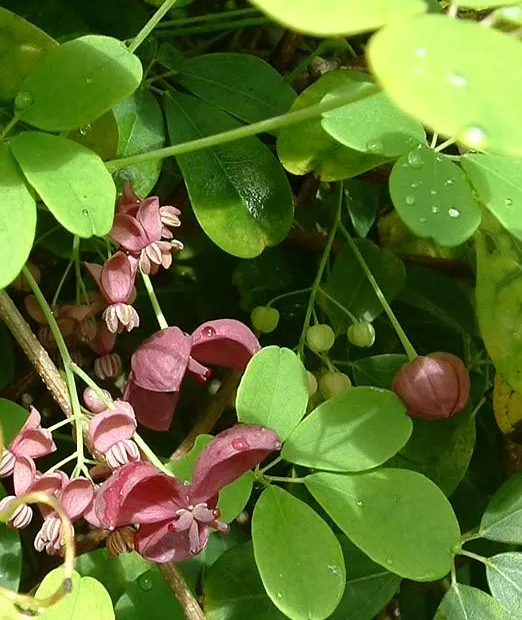
Leaves are palmately compound, usually with five rounded to elliptic leaflets arranged like fingers on a hand. Young stems are green to purplish and mature to woody brown. Fragrant flowers appear in hanging clusters, with separate female and male flowers on the same plant. The unusual sausage-shaped fruit pods are violet to purple when mature and split open to expose pale pulp and dark seeds.
Flowering
Flowering normally occurs in spring on established vines. The plant bears separate male and female flowers on the same individual, with female flowers generally larger and more conspicuous. Flowering is followed by elongated purple pods only when pollination is successful; planting genetically distinct plants improves fruit production.
Pollination and visitors
The flowers are insect-pollinated and have been studied as nectarless flowers with separate male and female structures. Documented floral biology supports insect visitation, but reliable sources do not establish a consistently strong attraction to a particular bee, bumblebee, butterfly, or hoverfly species. Do not treat the vine as a primary pollinator plant.
Akebia quinata photos
Click any photo for a larger view. Source, author and license are shown separately.
Diseases and pests
Diseases
Serious disease problems are not consistently reported, but wet, poorly drained conditions can encourage root and crown problems. Improve drainage, avoid overwatering, and provide airflow through selective pruning. Remove badly affected material and sanitize tools between cuts. Yellowing leaves may also reflect root stress, drought, nutrient imbalance, or unsuitable site conditions rather than a single disease.
Pests
Monitor new growth for aphids, scale, and chewing insects, although major pest damage is not usually characteristic. Inspect stems and leaf undersides regularly, especially during warm weather. Encourage natural predators, wash soft-bodied insects from foliage, and use horticultural oil or insecticidal soap only when a pest is confirmed and conditions allow safe application. Avoid unnecessary broad-spectrum insecticides.
Toxicity and pollen
Reliable horticultural sources describe the ripe fruit pulp as edible, but comprehensive human and pet toxicity data for the whole plant are limited. Do not assume that leaves, stems, seeds, unripe pods, or large quantities are safe. Prevent children and pets from chewing plant parts, identify the material before eating any fruit, and contact Poison Control or a veterinarian after a concerning exposure.
- Typical season
- Spring, typically April–May in much of the United States
- Pollination / pollen
- Insect-carried pollen released from flowers
Five-leaf Akebia is insect-pollinated, so its pollen is not released primarily as a windborne cloud. This generally reduces airborne exposure compared with wind-pollinated plants, but it does not prove zero allergy risk. People with strong pollen sensitivity should avoid handling flowers during bloom if symptoms occur.
Native habitat
In its native range, Five-leaf Akebia occurs in temperate parts of China, Japan, and Korea, including woodland margins, thickets, and disturbed habitats. It favors climates with adequate summer moisture and soils that drain while retaining organic matter. In the United States it has escaped cultivation in some regions and can spread through vegetative growth, layering, and seed.
Interesting fact
The genus name Akebia is derived from a Japanese vernacular name. The species epithet quinata refers to its commonly five-part leaves. Fruit set is often improved by planting more than one genetically distinct vine. The species is self-incompatible enough that a solitary plant may flower well yet produce little or no fruit.
Frequently asked questions (FAQ)
The most relevant questions about this plant, with short and direct answers.
🌱Quick care
What is Five-leaf Akebia?⌄
Five-leaf Akebia (*Akebia quinata*) is a fast-growing, twining perennial vine grown for blue-green, five-part leaves, fragrant purple-brown spring flowers, and occasional sausage-shaped fruit. It can reach about 20–40 feet when supported.
Is Five-leaf Akebia evergreen?⌄
Five-leaf Akebia is deciduous in colder parts of the United States and semi-evergreen in mild climates. Foliage may persist through winter where freezes are limited.
How fast does Five-leaf Akebia grow?⌄
Five-leaf Akebia grows rapidly once established, commonly producing a 20–40-foot vine under favorable conditions. Regular pruning is usually needed to keep it within bounds.
Is Five-leaf Akebia cold hardy?⌄
Five-leaf Akebia is generally cold hardy from about USDA Zone 5, although some references list hardiness extending into Zone 4. Winter behavior varies with cultivar, exposure, and local climate.
🌤️Environment and placement
How much sunlight does Five-leaf Akebia need?⌄
Five-leaf Akebia grows in full sun, partial shade, or shade, but filtered sun or partial shade with consistent moisture is often a good balance. More sun can support flowering, while heavy shade may reduce blooms.
Can Five-leaf Akebia grow in full shade?⌄
Five-leaf Akebia can tolerate shade, but flowering and fruiting are usually less reliable in deep shade. Give it bright filtered light or several hours of sun when possible.
What soil is best for Five-leaf Akebia?⌄
Plant Five-leaf Akebia in fertile, well-drained loam that stays moderately moist. It tolerates a wider range of soil types, but waterlogged or extremely dry soil can reduce performance.
Does Five-leaf Akebia need a trellis?⌄
Five-leaf Akebia needs a sturdy trellis, fence, arbor, or other support for upright climbing. Without support, its long twining stems can trail across the ground and root where they contact soil.
Can Five-leaf Akebia be used as a ground cover?⌄
Five-leaf Akebia can be grown as a ground cover because its stems trail and may root at contact points. This use requires frequent monitoring because the vine can spread and smother nearby vegetation.
Is Five-leaf Akebia invasive in the United States?⌄
Five-leaf Akebia is considered invasive or potentially invasive in parts of the eastern United States, including several Mid-Atlantic and Southeastern states. Check your state and county invasive-plant guidance before planting it.
💧Care and problems
How often should I water Five-leaf Akebia?⌄
Water Five-leaf Akebia when the upper few inches of soil begin to dry, especially during its first growing season and periods of drought. Established plants tolerate some dryness but grow best with moderate, consistent moisture.
Does Five-leaf Akebia need fertilizer?⌄
Five-leaf Akebia usually needs little fertilizer when planted in fertile soil. If growth is weak, apply a balanced slow-release fertilizer in spring according to the product label rather than heavily feeding the vine.
Why is my Five-leaf Akebia not flowering?⌄
Five-leaf Akebia may fail to flower because it is too young, heavily shaded, overpruned, or exposed to winter damage. Flowers develop on older wood, so avoid removing all mature stems before the spring bloom period.
What problems commonly affect Five-leaf Akebia?⌄
Five-leaf Akebia generally has few serious pest or disease problems, but powdery mildew and excessive, uncontrolled growth can occur. Improve air circulation, avoid prolonged wet foliage, and prune crowded stems.
Why are the leaves on my Five-leaf Akebia turning purple?⌄
Five-leaf Akebia leaves can develop purple or bronze tones in cold weather, particularly in autumn or winter. Sudden discoloration during the growing season may instead indicate stress from drought, root damage, or poor drainage.
🪴Planting and repotting
When is the best time to plant Five-leaf Akebia?⌄
Plant Five-leaf Akebia in spring or fall when temperatures are moderate and the soil can be worked. Spring planting is especially useful in colder regions because it gives the roots a full growing season to establish.
How far apart should I plant Five-leaf Akebia?⌄
Space Five-leaf Akebia according to the intended support and desired coverage, commonly about 6–10 feet apart for separate vines. Allow more room where the plant will be managed as a spreading ground cover.
Can Five-leaf Akebia be grown in a container?⌄
Five-leaf Akebia can be grown in a large container with drainage holes and a strong support, but its vigorous growth requires regular pruning. Container plants also need more frequent watering than plants in the ground.
Can Five-leaf Akebia be transplanted?⌄
Five-leaf Akebia can be transplanted, preferably after substantial pruning and while the plant is not actively stressed by heat or drought. Preserve as much of the root ball as possible and keep it evenly moist during establishment.
✂️Propagation and pruning
How do you propagate Five-leaf Akebia from cuttings?⌄
Propagate Five-leaf Akebia from softwood cuttings taken from vigorous spring growth. Root cuttings in a moist, well-drained medium under warm, humid conditions until new roots and shoots develop.
Can Five-leaf Akebia be grown from seed?⌄
Five-leaf Akebia can be grown from seed, although seedlings may vary from the parent and fruit production is unreliable. Freshly collected seed generally requires careful cleaning and a period of cool, moist treatment to improve germination.
Does Five-leaf Akebia root where its stems touch the ground?⌄
Yes, Five-leaf Akebia can spread when stems contact and root in the soil. This makes it easy to propagate but also increases the need to remove unwanted rooted sections promptly.
When should Five-leaf Akebia be pruned?⌄
Prune Five-leaf Akebia immediately after flowering because it blooms on older wood. Remove tangled, weak, damaged, or unwanted stems, and shorten vigorous growth to maintain the desired size.
Can Five-leaf Akebia be cut back hard?⌄
Five-leaf Akebia usually tolerates severe pruning and can regrow quickly from the base. Hard cutting is best reserved for renovation or control, because removing all older wood can reduce flowering the following season.
⚠️Toxicity and safety
Is Five-leaf Akebia toxic to people or pets?⌄
The toxicity of Five-leaf Akebia is not well established, even though the ripe inner fruit pulp is described as edible in horticultural references. Keep plant material away from children and pets and contact Poison Control or a veterinarian after suspected ingestion.
Is Five-leaf Akebia safe to plant near native habitats?⌄
Five-leaf Akebia may be unsafe near natural areas in regions where it is invasive or weedy. Check local regulations and invasive-species lists, prevent fruiting and stem spread, and never allow it to climb into trees.
🌸Flowering and special interest
When does Five-leaf Akebia bloom?⌄
Five-leaf Akebia usually blooms in mid- to late spring, often around April or May depending on local climate. The small purple-brown flowers are fragrant but may be partly hidden by the foliage.
Do Five-leaf Akebia flowers smell like chocolate?⌄
Five-leaf Akebia flowers have a sweet, spicy fragrance commonly described as chocolate-like. The scent is most noticeable during warm weather when the flowers are open.
Why does my Five-leaf Akebia have flowers but no fruit?⌄
Five-leaf Akebia often needs pollen from a genetically different plant for dependable fruit production. A single vine may flower well yet produce little or no fruit, and hand pollination can improve fruit set.
Are Five-leaf Akebia fruits edible?⌄
The soft white pulp inside ripe Five-leaf Akebia fruit is reported as edible, but the fruit contains many seeds and its palatability is variable. Do not eat unidentified plant material, and avoid consumption if the fruit is unripe or spoiled.