
 Source:
 Common agrimony (Agrimonia eupatoria) short overview
Common agrimony is an upright, softly hairy herb in the rose family, valued for its slender spikes of small yellow flowers and distinctive burr-like fruits. Native from Europe through western Asia and North Africa, it favors sunny, well-drained grasslands, meadow edges, roadsides, and open woodland margins. In the United States it is chiefly grown as an unusual botanical, habitat, or naturalistic garden plant.
Taxonomic classification
Common agrimony (Agrimonia eupatoria) care guide
Light and placement
Give common agrimony full sun for the strongest stems, compactest growth, and best flowering; it can tolerate light afternoon shade, especially in hot, dry regions. An open position with good air movement is preferable. Sparse growth and fewer flower spikes usually indicate insufficient light, while scorched foliage or rapid wilting suggests excessive reflected heat combined with drought.
Watering and humidity
Water deeply after planting and keep the root zone lightly and evenly moist while plants establish. Once established, common agrimony generally tolerates short dry periods; water when the upper few inches of soil are dry rather than on a fixed daily schedule. Reduce irrigation after flowering and in cool weather, and avoid constantly wet soil.
Soil and growing medium
Use moderately fertile, sharply draining soil that does not remain saturated after rain. Sandy or loamy ground is suitable, and plants can tolerate calcareous conditions. Avoid heavy, poorly drained clay unless it is amended with mineral structure and planted slightly high. A near-neutral to mildly alkaline reaction is generally acceptable; excessive fertility may produce floppy stems.
Feeding
Common agrimony usually needs little fertilizer in ordinary garden soil. Incorporate a modest amount of finished compost before planting, then apply a light, balanced granular fertilizer only if growth is weak or the soil is demonstrably poor. Do not apply high-nitrogen fertilizer late in the season, because it can encourage soft, leafy growth and reduce stem strength.
Growth and habit
This species forms an upright, branching clump and may self-seed when mature burr-like fruits are allowed to develop. It is better suited to naturalistic beds, meadow-style plantings, and open woodland edges than to tightly formal borders. Removing spent flowering stems before seed dispersal helps limit unwanted spread and keeps the plant more orderly.
Planting and repotting
Plant nursery-grown specimens in spring or early fall when the soil is workable. Set the crown at the same depth as in the container and water thoroughly. Space plants about 12–24 inches apart according to the desired density. For direct sowing, press seed onto prepared soil and cover only lightly, since deep burial can reduce emergence. Keep the seedbed evenly moist until seedlings are established.
Container-grown plants should be moved into a slightly larger pot only when roots have filled the existing container. Use a free-draining loam-based mix with added grit or other mineral material, and ensure the pot has an unobstructed drainage hole. Transplant at the original depth and water thoroughly after repotting.
Propagation and pruning
Propagation
Propagate from seed or by division. Sow fresh seed in fall or provide a period of cool, moist stratification before spring sowing; press seed into the surface and cover lightly. Divide established clumps in spring or early fall, replanting divisions promptly. Germination and establishment can be uneven.
Pruning
Cut flowering stems back after bloom if you want to prevent burr-like seeds from dispersing. Remove damaged or collapsing stems at any time. A late-season cutback can tidy the plant, but leaving some mature stems through winter may provide structure and allow natural reseeding.
Overwintering
In the ground, established plants generally need no special winter protection where they are reliably hardy. In colder or poorly drained sites, improve drainage and apply a light, loose mulch after the soil cools. Container plants are more vulnerable to root freezing; shelter the pot in an unheated protected location or insulate it outdoors.
Uses
Common agrimony is primarily useful as a botanical, naturalistic, meadow-edge, or wildlife-supporting plant. Its yellow flower spikes add vertical texture, while the hooked fruits provide a distinctive seasonal feature and disperse by attaching to animals. Historical herbal uses are documented, but homemade medicinal preparations should not be assumed safe or effective and should not replace professional medical advice.
Appearance
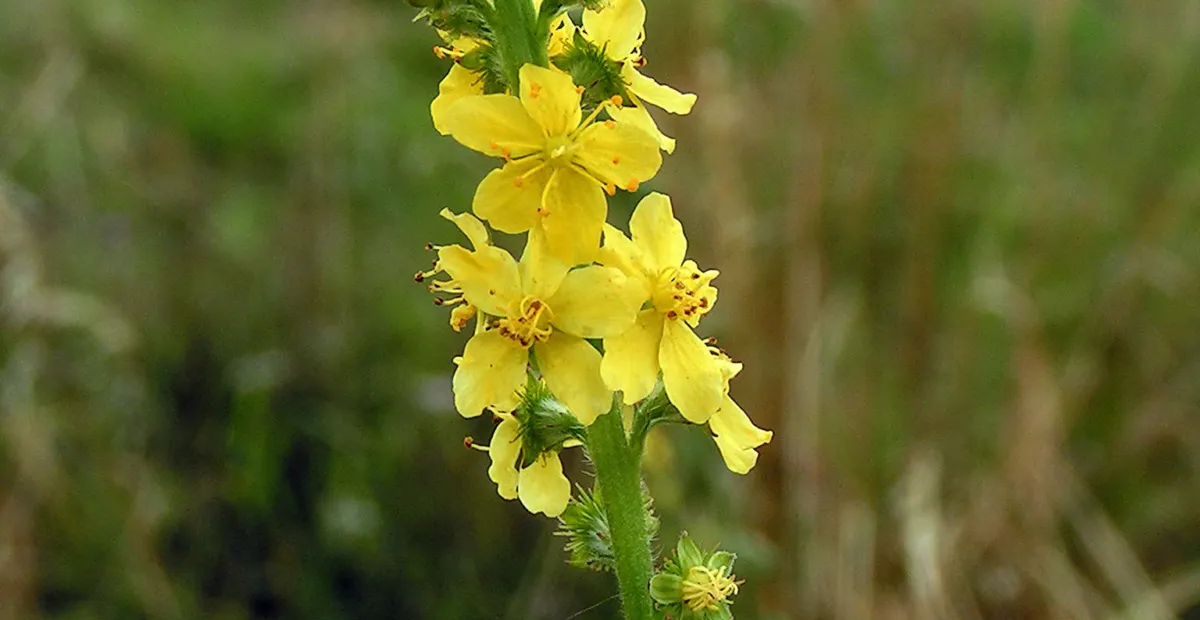
The stems and leaves are noticeably hairy. Leaves are pinnate, with a larger terminal leaflet and smaller side leaflets that have serrated margins; smaller leaflets may occur between the larger ones. Slender terminal racemes carry numerous small yellow, five-petaled flowers. After flowering, the receptacles develop hooked bristles that cling to fur, clothing, and other surfaces.
Flowering
Flowering typically occurs from early to late summer, with regional variation into early fall. The small yellow flowers are arranged closely along elongated terminal racemes and open progressively along the spike. Each flower has five petals and a shallow cup-like floral base. The resulting burr-like fruits are persistent and important for animal-assisted seed dispersal.
Pollination and visitors
The open yellow flowers provide accessible floral resources for small insect visitors, including bees, hoverflies, beetles, and wasps. The available evidence supports insect visitation at the group level rather than a single consistently documented pollinator species. Flowering stems can contribute modestly to insect diversity in meadow-like plantings.
Agrimonia eupatoria photos
Click any photo for a larger view. Source, author and license are shown separately.
Diseases and pests
Diseases
Good drainage, adequate spacing, and air circulation help prevent root problems and foliar disease. Remove heavily spotted or collapsing foliage and avoid overhead watering late in the day. Persistent decline in wet soil is more likely to reflect poor drainage than a need for additional fertilizer.
Pests
Inspect young shoots and flower stems for aphids, leaf-chewing larvae, and other generalist herbivores. Use hand removal or a strong water spray for minor infestations, preserve beneficial insects, and reserve labeled treatments for persistent damage. The hooked fruits can cling to pets or clothing but are not a pest symptom.
Toxicity and pollen
Reliable, species-specific veterinary and human toxicology information for Agrimonia eupatoria is limited. Historical herbal use should not be treated as proof of safety, particularly for concentrated extracts or internal use. Avoid ingestion of unidentified plant material, keep preparations away from children and pets, and seek medical or veterinary advice after a suspected exposure.
- Typical season
- Generally summer into early fall in the United States
- Pollination / pollen
- Insect-released pollen from open flowers
Common agrimony produces pollen in its summer flowers, but its airborne-allergy importance in the United States is not well characterized. Because the flowers are insect-pollinated, pollen is not expected to be released as freely as in strongly wind-pollinated plants, but sensitive individuals should avoid handling flowering material if symptoms occur.
Native habitat
Common agrimony occurs in open, temperate habitats such as dry to moderately moist meadows, pasture, grassland margins, hedgebanks, roadsides, scrub edges, and open woodland. It generally favors sunlight, mineral soils, and good drainage, with tolerance of occasional mowing or light grazing. Its broad native range extends from Macaronesia and Europe through North Africa and into western and central Asia.
Interesting fact
The mature fruits are burr-like and covered with hooked bristles that assist animal dispersal. The species belongs to Rosaceae, although its small yellow flowers look quite different from those of many cultivated roses. Historical sources associate agrimony with herbal traditions, but those uses do not establish modern medical safety.
Frequently asked questions (FAQ)
The most relevant questions about this plant, with short and direct answers.
🌱Quick care
What is common agrimony?⌄
Common agrimony is the accepted common name for Agrimonia eupatoria, an upright herb in the rose family, Rosaceae. It produces slender spikes of small yellow flowers and hooked fruits that can cling to clothing or animal fur.
Is common agrimony perennial or annual?⌄
Common agrimony is generally an annual or biennial rather than a dependable long-lived perennial. Its presence in a garden often depends on successful self-seeding.
How tall does common agrimony get?⌄
Common agrimony typically forms an upright, branching herb roughly 1 to 3 feet tall, although height varies with soil, light, and competition. Its flower spikes rise above pinnate leaves with smaller leaflets between the larger ones.
Is common agrimony related to roses?⌄
Yes, common agrimony belongs to Rosaceae, the rose family. Its pinnate leaves, five-petaled flowers, and small hooked fruits reflect relationships shared with other members of this family.
How can you identify common agrimony?⌄
Look for an upright herb with pinnate leaves, small yellow five-petaled flowers on slender spikes, and burr-like fruits covered with hooked bristles. Identification should be checked against regional Agrimonia species because native agrimonies can look similar.
🌤️Environment and placement
How much sun does common agrimony need?⌄
Common agrimony grows best in full sun but also tolerates partial shade. More sunlight generally supports stronger stems and better flowering, provided the soil does not become excessively dry.
What soil is best for Agrimonia eupatoria?⌄
Use well-drained loam or sandy loam for Agrimonia eupatoria. It can tolerate relatively lean ground, but constantly wet or poorly drained soil may cause weak growth or root problems.
Is Agrimonia eupatoria cold hardy?⌄
Agrimonia eupatoria is a cold-hardy herbaceous plant across suitable temperate conditions. Winter survival can vary because individual plants may behave as annuals or biennials rather than returning from a permanent crown.
Can common agrimony grow in partial shade?⌄
Yes, common agrimony can grow in partial shade, especially where the soil is well drained. It usually flowers more strongly with several hours of direct sunlight each day.
Where does common agrimony grow naturally?⌄
Common agrimony is native from Macaronesia and Europe through parts of western and central Asia and northwestern Africa. It commonly occupies grasslands, pastures, woodland edges, clearings, roadsides, and other open disturbed habitats.
Is common agrimony native to the United States?⌄
Common agrimony is not native to the United States; it is an introduced species recorded in several states. Do not confuse it with native North American agrimonies such as tall agrimony or downy agrimony.
💧Care and problems
How often should you water common agrimony?⌄
Water common agrimony moderately while it is establishing, then allow the soil to dry somewhat between waterings. Established plants usually need supplemental water only during prolonged heat or drought.
Is common agrimony drought tolerant?⌄
Common agrimony has relatively low to moderate water needs and can handle short dry periods once established. Extended drought, especially in full sun and sandy soil, can reduce vigor and flowering.
What problems commonly affect common agrimony?⌄
The main cultural problems are poor growth from waterlogged soil, stress from prolonged drought, and unwanted spread from hooked seed heads. Good drainage, moderate watering, and timely removal of spent spikes usually address these issues.
🪴Planting and repotting
When should you plant common agrimony seeds?⌄
Sow common agrimony outdoors in fall or early spring, using a prepared, weed-free bed. Fall sowing can provide natural winter chilling, while spring sowing is useful where winter conditions are severe or seed may wash away.
How deep should common agrimony seeds be planted?⌄
Press common agrimony seeds onto the soil surface or cover them only very lightly. Small seeds often germinate poorly when buried deeply, so maintain good seed-to-soil contact without adding a thick layer of soil.
Can common agrimony be grown in a container?⌄
Common agrimony can be grown in a container if it has a deep enough pot, drainage holes, and a loose, well-drained potting mix. Container plants dry out faster than in-ground plants and may need more frequent watering.
✂️Propagation and pruning
Does common agrimony self-seed?⌄
Yes, common agrimony can self-seed after flowering. Its burr-like fruits have hooked bristles that attach to animals, clothing, and other surfaces, so remove developing seed heads if you want to limit spread.
How do you grow common agrimony from seed?⌄
Sow common agrimony seed in well-drained soil and keep it lightly moist until germination. Because the plant is commonly propagated by seed and may have variable germination, sowing more than one seed is practical.
Should common agrimony seeds be stratified?⌄
Cold stratification may improve or synchronize germination of common agrimony, but requirements can vary by seed lot and source. A short period of moist chilling is a reasonable approach when direct sowing produces poor results.
Does common agrimony need pruning?⌄
Common agrimony does not require routine pruning for health. Cut stems back after flowering if you want a tidier appearance or want to prevent the hooked fruits from spreading seed.
⚠️Toxicity and safety
Is common agrimony invasive in the United States?⌄
Common agrimony is introduced in parts of the United States, but its invasive status is not uniform nationwide. Check your state or county invasive-plant database before planting, and remove seed heads where naturalization is a concern.
Is common agrimony toxic to dogs or cats?⌄
The toxicity of Agrimonia eupatoria to dogs and cats is not well established. Keep pets from eating unfamiliar plant material and contact a veterinarian or animal poison service if ingestion causes symptoms.
Is common agrimony safe to eat or use as tea?⌄
Common agrimony has a history of traditional herbal use, but safety data for the plant and its preparations are limited. Do not use it medicinally or as a tea during pregnancy, while taking medication, or for a medical condition without professional guidance.
Can you use common agrimony medicinally?⌄
Common agrimony has been used traditionally in herbal preparations, especially from its flowering aerial parts. Traditional use does not establish effectiveness or safety, and modern evidence and toxicology remain limited for many preparations.
🌸Flowering and special interest
When does common agrimony bloom?⌄
Common agrimony generally blooms in summer, with small yellow flowers opening progressively along elongated spikes. Exact timing varies by climate and growing conditions in the United States.
What do common agrimony flowers look like?⌄
The flowers are small, yellow, and typically five-petaled, arranged along narrow upright spikes. They are individually modest but create a distinctive wandlike appearance when the plant is in bloom.
Does common agrimony attract pollinators?⌄
Common agrimony flowers can provide nectar and pollen for visiting insects, including bees and other small pollinators. Its value is greatest in informal borders, meadow-style plantings, and other habitat-focused gardens.
Similar plants
 Azure Monkshood (Aconitum carmichaelii) care guideAconitum carmichaelii
 Monkshood (Aconitum ‘Stainless Steel’)Aconitum 'Stainless Steel'
 Monkshood (Aconitum ‘Bressingham Spire’)Aconitum 'Bressingham Spire'
 Golden full moon maple (Acer shirasawanum ‘Aureum’)Acer shirasawanum 'Aureum'
 Globosum (Acer platanoides ‘Globosum’)Acer platanoides 'Globosum'
 Striped maple (Acer pensylvanicum) care guideAcer pensylvanicum