
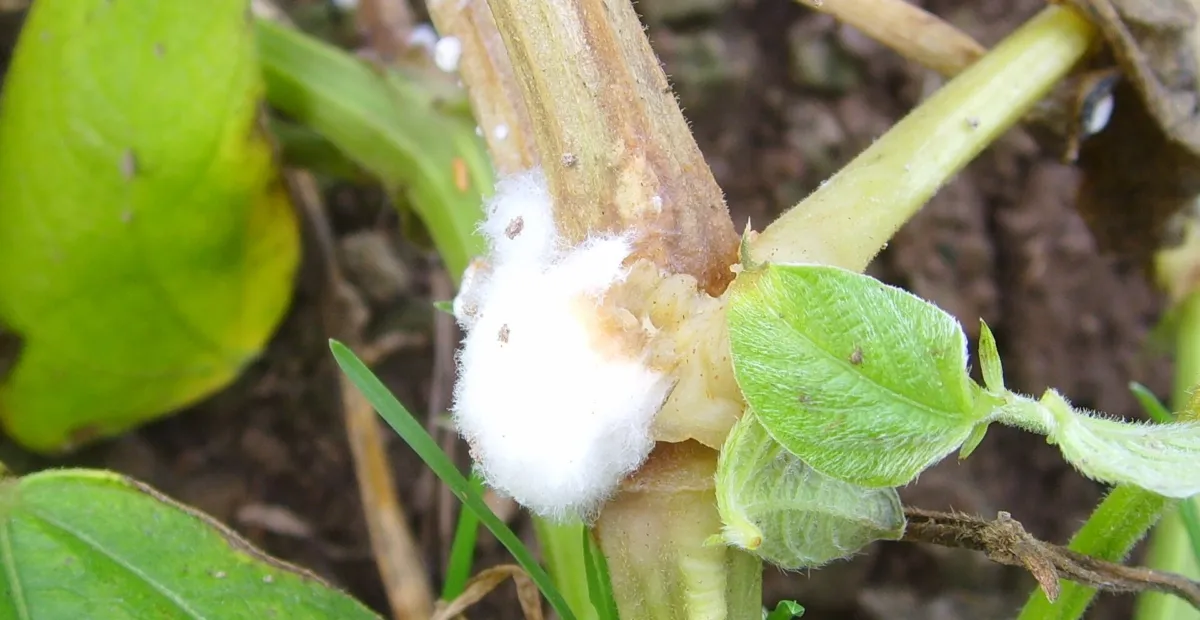
White mold (Sclerotinia stem rot)
Sclerotinia sclerotiorumWhite mold (Sclerotinia stem rot) overview
White mold is a widespread fungal disease caused by Sclerotinia sclerotiorum. It attacks many broadleaf crops, vegetables, flowers and weeds, producing water-soaked lesions, soft or bleached stem and fruit tissue, white cottony growth, and distinctive black resting bodies called sclerotia. Cool, wet weather, dense canopies, senescing flowers and prolonged leaf wetness strongly favor infection and recurring disease.
Typical conditions
Overview
In the United States, the disease is commonly called white mold in gardens and vegetable production and Sclerotinia stem rot in soybean. It affects hundreds of broadleaf plant species, but severity varies greatly among hosts and locations. Commonly affected plants include soybean, dry bean, sunflower, canola, pea, lentil, chickpea, tomato, carrot, lettuce, cabbage, cucurbits and many ornamentals.
Typical signs are white, cottony fungal growth and hard black sclerotia on or inside infected tissue. Disease often appears in patches or scattered plants where the canopy remains wet for long periods.
Symptoms and identification
Early lesions are usually water-soaked, light brown to tan and soft. Stems may develop lesions at nodes, branch junctions, the soil line, or where senescent flowers and leaves remain attached. Tissue above the lesion wilts, yellows, collapses or dies.
Under humid conditions, abundant white cottony mycelium covers stems, fruit, pods or soil-contacting tissue. As the tissue dries, stems become bleached, pale gray or brittle. Black, irregular to rounded sclerotia may form on the surface or inside stems, pods, fruit and heads. Infected fruit and roots can develop soft rots. Symptoms can resemble Botrytis, other stem rots or lodging-related decline; laboratory confirmation may be needed when signs are absent.
Causes and spread
The pathogen survives mainly as sclerotia in soil and infected plant debris. Sclerotia can be moved in contaminated soil, crop residue, seed lots, transplants, tools, equipment and irrigation or runoff water. Windborne ascospores from apothecia are important for infections of aboveground tissue.
Ascospores generally need a susceptible food base, such as aging flower petals, senescent leaves or injured tissue, before the fungus can invade healthy plant parts. Dense canopies, lodging, weeds, excessive fertility, frequent irrigation and poor air movement increase the duration of wetness and can intensify disease.
Life cycle and persistence
Sclerotia can persist in soil for many years. When they are near the soil surface and receive prolonged moisture, they may germinate directly to produce mycelium that infects roots or crowns, or they may undergo carpogenic germination and form small, tan to gray, saucer-shaped apothecia.
Apothecia release airborne ascospores. Cool, wet conditions and approximately 16–48 hours of tissue wetness favor spore germination and infection, especially during flowering or canopy closure. New sclerotia develop in killed plant tissue and return to the soil with residue. The disease is generally monocyclic, so within-season spread is mainly from the original infection rather than repeated spore production throughout the canopy.
Treatment and control
There is no curative treatment that reliably restores tissue already girdled or rotted. Remove and dispose of infected plants, fruit and heavily infected stems as soon as practical. Do not place diseased material in a home compost pile unless the composting system reliably reaches pathogen-killing temperatures throughout the pile.
Reduce irrigation and canopy humidity without causing drought stress, improve airflow, and prevent contact between healthy tissue and wet infected debris. In field crops, use crop-specific disease forecasting, cultivar resistance, canopy management and rotation as the foundation of an integrated program. Fungicide performance is preventive and crop-specific, and results can be inconsistent; diagnosis should be confirmed before treatment.
Low-impact and biological control
For home gardens and certified-organic production, emphasize sanitation, moisture management, wide spacing, weed control, resistant or less-susceptible varieties and rotation with nonhost grasses. Remove infected plants and residue before sclerotia mature, and avoid spreading contaminated soil.
Commercial biological products containing antagonistic organisms such as Coniothyrium minitans may reduce sclerotia under some crop and environmental conditions, but efficacy depends on formulation, timing, application method and local authorization. Use only products approved for the specific crop and production system, and follow the label.
Prevention
- Use resistant or partially resistant cultivars when they are available for the crop; resistance is often incomplete and cultivar performance varies.
- Start with clean seed, transplants and planting media. Avoid moving infested soil or residue between beds and fields.
- Increase air circulation with appropriate plant and row spacing, weed control, pruning where horticulturally suitable, and an open plant architecture.
- Use drip irrigation or soaker hoses rather than overhead sprinklers, and irrigate early enough for foliage to dry.
- Remove diseased plants and crop debris promptly, handling them carefully so sclerotia are not scattered. Do not save seed from diseased crops.
- Rotate susceptible broadleaf crops with less-susceptible grasses such as corn or small grains where practical. Rotation reduces risk but does not eliminate long-lived sclerotia because many weeds and broadleaf crops can maintain the pathogen.
Interesting facts
- Sclerotinia sclerotiorum has one of the broadest host ranges among important plant-pathogenic fungi, with more than 400 documented plant species reported in agricultural and research references.
- The conspicuous black sclerotium is a survival structure, not a seed or insect egg. Its dark outer rind helps protect the fungus during unfavorable conditions.
- Ascospores commonly infect aging flower petals or other senescent tissue first because they generally cannot penetrate completely healthy plant tissue efficiently on their own.
- Corn and small grains are generally not hosts in the same way as susceptible broadleaf crops, which is why they can be useful rotation crops, although rotation alone will not eradicate sclerotia or infected weeds.
- White mold can be confused with Botrytis gray mold and other stem rots. Large black sclerotia and abundant white cottony mycelium support the diagnosis, but symptoms can vary by host.
Use only fungicides legally authorized for Sclerotinia sclerotiorum or white mold on the specific crop in the United States. Product registrations, crops, rates, application timing, worker protections and preharvest intervals can change; follow the current EPA-approved label and all state requirements. Do not apply a product based only on the disease name or on recommendations for another crop.
Affected plants
The plants below are linked to this problem by structured host-plant data. The list updates automatically as new plant profiles are added.
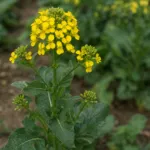 Ethiopian Rape (Brassica carinata) care guideBrassica carinata
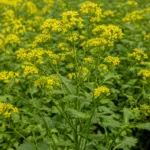 Brown Mustard (Brassica juncea) care guideBrassica juncea
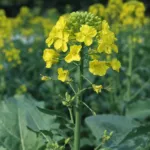 Rapeseed (Brassica napus) care guideBrassica napus
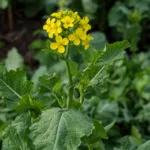 Urnip rape (Brassica rapa) care guideBrassica rapa
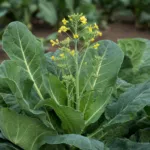 Collard greens (Brassica oleracea) care guideBrassica oleracea
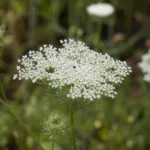 Wild carro (Daucus carota) care guideDaucus carota
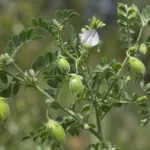 Chickpea (Cicer arietinum) care guideCicer arietinum
 He tepary bea (Phaseolus acutifolius) care guidePhaseolus acutifolius
 Snap bean (Phaseolus coccineus) care guidePhaseolus coccineus
 Butter bea (Phaseolus lunatus) care guidePhaseolus lunatus
 String Bean (Phaseolus vulgaris) care guidePhaseolus vulgaris
 Solanum aethiopicum care guideSolanum aethiopicum