
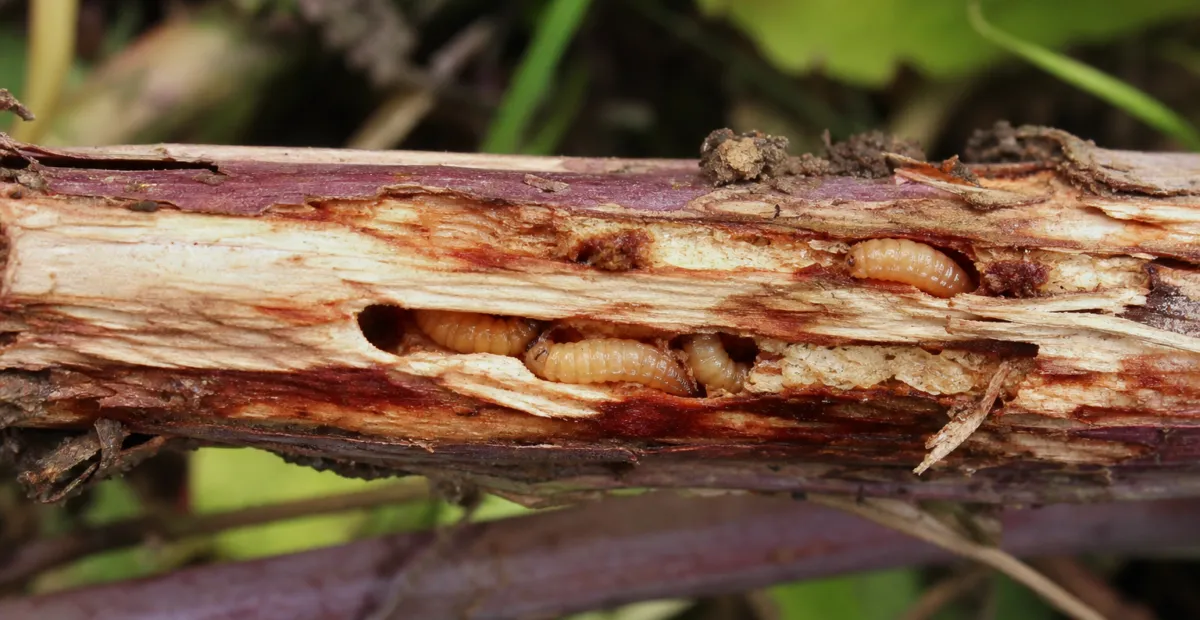
Raspberry Cane Midge
Resseliella theobaldiRaspberry Cane Midge overview
Raspberry cane midge is a small gall midge whose larvae develop beneath split or wounded bark on raspberry canes. Feeding injuries weaken the cane and can allow cane-blight fungi to invade, producing lesions, dieback and premature cane death. It is best managed through careful cane handling, sanitation, cultivar selection, monitoring and precisely timed integrated pest management rather than routine spraying.
Typical conditions
Overview
The raspberry cane midge, Resseliella theobaldi, is a small fly in the family Cecidomyiidae. It is principally associated with raspberry, especially red raspberry (Rubus idaeus). Adults are inconspicuous; the damaging stage is the larva, which develops under bark at natural cracks, pruning injuries, abrasion points or other wounds.
Damage is most important where cane splitting and fungal infection occur together. The insect itself may not be the sole cause of cane death: feeding wounds can be colonized by several weakly pathogenic or cane-blight fungi, producing the combined condition sometimes called midge blight. In the United States, diagnosis should be confirmed carefully because cane borers, spur blight, anthracnose, winter injury and other cane diseases can cause similar dieback.
Symptoms and identification
- Longitudinal splits, shallow wounds or peeling bark, commonly near the base or lower portions of young raspberry canes.
- Brown, reddish-brown or dark lesions beneath the bark, sometimes appearing as patches or stripes.
- Larvae may be found beneath loosened bark at the wound site; they are small, pale to reddish larvae and are easily overlooked.
- Weak shoots, wilt, premature yellowing and dieback above the injured area.
- Dead floricanes or primocanes during winter or the following spring, with reduced fruiting and patchy stand decline.
Finding a larva alone is not definitive because other cane-inhabiting insects may be present. Inspect the injury pattern and, when possible, submit an infested cane to a diagnostic laboratory.
Causes and spread
Females deposit eggs in bark splits and wounds. Common entry sites include frost cracks, pruning cuts, cane abrasion against wires or old stubs, mechanical harvesting injuries and wounds made during thinning or training. Larvae feed within the protected bark tissues, so contact sprays directed at foliage generally provide poor control after larvae have entered the cane.
Spread is favored by infested canes left in or near the planting, overlapping generations, dense humid canopies and cultivars or production practices that produce frequent cane splits. Wounds may also become infected by cane-blight fungi, increasing lesion development and cane mortality.
Life cycle and persistence
Adults emerge from overwintered immature stages and lay eggs during spring and summer; the exact flight calendar varies with climate and elevation. Published European field studies have recorded approximately three to four generations per year under different conditions. Eggs are laid in cane cracks or wounds, and larvae feed beneath the bark for roughly two to three weeks before leaving the cane.
Mature larvae generally drop or move to the soil and pupate a few inches below the surface. Later generations can overlap, and larvae from late-season infestations may overwinter in the cane or nearby soil depending on local conditions. Pheromone traps can help detect adult flight, but trap captures should be interpreted with cane inspections rather than used alone.
Treatment and control
First confirm the diagnosis by opening a fresh lesion and looking for larvae beneath the bark. Prune out infested canes below the damaged tissue, preferably before larvae mature or leave the cane. Remove cut material from the field rather than leaving it in the row or composting it unless the composting process reliably destroys insects.
Reduce associated cane disease by improving air movement, avoiding overhead irrigation when foliage and canes remain wet for long periods, and protecting canes from mechanical injury. In commercial plantings, use local scouting data and adult-flight monitoring to time any intervention against exposed adults or newly laid eggs. The first flight may be especially important, but local timing and thresholds are not interchangeable among regions.
Low-impact and biological control
Sanitation and wound reduction are the most dependable low-input measures. Remove infested canes promptly, maintain an open canopy, avoid unnecessary bark injury and select less-splitting cultivars when available.
Conserve naturally occurring parasitoids, including reported eulophid parasitoids such as Aprostocetus epicharmus, by avoiding broad-spectrum applications during periods of parasitoid activity. Entomopathogenic fungi and microbial products have been investigated, but effectiveness depends on formulation, timing, weather and local authorization; use them only when registered or otherwise legally permitted for the crop and target in the United States.
Prevention
- Plant certified, pest-free raspberry stock and inspect new canes before planting.
- Use a narrow, open canopy with adequate air circulation and avoid excessive cane density.
- Train and prune carefully to minimize bark splitting, abrasion and unnecessary wounds.
- Remove old stubs and prevent canes from rubbing against trellis components or each other.
- Select cultivars that are less prone to cane splitting where locally suitable; resistance is not absolute and cultivar responses vary.
- During dormancy or early spring, remove visibly infested canes below the lesion and destroy or remove them from the planting.
- Monitor primocanes and cane wounds during spring and summer, and use pheromone trapping where locally available for flight timing.
Interesting facts
- The species is also known in older literature under the names Thomasia theobaldi and Thomasiniana theobaldi.
- The female sex pheromone has been identified as (S)-2-acetoxy-5-undecanone, allowing specialized monitoring lures to be developed.
- Damage is often a pest–pathogen interaction: larval feeding wounds can facilitate infection by cane-blight fungi.
- Some raspberry breeding material, including reported Rubus crataegifolius backgrounds and hybrids, can rapidly seal bark wounds and show reduced damage, but this should not be treated as universal resistance.
- Raspberry cane midge is primarily documented as an important pest in Europe; a similar-looking dead or split cane in a United States planting requires differential diagnosis rather than automatic attribution to this species.
No routine pesticide program should be copied from older European trials or from another crop. In the United States, use only products legally registered and currently labeled for raspberry, the target pest and the intended application site in your state. Follow the current label, preharvest interval, pollinator precautions and all worker-protection requirements. Because larvae are protected beneath bark, timing against adult flight or newly exposed life stages is critical; consult your state Cooperative Extension service or a licensed crop adviser before treatment.