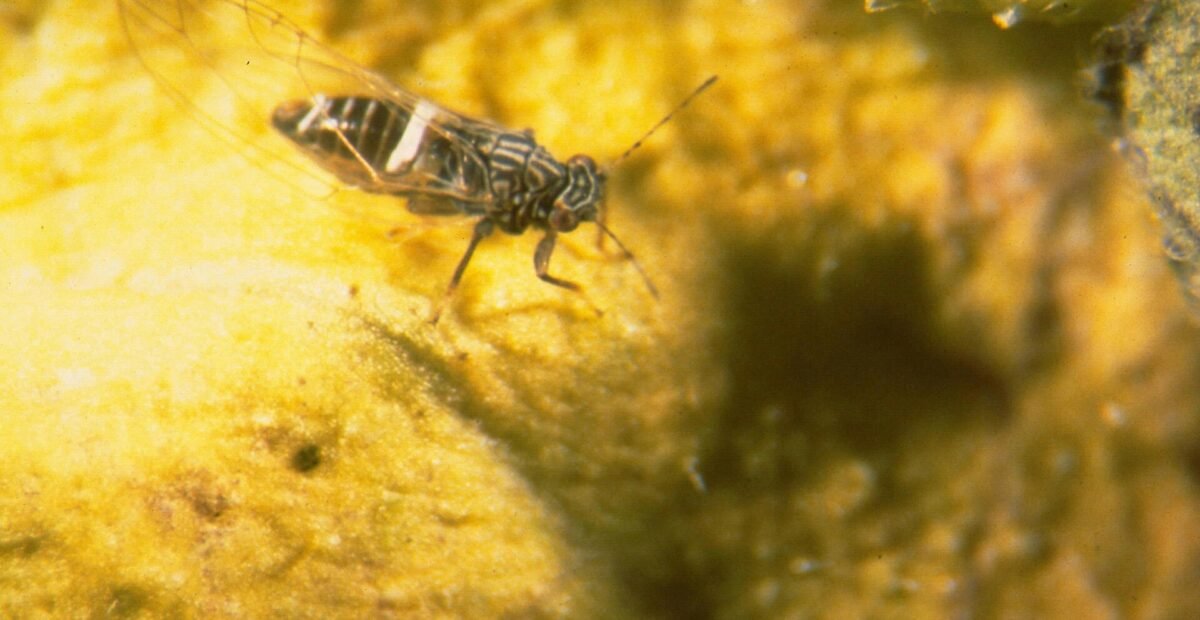
Potato/tomato psyllid
Bactericera cockerelliPotato/tomato psyllid overview
The potato/tomato psyllid, Bactericera cockerelli, is a tiny, mobile sap-feeding insect that attacks potatoes, tomatoes, peppers, eggplants and related plants in the United States. Feeding can cause yellowing, curling, purpling, stunting and plant decline. It is also the principal vector of ‘Candidatus Liberibacter solanacearum’, the bacterium associated with zebra chip disorder in potato tubers.
Typical conditions
Overview
Bactericera cockerelli, commonly called the potato psyllid or potato/tomato psyllid, is about 1/16–1/8 inch (2–3 mm) long. Adults resemble miniature cicadas, jump readily when disturbed and have clear wings held roof-like over the body. They are usually gray, brown or black with conspicuous pale markings.
Eggs are tiny, yellow to orange and attached to leaves by short stalks. Nymphs are flattened, pale green to yellow-green and fringed with short marginal spines. They are commonly found on leaf undersides and can resemble soft scales or whiteflies, but move when disturbed.
The pest is especially important in potatoes, tomatoes, peppers and eggplants in the western and central United States. Its importance varies by region and season because populations may migrate into crops from warmer areas or persist locally on crop and weed hosts.
Symptoms and identification
Feeding symptoms vary with host, psyllid density, insect biotype and plant age. Typical signs include:
- yellowing or chlorosis of young leaves;
- upward or downward leaf curling, distortion and reduced leaf expansion;
- purpling or reddish discoloration, particularly in potato;
- shortened internodes, stunting, wilting or general loss of vigor;
- reduced fruit or tuber production and, in severe infestations, plant death.
Potato plants may develop psyllid yellows from toxic saliva injected during feeding. When the psyllid transmits ‘Candidatus Liberibacter solanacearum’, potato tubers may show brown internal streaking that becomes more obvious after frying, the characteristic zebra chip disorder. Similar foliar symptoms can also result from nutrient problems, drought, herbicide injury, viruses or other pests, so confirmation should include inspection for psyllids and, where relevant, laboratory testing.
Causes and spread
Both adults and nymphs feed with piercing-sucking mouthparts, primarily on the phloem. Direct injury results from sap removal and salivary toxins. The bacterium associated with zebra chip is acquired when psyllids feed on infected plants and may then be transmitted during feeding on healthy potatoes and other susceptible solanaceous plants.
Spread is promoted by adult migration, movement of infested transplants, overlapping crop plantings and nearby unmanaged nightshade-family weeds. Adults can move between potatoes, tomatoes, peppers, eggplants and noncrop hosts. The pest is difficult to detect early because eggs and nymphs are small and usually remain on leaf undersides.
Life cycle and persistence
Adults migrate, overwinter or reproduce wherever suitable host plants and temperatures allow. Females lay stalked eggs on leaves, often near leaf margins or in the upper canopy. Depending on temperature, eggs may hatch in approximately 3–8 days.
Nymphs pass through five instars while feeding on the underside of leaves. Development from hatching to adulthood commonly takes about 15–20 days under favorable conditions, although the rate varies with temperature and host quality. Adults then disperse, reproduce and may acquire or transmit ‘Candidatus Liberibacter solanacearum’. Several generations can occur during a growing season in suitable regions.
Treatment and control
Confirm the pest before treating. Examine leaves for eggs and nymphs, tap foliage over a white surface and use sticky traps to track adults. Treating solely for yellowing is unreliable because symptoms overlap with nutrient deficiencies, drought, viruses and herbicide injury.
When monitoring shows a damaging population or a local zebra chip risk, use a crop-specific, locally recommended IPM program. Target the most vulnerable crop stage, obtain thorough coverage of leaf undersides when the product label requires it, and rotate insecticide groups according to resistance-management guidance. Avoid repeated use of the same mode of action. Protect pollinators and natural enemies by following label restrictions and avoiding applications during active bloom or bee activity unless specifically permitted.
For home gardens, removing badly infested plants, controlling nearby host weeds, using row cover before adult arrival and maintaining vigorous plants may be more practical than repeated spraying. Once a plant is severely affected, insecticide treatment may not reverse existing yellowing, stunting or tuber symptoms.
Low-impact and biological control
Organic and reduced-risk tactics are most effective when combined with monitoring and sanitation. Use insect-exclusion fabric over young crops where it does not interfere with pollination or increase heat stress, remove heavily infested plants, and control nearby volunteer potatoes and relevant weeds.
Conserve predators such as lacewings, lady beetles, minute pirate bugs and other generalist insects by avoiding broad-spectrum sprays. The parasitoid Tamarixia triozae and entomopathogenic fungi have been studied as biological-control tools, but their effectiveness depends on climate, crop system and product availability. In certified organic production, use only inputs permitted by the current organic standard and product label; some labeled spinosad products are used in organic systems, but they can harm beneficial insects and must be applied only when legally labeled and justified by monitoring.
Prevention
Use an integrated monitoring and sanitation program:
- Inspect young growth and leaf undersides weekly with a hand lens, especially along field margins and during periods of adult movement.
- Place yellow sticky cards near the tops of plants and at crop edges to detect incoming adults; replace and record them regularly.
- Start with healthy, pest-free transplants from reputable sources and avoid moving infested plant material between growing areas.
- Remove volunteer potatoes and manage nightshade-family weeds such as nightshade, groundcherry and matrimony vine near production areas, while avoiding unnecessary removal of beneficial habitat.
- Coordinate planting, monitoring and control decisions across nearby potato, tomato and other solanaceous crops when practical.
- Remove and destroy heavily infested annual plants after harvest, and promptly manage crop residues where local recommendations support this practice.
- Use resistant or less susceptible cultivars where locally available and supported by extension guidance.
Interesting facts
- Adults are only about 2–3 mm long but can migrate considerable distances into crop fields.
- The insect was historically referred to as Paratrioza cockerelli; current references generally place it in the genus Bactericera.
- The pest can cause psyllid yellows through feeding toxins even when the zebra chip-associated bacterium is not present.
- Potato zebra chip symptoms may be most evident only after tubers are sliced and processed into fries or chips.
- Some potato psyllid populations differ in seasonal movement, host preference and ability to transmit the associated bacterium, so regional monitoring is important.
Use only pesticide products legally authorized for Bactericera cockerelli on the specific crop in the United States, and follow the current EPA-approved label exactly, including crop, rate, preharvest interval, reentry interval, application method, protective equipment, pollinator precautions and resistance-management instructions. Product registrations and labels change; consult the current state extension recommendation and label before use. Do not treat zebra chip symptoms with insecticide after harvest or assume that a product labeled for another crop is legal for the crop being grown.
Affected plants
The plants below are linked to this problem by structured host-plant data. The list updates automatically as new plant profiles are added.