Pocket Plum
Taphrina pruniPocket Plum overview
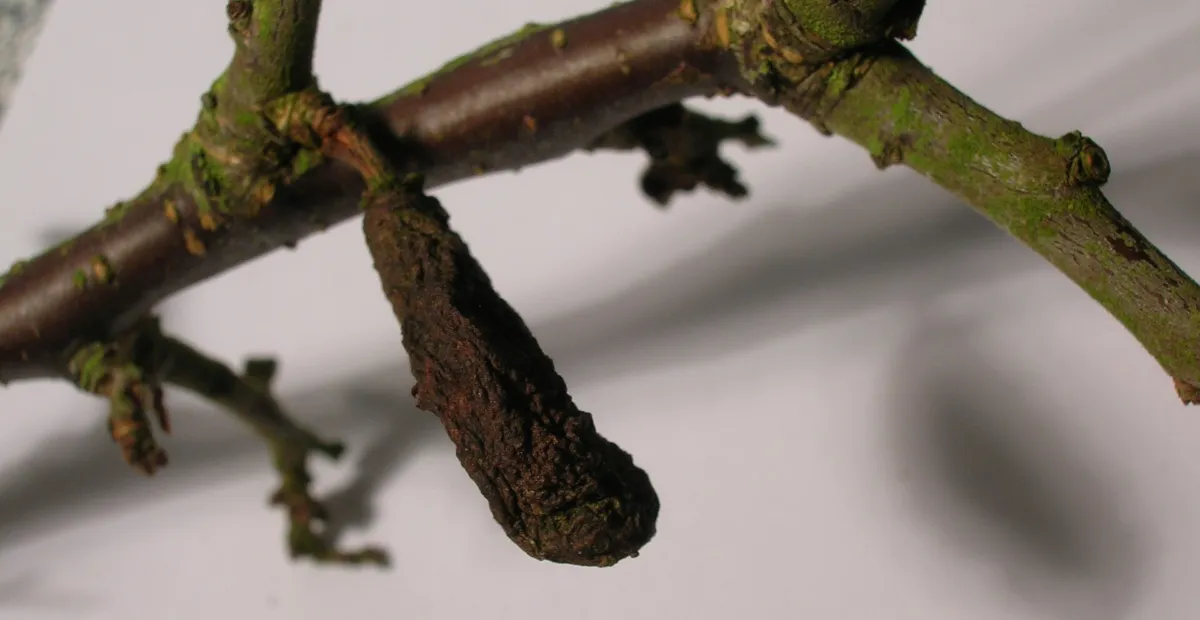
Pocket plum is a fungal disease of young plum and blackthorn fruit caused by Taphrina pruni. Shortly after flowering, infected fruit enlarge rapidly, become elongated or pouch-like, remain hollow because the stone fails to develop, and may later develop a pale gray-white spore coating before shriveling and falling. In the United States, similar symptoms are more commonly attributed to Taphrina communis, so laboratory confirmation may be needed.
Typical conditions
Overview
Pocket plum, also called bladder plum, affects developing fruit soon after bloom. The infected fruit may become several times longer than normal, often curved, flattened or pouch-like. The stone and normal seed cavity do not develop, leaving a hollow, spongy interior. As the fungus matures, the fruit surface can develop a pale gray-white, velvety layer of asci and ascospores. Fruit eventually shrivels, turns brown to black, and drops or remains attached.
The name describes a symptom group rather than a universally reliable field identification. Taphrina pruni is the documented cause of pocket plum in parts of Europe and elsewhere, while T. communis is the more prevalent cause of comparable plum pockets in much of the United States. Molecular or specialist confirmation may be required when the distinction matters.
Symptoms and identification
- Small pale or whitish blisters appear on young fruit shortly after flowering.
- The entire fruit enlarges abnormally and becomes elongated, flattened, curved or sac-like.
- Fruit remains green to yellow-green or develops reddish tones, but does not ripen normally.
- The stone fails to develop; cut fruit is hollow or contains only a greatly reduced seed structure.
- A grayish-white to pale green, velvety spore-producing layer may cover the fruit surface.
- Diseased fruit becomes dry, brown or black and may fall prematurely or persist on the tree.
- Occasional leaf or shoot distortion has been reported, but fruit symptoms are the most characteristic.
Other causes of malformed plum fruit include insect injury, frost damage and other Taphrina species. Examine the whole tree and the timing of symptoms before concluding that T. pruni is present.
Causes and spread
The causal organism is the ascomycete fungus Taphrina pruni. It colonizes young fruit tissue and alters normal fruit and stone development. Mature infected fruit produce asci directly through the epidermis rather than forming conventional mushroom-like fruiting bodies.
Spread occurs primarily through wind-driven rain and rain splash. Spores from diseased fruit can reach bark, twigs, buds and newly developing flowers or fruit. The risk is greatest when cool, wet conditions coincide with bud break, bloom and the first stages of fruit development. Nearby unmanaged plum or blackthorn hosts may contribute inoculum.
Life cycle and persistence
After infected fruit mature, asci release ascospores that can colonize suitable surfaces on the host. Taphrina species may persist on twigs and around buds during the dormant period, commonly in a yeast-like phase. During cool, wet spring weather, spores germinate and infect susceptible tissues around bloom and early fruit development.
The fungus grows within living host tissue as the fruit enlarges. A surface layer of asci becomes visible later, producing additional spores. Because infection occurs early, fungicide applications made after symptoms are obvious generally cannot restore normal fruit development. Details of the overwintering and infection process vary among Taphrina species and are not fully resolved for every host population.
Treatment and control
Once a plum has become enlarged and hollow, it cannot be cured or returned to normal. Hand-remove affected fruit as soon as they are recognizable and place them in sealed trash or remove them well away from the orchard; do not compost diseased fruit unless the composting process reliably reaches pathogen-inactivating temperatures.
For a tree with repeated, serious losses, a dormant-season disease-management program may be considered before bud swell, because protection must be present before infection. Timing and product choice depend on the confirmed Taphrina species, crop, state registration and label directions. Pruning, sanitation and canopy drying remain important even where a fungicide is used.
In the United States, confirm the diagnosis when possible because T. communis is reported more frequently than T. pruni as the cause of plum pockets. Contact a state university diagnostic laboratory or Extension service if species identity affects management.
Low-impact and biological control
- Use frequent scouting and hand-pick abnormal fruit shortly after bloom.
- Remove overwintered pockets, mummified fruit and infected debris before spring growth.
- Maintain an open canopy through careful dormant pruning to shorten drying time after rain.
- Limit overhead irrigation and water at the root zone when irrigation is needed.
- Support steady tree vigor with appropriate watering, mulching and soil fertility rather than excessive nitrogen.
No biological control method has been sufficiently validated for dependable home-orchard control of Taphrina pruni. Copper- or sulfur-based materials may be permitted for some crops or production systems, but authorization and efficacy are product-, crop- and state-specific; use only a currently registered product whose label specifically allows the intended use.
Prevention
- Inspect plum and blackthorn trees soon after bloom and remove abnormal fruit before the surface becomes heavily coated with spores.
- Collect and discard fallen pocket fruit; do not leave infected fruit hanging through winter.
- Prune to improve air circulation and light penetration, while avoiding unnecessary wounds and excessive vigor.
- Remove neglected or heavily diseased host material near the planting when practical, especially persistent mummified fruit.
- Choose locally adapted cultivars with lower susceptibility where reliable cultivar information is available.
- Monitor the period from bud swell through early fruit set, particularly during a cool, rainy spring.
Interesting facts
- The common name comes from the distinctive hollow, pouch-like fruit produced when the stone fails to develop.
- The visible gray-white coating consists largely of exposed asci and spores, not a conventional mushroom cap.
- Taphrina pruni has been associated with cultivated plums and blackthorn, while other closely related Taphrina species produce similar pocket symptoms on different Prunus hosts.
- In North American references, plum-pocket symptoms are commonly attributed to T. communis; reports of T. pruni on plums in North America have not always been confirmed.
- Fruit symptoms can be striking even when only a small proportion of the crop is affected.
Use pesticides only when the disease has been diagnosed and only products legally authorized for the specific crop and problem in your country and state. Follow the current label for crop, rate, timing, personal protective equipment, re-entry interval, preharvest interval and environmental precautions. Do not apply post-bloom or curative treatments unless the label and local Extension guidance specifically support that use.
Affected plants
The plants below are linked to this problem by structured host-plant data. The list updates automatically as new plant profiles are added.