
European Cherry Fruit Fly
Rhagoletis cerasi (Linnaeus)European Cherry Fruit Fly overview
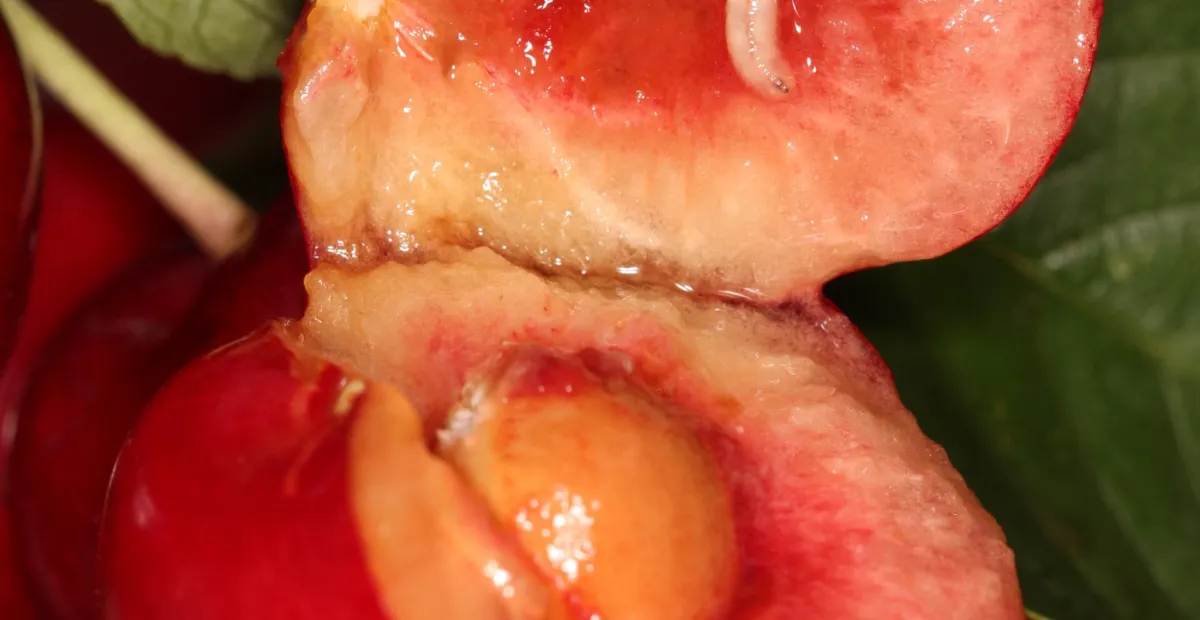
European cherry fruit fly, Rhagoletis cerasi, is an invasive tephritid pest that attacks ripening cherries. Females insert eggs beneath the fruit skin, and the developing maggots tunnel through the flesh, causing soft brown decay, shriveling, premature fruit drop and exit holes. In the United States it remains a regulated pest with a restricted distribution, so suspected findings should be reported promptly.
Typical conditions
Overview
The European cherry fruit fly is a tephritid pest of greatest importance on sweet cherry (Prunus avium). Adults are small flies, approximately 1/8 to 3/16 inch long, with a mostly black body, yellow-orange head, a yellow marking on the thorax and transparent wings crossed by dark bands. The damaging stage is the larva, which feeds inside fruit and is usually concealed until the cherry softens, collapses or develops an exit hole.
In the United States, R. cerasi has a restricted distribution centered on New York State and is subject to federal and state regulatory action. It should not be confused with native or established North American cherry fruit flies such as Rhagoletis cingulata or R. indifferens; adult identification and official confirmation are important.
Symptoms and identification
- Small darkened or soft spots at the egg-laying site on ripening cherries.
- Internal cream-colored maggots and brown, watery or decaying flesh.
- Fruit that becomes wilted, shriveled, misshapen or prematurely drops.
- Small exit holes where mature larvae leave the fruit.
- Infestation may be difficult to detect externally before fruit damage becomes advanced.
Symptoms overlap with other cherry fruit flies, fruit rots and mechanical injury. Diagnosis should be based on the larva, adult, trap capture and host context rather than fruit appearance alone.
Causes and spread
Adult females deposit eggs beneath the skin of suitable fruit, generally placing one egg per fruit. Larvae hatch and feed within the flesh for several weeks, then leave the fruit and enter the soil to pupate. The pest can spread through movement of infested fresh cherries, fruit-bearing host material and associated soil. Fallen fruit left beneath trees provides a local source of larvae and future adults.
In the United States, human-assisted movement is a major regulatory concern. Wild Prunus and some Lonicera fruits can maintain populations where they occur near cultivated cherries.
Life cycle and persistence
Rhagoletis cerasi normally has one generation per year. Pupae overwinter in the soil, with emergence commonly occurring from May through July depending on temperature, latitude and local host phenology. Adults live for roughly two to four weeks. After mating, females oviposit in ripening fruit. Larvae feed internally for up to about six weeks, then exit the fruit and burrow into soil, where they form puparia and enter a prolonged diapause. Emergence timing varies by region and some pupae may remain dormant longer than one season.
Treatment and control
Begin with confirmation and monitoring. Place approved visual traps in the cherry canopy before the expected adult flight period, inspect them regularly and record captures alongside fruit color and maturity. Because larvae are protected inside fruit, measures directed only at infested cherries are too late to rescue that crop; management must target adults before or during egg laying.
For home trees, combine exclusion netting, complete harvest and removal of fallen fruit, and destruction of suspect fruit. In regulated or commercial situations, coordinate with USDA APHIS, the state agriculture department and cooperative extension personnel, who may direct trapping, quarantine, fruit removal or other response actions. Treating soil alone is generally unreliable because pupae are protected underground and emergence timing is variable.
Low-impact and biological control
- Fine-mesh exclusion netting can prevent adult flies from reaching fruit when installed before emergence and kept closed.
- Frequent harvest and sanitation reduce the number of larvae returning to the soil.
- Yellow sticky traps can suppress some adults on small trees and are useful for detection, but trapping alone may not provide commercial-level protection.
- Maintain ground cover and habitat that support ants, carabid beetles and other generalist predators, while recognizing that natural mortality is variable.
- Parasitoids such as Utetes magnus and Psyttalia rhagoleticola are under biological-control research; they should not be released unless supplied through an officially approved program.
- Beauveria bassiana has been studied as a microbial control option, but product performance, crop registration and label availability must be verified locally.
Prevention
- Harvest cherries promptly and completely; do not leave overripe fruit on the tree.
- Collect and destroy fallen or suspect cherries before larvae can exit. Do not compost them unless the composting process reliably reaches temperatures sufficient to kill insects.
- Remove abandoned or unmanaged host fruit where permitted, especially nearby wild or volunteer Prunus and susceptible honeysuckles.
- Use fine-mesh insect exclusion netting on small or dwarf trees before adult emergence and maintain a sealed barrier around the canopy and trunk.
- Monitor with appropriate sticky traps and follow state or federal survey instructions.
- Do not move fresh cherries, host fruit or potentially infested soil from regulated areas without checking current USDA APHIS and state requirements.
- Report suspected adults, larvae or regulated-area infestations to the state plant regulatory official or cooperative extension service.
Interesting facts
- The species is also called cherry fruit fly, but the name European cherry fruit fly helps distinguish it from North American Rhagoletis species.
- Its principal documented cultivated host is sweet cherry, Prunus avium; sour cherry, Prunus cerasus, and mahaleb cherry, Prunus mahaleb, are also documented hosts.
- Documented alternate hosts include several honeysuckles, including Lonicera tatarica; host importance varies among species and locations.
- The adult's dark wing bands and yellow thoracic marking are useful field clues, but official identification may require expert examination.
- USDA APHIS first detected the pest in the United States in 2017, after earlier detections in Ontario, Canada.
Use only pesticide products legally authorized for European cherry fruit fly or the applicable cherry fruit-fly use on cherries in your state and country. Follow the current product label exactly, including crop, target pest, timing, rate, preharvest interval, reentry interval, pollinator precautions and restrictions for regulated areas. Do not infer legality or efficacy from products labeled for other fruit flies. Contact your state cooperative extension service or state pesticide regulatory agency for current, crop-specific guidance.