
 Source:
 Brown Marmorated Stink Bug
Halyomorpha halysBrown Marmorated Stink Bug overview
The brown marmorated stink bug, Halyomorpha halys, is an invasive, highly polyphagous piercing-sucking pest of fruit trees, vegetables, field crops, ornamentals and landscape plants in the United States. Adults and nymphs puncture fruit, pods, seeds, leaves and shoots, causing dimples, cat-facing, corky internal tissue, deformity and crop contamination. It also commonly enters buildings in late summer and fall to overwinter.
Typical conditions
Overview
The brown marmorated stink bug (BMSB), Halyomorpha halys (Hemiptera: Pentatomidae), is native to East Asia and is established across much of the United States. It is a generalist, piercing-sucking insect rather than a plant disease. Both nymphs and adults feed, although adults and older nymphs usually cause the most conspicuous crop injury.
BMSB is particularly damaging when populations move from woodland, unmanaged vegetation, ornamental hosts or buildings into orchards and gardens. Damage can resemble injury from native stink bugs, plant bugs or leaffooted bugs, so confirmation of the insect is important before management decisions are made.
Symptoms and identification
Feeding punctures may produce small sunken spots, dimples, discoloration, scarring and deformation. On apples and other tree fruit, early feeding can cause cat-facing, uneven growth and depressed lesions. Internal tissue beneath a puncture may become brown, corky, hard, pithy or necrotic.
On peaches and other fleshy fruit, feeding may cause sap exudation, soft external injury or cork-like internal tissue. Tomatoes and peppers can develop pale or yellowish spots, sunken areas and spongy internal damage. Beans and okra may show scarred, distorted pods, while corn and soybean injury is associated with damaged kernels, seeds or pods.
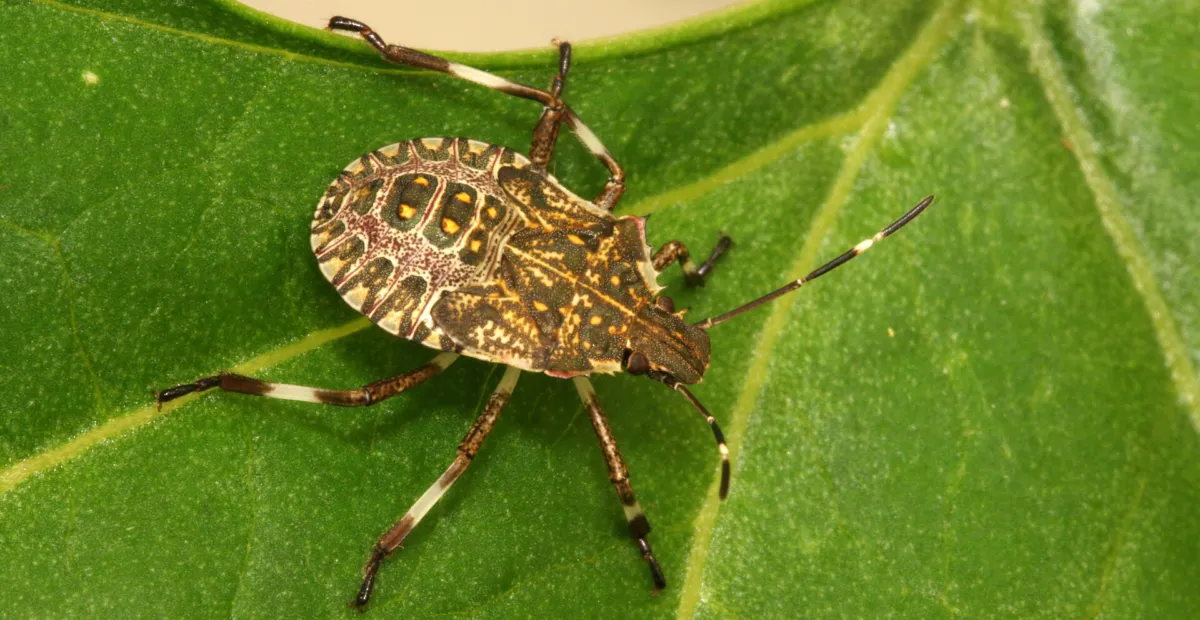
Adults are shield-shaped and mottled brown, with alternating light and dark bands on the exposed edge of the abdomen and antennae. Egg masses are commonly laid on leaf undersides; nymphs are more rounded and brightly marked than adults. Several native stink bugs can look similar.
Causes and spread
BMSB spreads through active flight and movement among successive host plants, and over longer distances by hitchhiking in vehicles, freight, nursery material and other human transport. It often enters crops from field edges, woodlots, residential landscapes, unmanaged host plants and overwintering buildings.
Its broad host range allows populations to build on early-season hosts and then shift into fruit, vegetable and field crops as those plants develop. Abundant shelter, nearby host plants and warm growing seasons can increase pressure. Crop injury is often greatest along orchard or garden edges near likely source areas.
Life cycle and persistence
Adults overwinter in protected cracks, buildings, bark crevices and other sheltered sites. They become active in spring, feed on available hosts and mate. Females lay clusters of usually about 20–28 pale eggs on the undersides of leaves. Nymphs pass through five immature stages before becoming adults.
In the mid-Atlantic United States, one or two generations may occur depending on temperature and season length. Warmer regions may support more generations, while cooler areas may have fewer. Adults aggregate in late summer and fall and seek protected overwintering sites; they do not reproduce inside homes.
Treatment and control
Begin with correct identification and monitoring. Hand-pick accessible bugs into soapy water, vacuum indoor aggregations with a dedicated or disposable-lined vacuum, and remove affected fruit when practical. In orchards and larger plantings, inspect crop edges and use beating trays to determine whether adults, nymphs or egg masses are present.
When treatment is justified, target the most vulnerable immature stages and use a locally appropriate, selective, edge-focused IPM approach where supported by crop guidance. Avoid routine calendar spraying: adults are mobile, reinvasion is common, and broad-spectrum insecticides can disrupt natural enemies and trigger secondary pests such as mites. Follow the crop-specific extension recommendations for monitoring thresholds, timing and resistance management.
Low-impact and biological control
Useful nonchemical and organically compatible tactics include row covers, hand removal, sanitation, edge monitoring, trap crops where validated locally, and conservation of predators and parasitoids. Kaolin clay protectant films may reduce fruit injury when coverage is thorough and repeated according to the product label.
Generalist predators such as spiders, assassin bugs and other predatory arthropods may attack BMSB, but native natural enemies alone generally do not provide reliable control of established crop infestations. Organic insecticides such as products based on pyrethrins, azadirachtin or spinosad may suppress some populations in certain crops, especially younger stages, but effectiveness, crop registration and pollinator precautions vary.
Prevention
- Scout orchard, garden and field edges regularly from spring through harvest, concentrating near woodlots, buildings and ornamental host plants.
- Use pheromone-baited traps as an aid to detection, but combine trap captures with visual inspection, egg-mass searches and beating-tray sampling because trap counts may not accurately represent crop pressure.
- Remove or manage highly attractive volunteer and invasive hosts where practical, especially tree-of-heaven near susceptible crops; avoid unnecessary removal of native vegetation solely on the assumption that every host sustains damaging populations.
- Use insect-excluding row cover over high-value vegetables when feasible, removing it for pollination when necessary.
- Harvest promptly, remove damaged or fallen produce, control weeds that can sustain populations, and keep crop edges and nearby structures monitored.
- For buildings, repair screens, install door sweeps and weather stripping, and seal cracks around windows, doors, vents, siding, utilities and air-conditioning units before late-summer aggregation.
Interesting facts
- The species was first officially identified in the United States in Pennsylvania in 2001, although it had likely been established there earlier.
- Reports document feeding on more than 100 plant species, and some US extension references list more than 170 or 300 reported hosts depending on how host use is defined.
- One adult can feed on multiple fruits, allowing relatively small populations to cause economically important injury.
- BMSB does not bite, sting, suck blood or reproduce inside homes. Its strong odor is released when the insect is disturbed or crushed.
- The invasive brown marmorated stink bug is a different species from native stink bugs, but field damage alone may not distinguish them reliably.
Use pesticides only when monitoring shows that treatment is justified and only products legally authorized for brown marmorated stink bug on the specific crop and use site in the United States. Read and follow the current product label for rate, timing, preharvest interval, restricted-entry interval, protective equipment, pollinator precautions and environmental restrictions. Do not rely on household or indoor sprays for crop protection, and do not apply any product to a crop or site not listed on its label.