
Sirococcus shoot blight of conifers
Sirococcus conigenusSirococcus shoot blight of conifers overview
Sirococcus shoot blight is a fungal disease of conifers caused primarily by Sirococcus conigenus. It attacks succulent current-season shoots, especially on pine, spruce, fir, larch and Douglas-fir seedlings and young trees. Infected shoots may droop, curl, turn reddish brown and die. Extended wet weather in spring and early summer strongly favors infection and rain-splash spread.
Typical conditions
Overview
Sirococcus shoot blight primarily kills the current season’s shoots of conifers. The disease is most damaging to seedlings and young trees, although older trees can also develop localized branch dieback. In the United States, Sirococcus conigenus is especially associated with red pine, other pines, spruce, fir, larch and Douglas-fir.
Diagnosis should not rely on symptoms alone. Several shoot blights can cause similar tip dieback, including environmental injury, insect damage and other fungi. Small black, flask-shaped pycnidia on dead shoots or needle bases support a Sirococcus diagnosis, but confirmation by a plant diagnostic laboratory is advisable when management or nursery certification is important.
Symptoms and identification
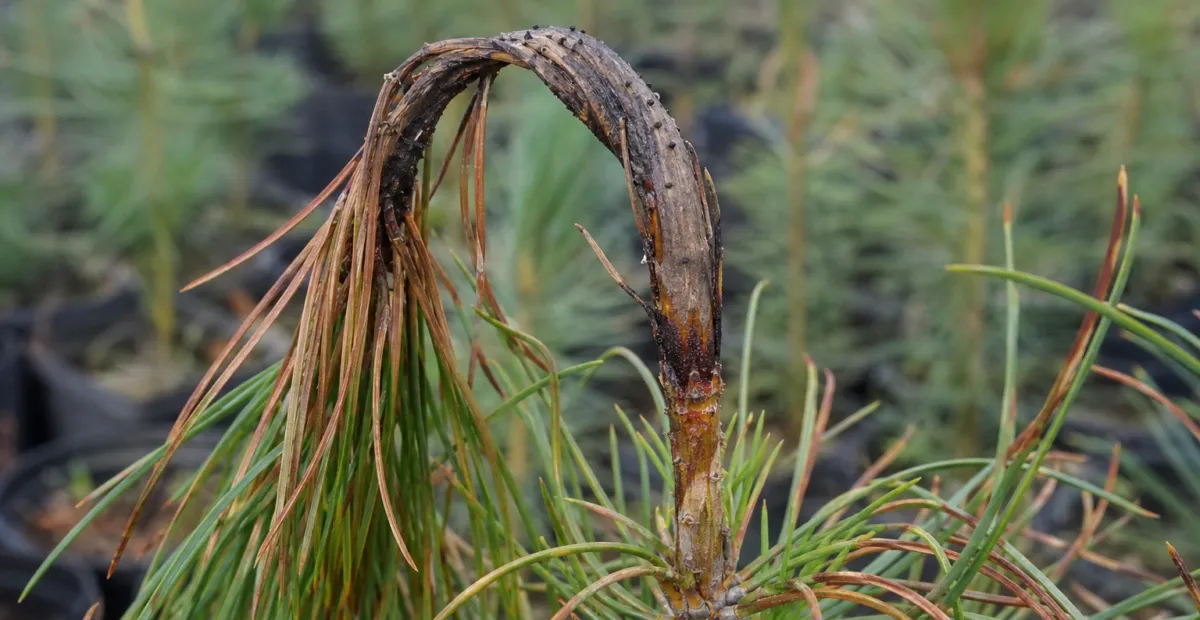
- Current-year shoots wilt, droop, curl or develop a characteristic hooked or crooked form while elongating.
- Needles near the infection site turn reddish brown, gray or brown and may either drop or remain attached to dead shoots.
- Small reddish to purplish lesions may girdle young pine stems and shoots.
- Dieback commonly remains limited to current-year or one-year-old growth, but repeated infections can deform or kill young trees.
- Black, raised, flask-shaped pycnidia may appear on dead twigs, needle bases, beneath fascicle sheaths or on open female cones.
- In mature trees, symptoms are often concentrated in lower branches; severe outbreaks in seedlings and saplings can cause substantial mortality.
Causes and spread
The causal fungus survives in infected or dead shoots, needles, cones and sometimes seed or asymptomatic nursery stock. Spores are released during wet weather and are dispersed mainly by rain splash, dripping water and contact with contaminated plant material. New shoots are most vulnerable as they emerge and elongate, especially when foliage remains wet for prolonged periods.
Infected overstory conifers, diseased windbreaks, dense nursery beds and movement of contaminated seedlings can provide important inoculum. Host range reports vary because older records often treated several related Sirococcus species as one pathogen.
Life cycle and persistence
Sirococcus conigenus overwinters in dead infected shoots, needles and cones. During wet periods in spring and early summer, black pycnidia produce asexual spores. Water carries the spores to the bases of newly expanding needles and young shoots, where infection can progress into the twig and cause shoot death.
Pycnidia may develop on dead tissue during the same season or later. The fungus can persist in nursery environments and may be seedborne on some conifer hosts, allowing apparently healthy planting material to introduce disease.
Treatment and control
There is no curative treatment that restores a shoot after it has been girdled and killed. On landscape trees, prune infected shoots and small branches back into healthy wood during a dry period, collect the debris and dispose of it appropriately. Reinspect plants during the following wet spring and early summer because new infections can arise from residual inoculum.
For nurseries and high-value plantings, management should be based on an accurate diagnosis, disease history and local extension guidance. Improve spacing, airflow, irrigation timing and sanitation first. Fungicides, where justified, are generally preventive rather than curative and are most useful when applied to protect susceptible new growth before infection periods.
Low-impact and biological control
- Use sanitation, dry-weather pruning and prompt removal of diseased plant material as the primary nonchemical measures.
- Reduce leaf and shoot wetness by improving spacing, pruning surrounding vegetation and avoiding unnecessary overhead irrigation.
- Remove severely affected nursery batches or young trees when they threaten to maintain inoculum.
- Select locally adapted conifers with lower observed susceptibility rather than repeatedly replacing plants with the same vulnerable host.
- Biological products should be considered only when they are specifically registered or labeled for the crop and disease; evidence for dependable field control of Sirococcus shoot blight is limited.
Prevention
- Buy nursery stock from reputable sources and inspect seedlings for dead tips, hooked shoots, lesions and black pycnidia.
- Remove and destroy blighted seedlings or branches rather than placing them in compost piles.
- Prune during dry weather, cutting below visibly diseased tissue and disinfecting tools between blocks or visibly infected plants.
- Space conifers according to mature size and avoid dense plantings that keep shoots and needles wet.
- Use drip irrigation or water at the soil surface when practical; avoid overhead irrigation during shoot elongation.
- Remove heavily infected volunteer conifers, diseased windbreak material or nearby sources of inoculum where feasible.
- Use locally appropriate, less-susceptible conifer species or proven seed sources when the disease has been persistent.
- Do not move suspect seedlings, cuttings, cones or prunings between nursery blocks or properties.
Interesting facts
- The name Sirococcus conigenus was historically used broadly for several closely related conifer pathogens.
- Modern taxonomic work separated S. conigenus from S. piceicola and S. tsugae, which differ in host associations and geographic occurrence.
- Black pycnidia can be visible with the unaided eye or a hand lens and are useful diagnostic clues.
- Red pine plantations and nursery seedlings can be especially vulnerable when young trees grow beneath or near infected overstory trees.
- Repeated shoot infections may cause crown deformation even when a mature tree survives.
Use only fungicides legally authorized for Sirococcus shoot blight on the specific crop in the United States and follow the current product label exactly, including crop/site, application timing, personal protective equipment, re-entry interval and restrictions. Do not infer legality or efficacy from recommendations for another conifer disease. Because symptoms are easily confused with other shoot blights, obtain a confirmed diagnosis before establishing a spray program.