Bull’s-eye Rot Caused by Neofabraea alba
Neofabraea alba (E.J. Guthrie) Verkley; often treated in current literature under the name Neofabraea vagabunda or its preferred name Phlyctema vagabundaBull’s-eye Rot Caused by Neofabraea alba overview
Neofabraea alba is a fungus associated with bull’s-eye rot, a mainly postharvest disease of apples and pears. Fruit may be infected in the orchard through lenticels, wounds, or the stem and calyx ends, yet remain symptomless until weeks or months in storage. Brown, circular lesions slowly enlarge and may develop pale centers, firm decay, and cream-colored spore masses. Orchard sanitation, careful harvest, and storage management are central to control.
Typical conditions
Overview
Neofabraea alba is associated with bull’s-eye rot, an economically important postharvest disease of apples and pears. In the Pacific Northwest, it is reported particularly often from pear, while the relative importance of Neofabraea species varies by orchard, host, and region.
The fungus may colonize fruit through lenticels, small wounds, or the stem and calyx ends. Disease is frequently inconspicuous at harvest and becomes evident during refrigerated storage, where lesions enlarge slowly. Similar bull’s-eye symptoms can be caused by N. perennans, N. malicorticis, N. kienholzii, and related taxa, so visual diagnosis alone is not always reliable.
Symptoms and identification
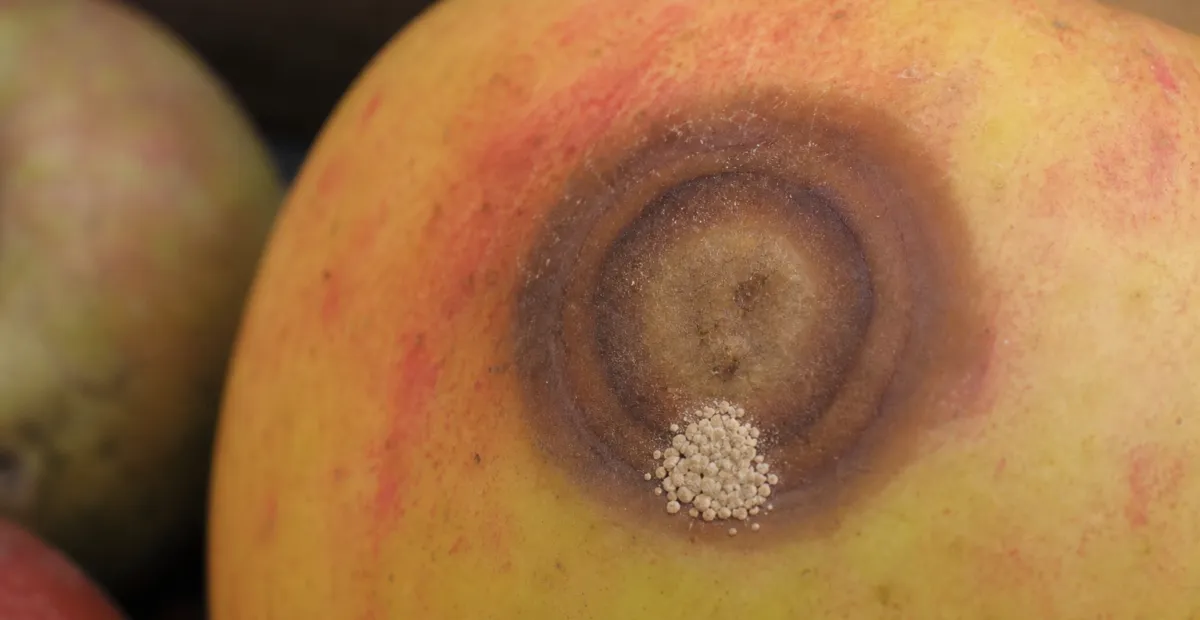
- Fruit lesions are circular, brown, flat to slightly depressed, and may have a lighter tan or brown center surrounded by a darker margin.
- Lesions beginning at lenticels are often sunken; stem-end and calyx-end infections may remain relatively flat.
- The decayed flesh is commonly firm to somewhat mealy, dark brown, and clearly separated from healthy tissue.
- As decay advances, cream-colored spore masses or other fungal fruiting structures may emerge from the lesion, sometimes in rings.
- Symptoms usually develop during storage, although late-season orchard symptoms and woody cankers can occur in some host and disease complexes.
Causes and spread
Inoculum is produced on infected fruit, dead or diseased twigs, cankers, and other colonized plant tissue. Spores are dispersed primarily by rain splash and wet conditions. Infection risk increases when fruit remains wet near harvest, when lenticels are open or damaged, and when picking, hauling, or packing causes bruises and skin breaks. Symptomless infected fruit can introduce the pathogen into storage lots.
Several Neofabraea species cause similar bull’s-eye rot. Confirming N. alba may require culture, conidial examination, and/or molecular testing rather than symptom comparison alone.
Life cycle and persistence
The fungus survives in infected woody tissues, cankers, fallen or mummified fruit, and other plant debris. During wet weather, fruiting bodies release conidia that are moved to susceptible fruit and tree tissues by water. Infections may remain quiescent in lenticels or minor wounds through harvest. After harvest, the pathogen resumes growth, particularly during prolonged storage, and produces expanding rot lesions and new sporulation.
The timing and importance of the canker phase differ among Neofabraea species and regions. For N. alba, fruit rot is the most consistently documented concern, while additional woody hosts and canker symptoms have been reported in some surveys.
Treatment and control
There is no practical treatment that reliably cures fruit once internal rot is established. Remove and discard infected fruit during orchard and storage inspections, and do not return diseased culls to compost or orchard ground unless the process reliably destroys pathogens.
For trees, remove dead or cankered wood where feasible and disinfect pruning tools between cuts when moving from diseased to healthy tissue. In commercial orchards, disease management is preventive and must be integrated with preharvest risk assessment, harvest handling, packinghouse sanitation, and storage practices. The exact contribution of N. alba should be confirmed where a spray decision depends on species identification.
Low-impact and biological control
Use an integrated, nonchemical program centered on sanitation, dry-weather pruning, removal of diseased fruit and wood, gentle harvest, rapid cooling, clean bins, and careful lot segregation. Improve canopy airflow and avoid excessive irrigation or prolonged wetness around fruit. Biological control products or antagonistic microorganisms may be available for some postharvest systems, but performance is product-, crop-, strain-, and label-specific; use only products registered for the intended use and follow the current U.S. label.
Home gardeners should prioritize removing infected fruit and cankered wood, preventing fruit injury, and storing only sound fruit. Do not rely on household disinfectants or untested biological mixtures applied to edible fruit.
Prevention
- Remove mummified fruit, prunings, dead wood, and clearly diseased cankers from the orchard rather than leaving them beneath trees.
- Prune infected wood back to healthy tissue during dry weather; remove badly cankered branches or trees when practical.
- Maintain balanced tree vigor and avoid practices that create unnecessary wounds or dense, poorly ventilated canopies.
- Harvest fruit carefully, minimizing bruises, punctures, stem tears, and contact with contaminated containers.
- Sanitize bins, picking equipment, grading lines, and storage areas according to local postharvest sanitation procedures.
- Cool fruit promptly and manage storage temperature, humidity, ventilation, and handling to limit latent-rot development.
- Separate suspect lots and inspect stored fruit periodically, especially after long storage.
Interesting facts
- The name Neofabraea alba is part of a complex taxonomic history; current databases and literature may use Neofabraea vagabunda or Phlyctema vagabunda for the same or closely interpreted taxon.
- Bull’s-eye rot is often a latent infection: fruit can look healthy at harvest and decay only after extended storage.
- In the Pacific Northwest, N. alba has been reported especially often from pear, whereas other Neofabraea species may dominate particular apple-growing regions.
- Several Neofabraea species produce overlapping fruit symptoms, making laboratory confirmation valuable for research, certification, and targeted management.
Use chemical treatments only when a product is legally authorized in the United States for the specific crop, site, disease, and application timing. Always follow the current label, including rate, preharvest interval, worker-protection requirements, resistance-management instructions, and any state restrictions. Fungicides are preventive and may not eliminate latent infections; consult the current recommendations from your state Extension service or the Pacific Northwest Pest Management Handbooks.
Affected plants
The plants below are linked to this problem by structured host-plant data. The list updates automatically as new plant profiles are added.