
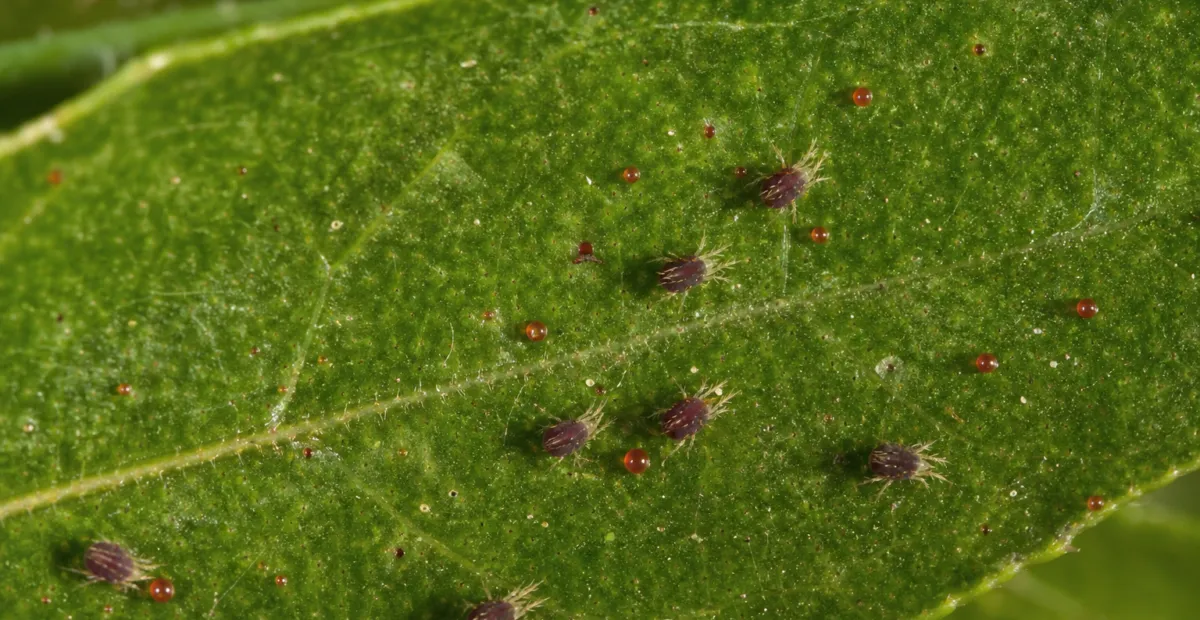
Citrus red mite
Panonychus citriCitrus red mite overview
The citrus red mite, Panonychus citri, is a tiny reddish spider mite associated primarily with citrus but reported from a broader range of woody plants. Feeding produces pale stippling on the upper leaf surface, which may progress to bronzing, dry necrotic patches, leaf drop and twig dieback. Hot, dry weather and water stress increase risk, while predatory mites and careful IPM often keep populations below damaging levels.
Typical conditions
Overview
The citrus red mite is a minute tetranychid spider mite that feeds mainly on the upper surfaces of mature or fully expanded young citrus leaves. Females are oval, deep red to reddish purple and about 0.4–0.5 mm long, with pale setae arising from prominent dorsal tubercles. Eggs are round, red and often have a conspicuous upright stalk.
It is economically most important on citrus, especially lemon and grapefruit, followed by orange and mandarin. Records also exist from pear, almond, grape, castor bean, palms, broadleaf ornamentals and evergreen shrubs, but host suitability and damage can vary among mite populations. Other mites can cause similar symptoms, so identification should be checked with a hand lens or microscope.
Symptoms and identification
Early feeding appears as fine pale stippling or bleaching, usually most visible on the upper leaf surface. As injury increases, leaves may bronze, develop dry tan or brown necrotic areas, and drop prematurely. Severe infestations can contribute to twig dieback and reduced tree vigor.
Green fruit may show pale stippling or silvering. This discoloration often becomes less obvious as fruit colors, although injury on nearly mature fruit may persist. Hot, dry winds can intensify foliage injury and may cause leaf drop even when mite numbers are not extremely high.
Look closely for reddish mites, red eggs and sometimes fine webbing. Distinguish this pest from citrus rust mites, twospotted spider mites and other tetranychids by examining mite body shape, color, dorsal bristles, eggs and feeding location.
Causes and spread
Outbreaks develop when warm, dry conditions coincide with tender or fully expanded citrus foliage, inadequate irrigation, dusty leaves or loss of natural enemies. Mites can spread within a tree by crawling and wind-assisted movement, and they may be moved between plants on infested nursery stock, foliage, tools or workers.
Repeated use of nonselective insecticides—including some pyrethroids, organophosphates, carbamates and neonicotinoids—can remove biological control and favor mite resurgence. Nearby infested citrus or susceptible ornamentals may also contribute to reinfestation.
Life cycle and persistence
Eggs are deposited on both sides of leaves and hatch into six-legged larvae. The mite then passes through protonymph and deutonymph stages before becoming an adult. Under warm conditions, the egg-to-egg generation can be as short as about 12 days, allowing populations to increase rapidly.
Females may lay approximately 20–50 eggs over their reproductive period, commonly depositing two or three per day. Seasonal activity depends on temperature, humidity, host growth and region. In mild climates mites may remain active on trees; in colder areas they may persist on protected plant surfaces or alternate hosts.
Treatment and control
Confirm active mites before treatment by tapping leaves over white paper or examining several leaves with a hand lens. Spot-treat localized infestations when practical and reassess after treatment. Thorough coverage is important because mites and eggs occur on leaf surfaces; follow the label for spray volume, temperature limits and crop safety.
For valuable citrus, treatment is generally justified only when mite numbers are increasing, natural enemies are insufficient and the crop or tree is at meaningful risk. Healthy, well-irrigated citrus can tolerate considerably more mites than drought-stressed trees. If a pesticide is required, choose a legally labeled, selective miticide or horticultural oil where appropriate, protect beneficials, and rotate effective modes of action.
Do not combine or closely sequence sulfur and oil unless the current labels specifically allow it; many citrus labels require a separation interval. Never spray drought-stressed foliage, during excessive heat or outside the product label.
Low-impact and biological control
Begin with irrigation and habitat-based IPM. Keep citrus trees evenly watered according to soil, weather and root-zone conditions, and reduce dust on foliage and orchard roads. Avoid unnecessary broad-spectrum insecticides, which can destroy predatory mites and trigger secondary mite outbreaks.
Conserve naturally occurring predatory mites and insects. Inspect leaves for pear-shaped, translucent predatory mites, sixspotted thrips and mite-destroyer lady beetles before deciding to spray. On organically managed citrus, properly timed horticultural or petroleum oil products may be used where the product label permits. Apply only under label conditions and avoid heat, drought stress and incompatible sulfur-oil intervals.
Prevention
- Inspect new citrus and ornamental plants before bringing them indoors or planting them near established trees.
- Check upper leaf surfaces with a 10× hand lens, particularly during spring and late summer through early fall.
- Maintain consistent irrigation and mulch the root zone without piling mulch against the trunk.
- Limit dust and avoid unnecessary insecticide applications that harm predatory mites.
- Remove heavily infested fallen leaves when practical, but prioritize correction of drought stress and preservation of biological control.
- Record mite and predator counts over time rather than treating from symptoms alone.
Interesting facts
- Females are generally larger and more globular than males, while males have a smaller body and tapered abdomen.
- The pest has been reported from more than 100 plant species, but citrus is its principal agricultural host in the United States.
- Some citrus cultivars and rootstock combinations support faster mite development than others; California research has identified Troyer citrange as relatively susceptible.
- Predatory mites, especially Euseius species in California citrus, can suppress immature citrus red mites before outbreaks become severe.
- Very hot temperatures above about 90°F and low humidity can reduce mite survival, although heat and drought may simultaneously make plant injury more severe.
Use only pesticide products legally authorized in the United States for the specific crop, site and pest. Always follow the current product label, including rate, timing, personal protective equipment, reentry interval, preharvest interval and restrictions concerning oil, sulfur, heat and beneficial arthropods. Prefer selective products when treatment is justified, rotate modes of action to reduce resistance risk, and avoid broad-spectrum sprays that can disrupt predatory mites.
Affected plants
The plants below are linked to this problem by structured host-plant data. The list updates automatically as new plant profiles are added.
 Papaya (Carica papaya) care guideCarica papaya
 Silver maple (Acer saccharinum) care guideAcer saccharinum
 Pink Banana (Musa velutina) care guideMusa velutina
 Cassava (Manihot esculenta) care guideManihot esculenta
 Crested Coelogyne (Coelogyne cristata) care guideCoelogyne cristata
 Paphiopedilum ‘Maudiae’Paphiopedilum 'Maudiae'
 Penstemon ‘Stapleford Gem’Penstemon 'Stapleford Gem'
 Rainer’s Bellflower (Campanula raineri) care guideCampanula raineri
 Canna ‘Erebus’Canna 'Erebus'
 Canna ‘Stuttgart’Canna 'Stuttgart'
 Electric Pink (Cordyline australis ‘Electric Pink’)Cordyline australis 'Electric Pink'
 Pink Passion (Cordyline australis ‘Pink Passion’)Cordyline australis 'Pink Passion'