
English Grain Aphid
Sitobion avenae (Fabricius)English Grain Aphid overview
The English grain aphid, Sitobion avenae, is a phloem-feeding pest of wheat and other small grains. Colonies may develop on leaves, stems, and especially wheat heads, producing honeydew and sometimes causing premature yellowing, reduced grain filling, or harvest contamination. It can also transmit Barley yellow dwarf virus, so monitoring should continue even when direct feeding injury appears limited.
Typical conditions
Overview
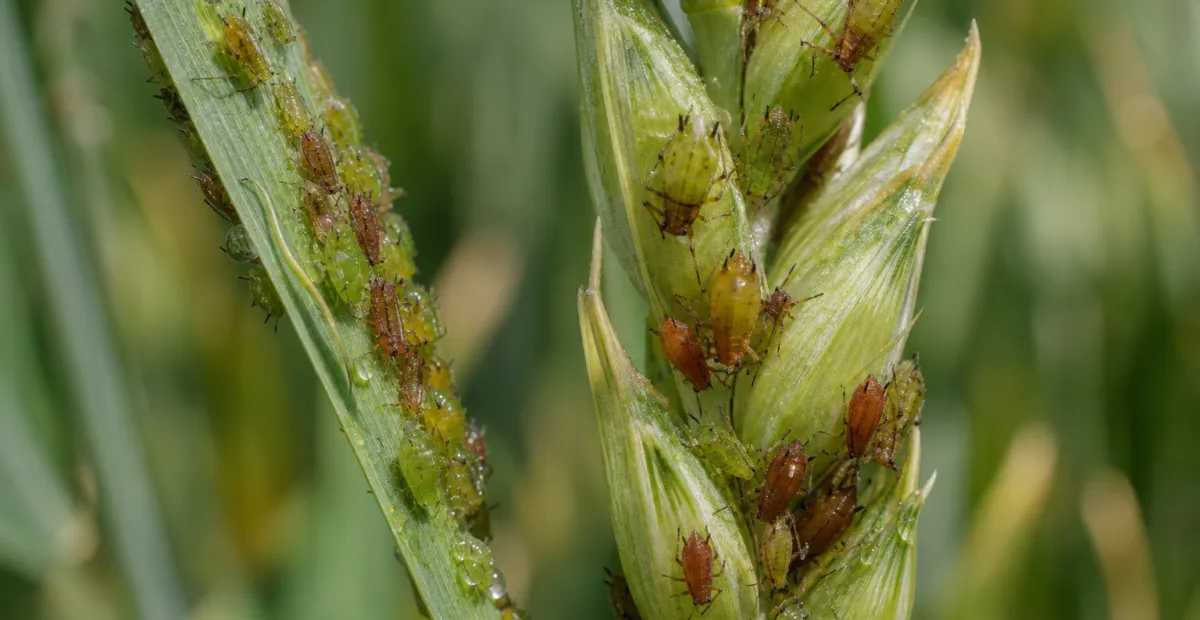
Sitobion avenae, commonly called the English grain aphid or grain aphid, is an aphid in the family Aphididae. Adults and nymphs are usually yellow-green, reddish brown, or darker, with long antennae and dark cornicles at the rear of the abdomen. Winged forms are responsible for much of the movement between fields.
In the United States, this pest is primarily associated with small grains. It may be found on leaves and stems of barley and oats, while in wheat it commonly concentrates in the heads. Low to moderate populations are often tolerated, but heavy infestations can cause direct feeding injury and increase the risk of virus transmission.
Symptoms and identification
- Clusters of yellow-green to reddish-brown aphids on cereal leaves, stems, or wheat heads.
- Sticky honeydew on foliage and heads, sometimes followed by dark sooty mold.
- Yellowing, premature senescence, reduced vigor, or poor grain filling when populations are high.
- In wheat, dense colonies may occur between spikelets and around developing kernels.
- Barley yellow dwarf virus may cause yellowing, reddening, stunting, and uneven crop growth; these symptoms cannot be diagnosed from aphid presence alone.
Distinguish this species from bird cherry-oat aphid and rose-grass aphid by examining body color, cornicle and leg markings, body shape, and colony location. A regional aphid identification key or diagnostic laboratory may be needed for confirmation.
Causes and spread
The aphid feeds with piercing-sucking mouthparts and removes phloem sap. Populations increase rapidly when cereal plants are actively growing and weather is mild, dry, and settled. Winged females disperse from crowded or deteriorating plants into new cereal stands. Wind-assisted movement, volunteer cereals, grassy field edges, and overlapping plantings can maintain local populations.
Sitobion avenae is not dependent on a woody alternate host; it can complete its cycle on cereals and grasses. It can transmit Barley yellow dwarf virus, although virus transmission depends on aphid acquisition, retention, and plant susceptibility rather than simply on the presence of aphids.
Life cycle and persistence
The species has a flexible life cycle that varies with clone, latitude, winter severity, and host condition. During much of the growing season, females reproduce parthenogenetically and give birth to live nymphs. Nymphs pass through four molts before becoming wingless or winged adults.
In colder regions, some populations produce sexual forms in autumn and overwinter as eggs on grasses or cereal plants. In milder regions, parthenogenetic females may survive on living cereals or grasses. Spring and summer generations can build on grasses and small grains, followed by production of winged migrants when crowding, plant aging, or declining host quality occurs.
Treatment and control
Begin with representative scouting rather than spot-checking only the most visibly infested plants. Count aphids on leaves and heads across the field and record beneficial insects and parasitized aphids. Treatment is most justified when populations are increasing, natural enemies are insufficient, crop value is at risk, or a locally validated economic threshold has been reached.
For small grains, preserve natural enemies whenever possible and avoid unnecessary rescue treatments late in crop development. If intervention is warranted, use a product and application method specifically registered for the crop and pest in the United States, and follow the current label for rate, timing, pollinator precautions, preharvest interval, worker protection, and resistance-management requirements.
Low-impact and biological control
- Conserve naturally occurring predators such as lady beetles, lacewing larvae, syrphid larvae, and predatory bugs.
- Protect aphid parasitoids, including cereal-aphid parasitoids that produce brown, swollen aphid mummies.
- Maintain flowering resources near, but not in competition with, the crop to support adult parasitoids and other beneficial insects.
- Use a strong spray of water on small, accessible plantings when practical, directing the spray at colonies on leaves and stems.
- For certified organic production, select only inputs permitted by the applicable organic standard and legally registered for the crop and use site. Botanical or microbial products should not be assumed effective without crop-specific evidence.
Prevention
- Scout wheat, barley, oats, and other small grains from tillering through heading and grain fill, with particular attention to wheat heads.
- Inspect volunteer wheat, grassy weeds, field margins, and newly emerged winter cereals because they can support early colonies.
- Use locally appropriate planting dates, balanced fertility, and varieties with good adaptation so plants are not unnecessarily stressed or delayed.
- Avoid routine broad-spectrum insecticide applications that destroy parasitoids, lady beetles, lacewings, syrphid larvae, and other aphid predators.
- Use regional extension thresholds and crop-specific scouting guidance rather than treating solely because a few aphids are present.
- Remove or manage volunteer cereals when agronomically appropriate, while considering erosion control and conservation requirements.
Interesting facts
- The former name Macrosiphum avenae appears in some older US references; the currently used name is Sitobion avenae.
- The species can occur in both winged and wingless forms, allowing rapid reproduction as well as long-distance dispersal.
- In wheat, the head is often a more important feeding site than the leaf, so scouting only lower foliage can underestimate risk.
- Honeydew production is especially noticeable when aphids are concentrated around heads, but claims that it routinely clogs harvesting equipment are not consistently confirmed.
- Host use and overwintering behavior vary geographically, so regional extension observations are more useful than applying one fixed calendar to every US location.
Use chemical control only when monitoring shows that intervention is justified and only with a pesticide legally authorized for English grain aphid on the specific crop and use site in the United States. Always follow the current EPA-approved label and state requirements; the label is the legal document governing rate, timing, application, harvest interval, protective equipment, and environmental precautions. Rotate effective modes of action where labels permit and avoid repeated use of the same mode of action because resistance has been documented in cereal aphids in some production regions.