Shallow Bark Canker of Walnut
Brenneria nigrifluensShallow Bark Canker of Walnut overview
Shallow bark canker is a bacterial disease associated primarily with English walnut, caused by Brenneria nigrifluens. It produces scattered brown-to-black bark spots, shallow necrotic lesions, and occasional dark, tar-like ooze on trunks and scaffold limbs. In the United States, the disease is usually considered minor, but stressed trees may show more extensive bark injury and can be confused with deep bark canker or other bleeding cankers.
Typical conditions
Overview
Shallow bark canker is caused by the gram-negative bacterium Brenneria nigrifluens, formerly known as Erwinia nigrifluens. In the United States it is chiefly documented on English walnut (Juglans regia) and is most often observed on trunks and major scaffold limbs.
The disease remains primarily in the outer bark and usually has limited effect on tree health or yield. Its symptoms can resemble deep bark canker, other bacterial cankers, sunscald, mechanical injury, or wetwood, so laboratory confirmation may be needed when diagnosis affects major management decisions.
Symptoms and identification
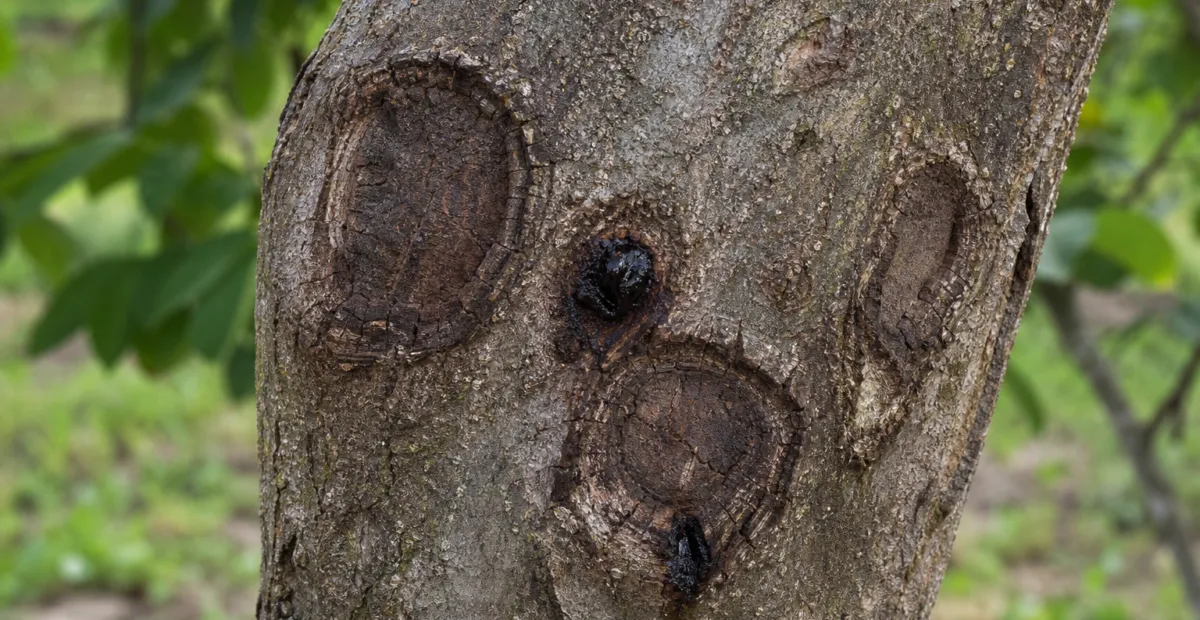
- Scattered round or irregular brown-to-black spots on the trunk or lower scaffold limbs.
- Water-soaked margins may surround newly affected areas.
- Small black droplets or dark, tar-like bacterial exudate may ooze from the bark and later dry.
- Removing loose outer bark can reveal shallow dark-brown tissue, sometimes with longitudinal streaking.
- Unlike deep bark canker, lesions usually do not extend deeply into the inner bark, although localized phloem injury can occur.
Extensive crown dieback is not typical of the disease in its usual US presentation. Trees with severe decline, deep discolored wood, or multiple bleeding sites should be evaluated for other diseases and abiotic stresses.
Causes and spread
The bacterium survives in affected bark and can be present in exudates. The natural infection route and the main means of field dissemination are not fully established. Infection has sometimes been associated with bark injuries, including bird damage, but obvious wounds are often absent.
Low tree vigor, drought or inadequate soil moisture, poor soil conditions, mechanical injury, and other stresses appear to favor symptom development. Bacterial movement may occur through contaminated tools, wound contact, or rain and surface water, but the relative importance of these routes for B. nigrifluens is uncertain.
Life cycle and persistence
The disease cycle is incompletely understood. The bacterium can persist in cankered bark and emerge in dark exudates when conditions are favorable. New symptoms are commonly noticed from late spring through fall, but the exact timing varies with host stress, temperature, moisture, and local climate.
Unlike many foliar pathogens, there is no well-defined, validated infection calendar or documented series of repeated infection cycles for this disease. Some Brenneria species may persist quiescently in tree tissues before symptoms become apparent, so visible ooze does not necessarily indicate a recent infection.
Treatment and control
There is no consistently proven curative treatment program for shallow bark canker. In most US situations, management is supportive rather than chemical: correct drought, soil, drainage, nutrition, or structural problems and minimize new wounds.
Because the disease is usually superficial and not economically serious, routine canker removal is generally not justified and may create larger wounds or entry points for other pathogens. If loose dead bark is removed for inspection or safety, cut only clearly dead, detached material with clean tools and avoid enlarging the wound into healthy trunk tissue. Confirm the diagnosis before removing major scaffold limbs or declining trees.
Low-impact and biological control
Use nonchemical integrated practices: maintain adequate soil moisture, improve root-zone conditions, protect bark from injury, prune selectively in dry weather, and sanitize tools between visibly diseased trees. Remove and dispose of severely declining woody material when warranted for safety or sanitation, while avoiding unnecessary stripping of superficial lesions.
No biological-control product or home organic treatment has been reliably demonstrated to eradicate B. nigrifluens in walnut. Copper, essential-oil, vinegar, bleach, and similar home remedies can injure bark and should not be applied to trees without a legally appropriate, crop-specific label.
Prevention
- Maintain consistent irrigation during drought, especially for young trees and walnut orchards on shallow or poor soils.
- Improve soil structure, drainage, root-zone aeration, and mulch management without piling mulch against the trunk.
- Prevent mower, string-trimmer, vehicle, staking, and pruning injuries.
- Prune during dry weather with properly cleaned and disinfected tools; avoid unnecessary cuts into trunk and scaffold bark.
- Remove dead or hazardous limbs for structural reasons, but do not routinely excise superficial cankers solely to eliminate this disease.
- Monitor stressed trees and investigate symptoms that extend into the inner bark or are accompanied by rapid dieback.
Interesting facts
- The species name nigrifluens refers to dark or black flowing exudate, one of the disease's characteristic signs.
- B. nigrifluens causes shallow bark canker, whereas the related B. rubrifaciens causes deep bark canker of walnut.
- Most walnut cultivars can be affected, but disease expression is strongly influenced by tree vigor and environment.
- Reports from outside the United States have associated the bacterium with additional woody hosts, including horse chestnut, but host susceptibility and pathogenic importance are not equally established for all reports.
No pesticide program is recommended for routine management of this usually minor bacterial canker. Use only products legally authorized for walnut and this specific problem in the United States, and follow the current product label exactly. A local extension specialist or certified arborist should be consulted before any trunk treatment or major pruning decision.
Affected plants
The plants below are linked to this problem by structured host-plant data. The list updates automatically as new plant profiles are added.