
Rhododendron–Spruce Needle Rust
Chrysomyxa rhododendri (DC.) de BaryRhododendron–Spruce Needle Rust overview
Rhododendron–spruce needle rust is a specialized rust disease caused by the fungus Chrysomyxa rhododendri. It alternates between rhododendron leaves and young spruce needles, producing orange to reddish spore pustules on rhododendron and yellowed, weakened or prematurely shed needles on spruce. The disease is most important where susceptible hosts grow close together in cool, humid mountain or northern climates.
Typical conditions
Overview
Chrysomyxa rhododendri is a rust fungus in the order Pucciniales. The disease is known as rhododendron–spruce needle rust, spruce needle rust, or rhododendron rust in different references. In the United States, identification should be confirmed carefully because several related Chrysomyxa species and former varieties have overlapping host and symptom descriptions.
The fungus alternates between Rhododendron and Picea. Rhododendron infections may be conspicuous but often cause limited long-term injury, whereas repeated infections on young spruce foliage can cause needle death, premature needle drop, reduced growth and, in severe forest situations, substantial crown thinning.
Symptoms and identification
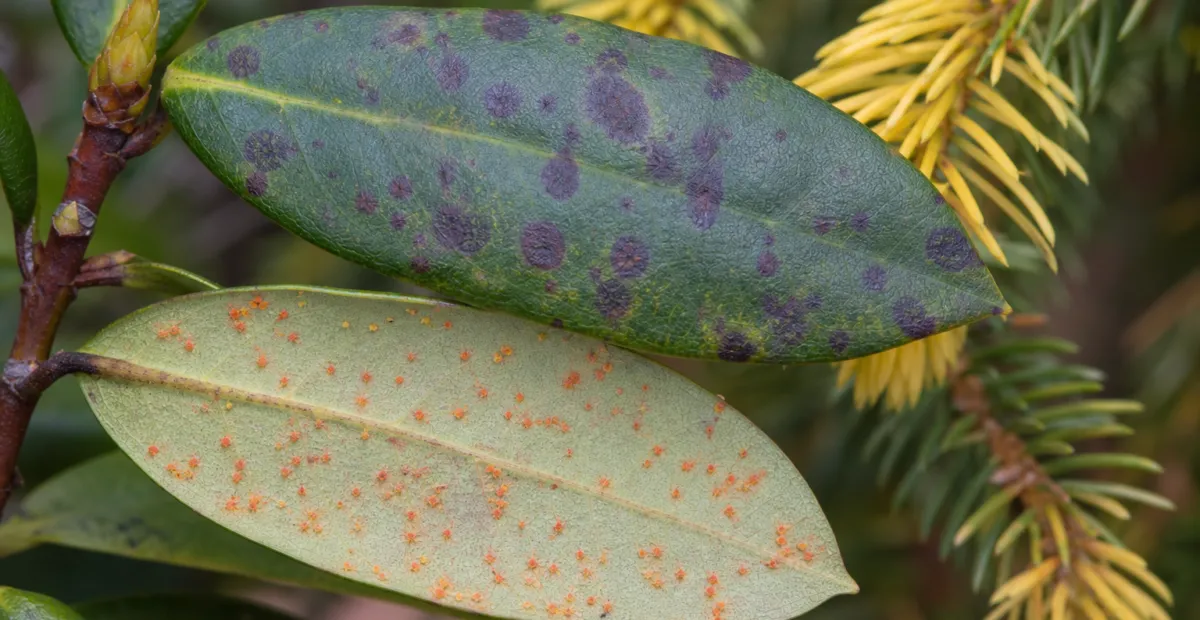
- Rhododendron: small reddish, dark-red or brownish leaf spots may develop, with orange-yellow to reddish uredinia or other spore-producing cushions mainly on the lower leaf surface.
- Spruce: newly emerged needles develop yellow zones, bands or general chlorosis. Later, pale yellow to whitish, tooth-like or columnar telial structures may form along the inner side of needles.
- Infected spruce needles may die and drop early. Symptoms are most noticeable on current-year foliage and can be unevenly distributed within the crown.
Rust pustules, host association and microscopic examination are more reliable for diagnosis than yellowing alone, which can also result from drought, nutrient stress, mites or other needle diseases.
Causes and spread
The disease is caused by the obligate rust fungus Chrysomyxa rhododendri. It spreads when spores produced on one host are carried by air to susceptible tissues of the other host. Short distances between infected rhododendrons and spruces increase the likelihood of repeated local infection, although wind can transport spores farther.
Newly expanding spruce needles are particularly vulnerable. Moisture from rain, fog, dew or prolonged high humidity allows spores to germinate and infect. The disease is favored by cool conditions, dense plantings, poor airflow and the presence of both compatible host plants within the same landscape or nearby natural vegetation.
Life cycle and persistence
This rust has a two-host, seasonal cycle. It survives the unfavorable season primarily in infected or dormant rhododendron tissues. In spring, dark reddish spore cushions or related rust structures on rhododendron leaves release spores that infect susceptible, newly expanding spruce needles.
During summer, infected spruce needles develop yellowed areas and later produce pale yellow to whitish telial structures. Spores from these structures infect rhododendron leaves and young shoots later in the season, where the fungus establishes the stage that persists into the next season. The exact timing varies with elevation, climate, host species and local weather.
Treatment and control
There is no curative treatment that removes the fungus from already infected needles. On landscape plants, begin with sanitation and host-management measures: remove badly infected rhododendron leaves when feasible, prune only dead or heavily affected spruce shoots where this can be done without disfiguring the plant, and dispose of diseased debris.
Protective fungicides may be considered for high-value plants when disease pressure is recurring, but timing is critical because applications must protect susceptible newly expanding tissue before infection. Treatment decisions should be based on a confirmed diagnosis, local extension advice and the product label. Large or repeatedly damaged spruces should be evaluated by a certified arborist or plant diagnostic laboratory.
Low-impact and biological control
Organic management is primarily preventive and cultural. Increase spacing and airflow, avoid overhead irrigation, remove heavily affected leaves and fallen debris, and reduce contact between compatible rhododendron and spruce hosts. Monitor newly expanding spruce needles and rhododendron foliage after cool, wet periods.
No universally reliable organic product should be assumed to eradicate this rust. Products marketed for disease suppression may provide inconsistent results and must be specifically labeled for the crop, site and disease in the United States.
Prevention
- Do not plant susceptible rhododendrons immediately beside valuable spruce specimens where the disease is established.
- Favor open spacing and pruning that improves air movement without excessively thinning or stressing the plants.
- Water the root zone rather than wetting foliage, and irrigate early enough for foliage to dry quickly.
- Inspect rhododendrons and spruces before purchase, especially in regions where the disease has been reported.
- Remove and discard heavily infected fallen foliage where practical, particularly around high-value nursery or specimen plants. Do not compost visibly diseased material unless the composting system reliably reaches pathogen-killing temperatures.
- Choose locally adapted cultivars and spruce species or provenances with lower observed susceptibility when planting in a disease-prone site.
Interesting facts
- Chrysomyxa rhododendri was historically treated in some literature as Chrysomyxa ledi var. rhododendri; modern taxonomic treatments recognize it as a separate species in relevant host and geographic contexts.
- The fungus is biologically dependent on two unlike host groups, so removing or separating one compatible host can reduce local disease cycling, although this is not always practical in natural or large planted landscapes.
- Reports from North America require careful interpretation because closely related rusts on native Ericaceae and spruces may have different host specificities.
- In severe outbreaks, repeated loss of spruce needles can reduce growth and cause conspicuous crown thinning, while rhododendron symptoms may remain comparatively localized.
Use only fungicides legally authorized in the United States for the specific crop, site and rust disease, and follow the current product label exactly, including personal-protection, reentry, preharvest and environmental restrictions. Do not apply a pesticide solely from a visual diagnosis; confirm the disease and consult state Cooperative Extension recommendations before treating ornamental plants or forest trees.