
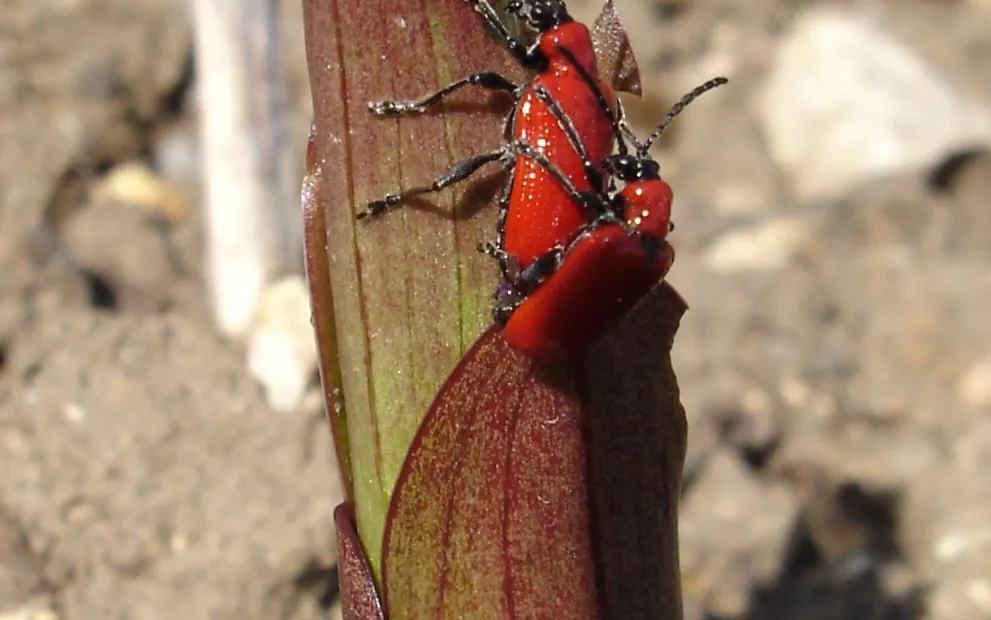
 Source:
 Lily Leaf Beetle (Scarlet Lily Beetle)
Lilioceris liliiLily Leaf Beetle (Scarlet Lily Beetle) overview
Lily leaf beetle, also called scarlet lily beetle, is an invasive leaf-chewing pest of true lilies and fritillaries in the United States. Bright red adults and frass-covered larvae can rapidly skeletonize leaves, damage stems and flower buds, and reduce flowering or plant vigor. Regular scouting, hand removal, sanitation, and regionally appropriate biological control are central to integrated management.
Typical conditions
Overview
Lily leaf beetle, also known as scarlet lily beetle, is a small, bright red leaf beetle in the family Chrysomelidae. Adults and larvae feed on leaves, stems, flower buds and, occasionally, flowers of true lilies (Lilium) and fritillaries (Fritillaria).
The pest is not a problem of daylilies (Hemerocallis). Adult beetles are typically about 1/4 to 3/8 inch long, with red wing covers and a darker head, legs and underside. Larvae are soft-bodied and often conceal themselves beneath a conspicuous coating of their own excrement.
Host range and regional importance are not identical everywhere. Lilium and Fritillaria are the best-supported primary hosts, while additional Liliaceae records may represent localized feeding or host suitability that differs among beetle populations.
Symptoms and identification
- Adults chew elongated holes and notches in young and mature leaves.
- Larvae often remove the leaf surface and leave skeletonized or ragged foliage.
- Feeding may occur on stems, developing buds and flowers, causing distorted or destroyed blooms.
- Heavy infestations can defoliate plants, reduce flowering and weaken bulbs over repeated seasons.
- Orange or reddish egg rows may be found on the undersides of leaves.
- Larvae are frequently recognized by their dark, wet-looking fecal shield, which can make them resemble bits of soil or debris.
Causes and spread
Damage is caused by chewing adults and larvae, not by a pathogen. Adults overwinter in soil, leaf litter, garden debris or other protected sites, then move to emerging lilies in spring. Females lay eggs on the undersides of host leaves. Larvae feed openly on the plant before dropping to the soil to pupate.
Local spread occurs through adult flight and movement between nearby lily plantings. Long-distance spread can occur when infested bulbs, nursery stock, containers or other host plant material are transported. The pest is especially difficult to contain where susceptible lilies are grown continuously in connected landscapes.
Life cycle and persistence
Lily leaf beetle normally has one generation per year in the United States, although timing varies with climate. Overwintered adults emerge in spring as lilies break dormancy and begin feeding soon after shoots appear. Females deposit clusters of eggs on leaf undersides.
Larvae pass through several feeding stages over roughly two weeks, with the later stages responsible for substantial defoliation. Mature larvae drop to the ground, form a cocoon or pupal chamber in the soil, and adults generally emerge after about two to four weeks. New adults feed through summer and then seek protected overwintering sites. Monitor from spring emergence through late summer because adults, eggs and larvae may overlap.
Treatment and control
Begin control as soon as adults or fresh feeding are found. Hand-pick adults, larvae and egg masses during regular inspections. Adults may drop or turn away when disturbed, so hold a container of soapy water beneath the foliage. Crush or remove egg rows from leaf undersides before they hatch.
For larger plantings, use an integrated approach: monitor population levels, target the most vulnerable early larval stages, and protect beneficial organisms. If foliage is heavily damaged, maintain adequate water and suitable fertility without forcing soft, excessive growth; healthy bulbs may produce new foliage, but severe repeated defoliation can reduce future flowering.
In areas where approved biological-control releases have established, parasitoid wasps can contribute to long-term suppression, although results are gradual and uneven. Coordinate releases or monitoring with a state university Extension or biological-control program rather than releasing unverified organisms.
Low-impact and biological control
- Hand-picking is effective in small beds and avoids harm to pollinators and natural enemies.
- Remove egg masses and frass-covered larvae before larvae mature and enter the soil.
- Use a strong water spray to dislodge exposed larvae, then collect and destroy them; repeat monitoring because this is not a stand-alone treatment.
- Support established parasitoids by minimizing unnecessary broad-spectrum sprays and retaining nearby nectar resources.
- Do not assume that a product labeled organic is harmless to bees, parasitoid wasps or other beneficial arthropods; read the label and apply only when monitoring justifies treatment.
Prevention
- Inspect lilies at least weekly from shoot emergence through summer, checking both leaf surfaces and leaf undersides.
- Remove adults, egg masses and larvae by hand whenever practical; drop insects into soapy water rather than onto the soil.
- Remove heavily infested leaves and spent plant debris after confirming that doing so will not excessively weaken the bulb.
- Do not move lilies, bulbs, divisions or potted plants from infested sites without inspecting them carefully.
- Buy clean, reputable nursery stock and quarantine newly acquired lilies for observation.
- Where lily beetle pressure is consistently severe, consider replacing some highly susceptible plantings with less preferred ornamental choices, while recognizing that susceptibility varies among cultivars and regions.
- Preserve flowering plants and habitat that support parasitoids and other natural enemies, and avoid unnecessary broad-spectrum insecticide use.
Interesting facts
- The species name lilii reflects its strong association with lilies.
- Larvae carry a fecal shield over their bodies, which may deter predators and makes visual detection more difficult.
- Daylilies are not true lilies and are generally not suitable hosts for completing the beetle's life cycle.
- Three European parasitoid wasps—Tetrastichus setifer, Lemophagus errabundus and Diaparsis jucunda—have been released for biological control in parts of the United States.
- Documented susceptibility is broad within Lilium and includes many cultivated hybrids, but host preference and damage severity can vary by cultivar, region and beetle population.
Use chemical treatments only when monitoring shows that damage cannot be managed adequately by hand removal and other IPM measures. In the United States, use only a pesticide legally registered and currently labeled for lily leaf beetle or the specific ornamental crop and site in your state. Follow the current label for crop/site, rate, timing, personal protective equipment, reentry, pollinator precautions and disposal. Products and registrations vary by state and may change; do not use a pesticide on edible crops or ornamentals unless the label specifically permits that use. Treatments directed at young larvae are generally more useful than late applications against fecal-shielded larvae, but product performance and legal options must be verified locally.