European Apple Sawfly
Hoplocampa testudinea (Klug)European Apple Sawfly overview
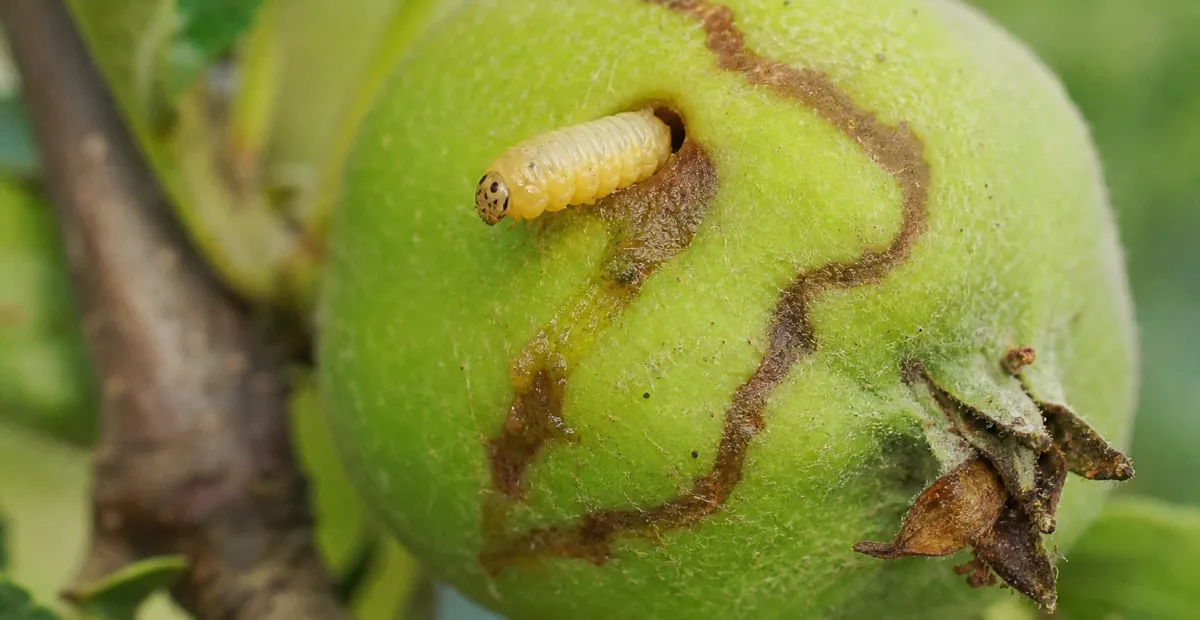
European apple sawfly, Hoplocampa testudinea, is an introduced sawfly pest of apple in parts of the eastern United States. Adults fly and lay eggs during bloom, while larvae tunnel beneath the skin of developing fruitlets. Early injury appears as winding, brown ribbon-like scars; later feeding can reach the core, leave wet frass and exit holes, and cause fruit to drop during June drop.
Typical conditions
Overview
European apple sawfly is a small wasp-like insect in the sawfly family Tenthredinidae. The adult flight period coincides with apple bloom. Females insert eggs near the base of flowers, and the larvae feed within developing fruitlets. This pest should not be confused with codling moth, whose damage generally appears later and produces a different type of fruit injury.
In the United States, documented concern is concentrated in eastern apple-growing regions, including Pennsylvania and neighboring mid-Atlantic areas. Distribution and local abundance should be confirmed through state extension or plant-health authorities.
Symptoms and identification
- Early larval feeding produces a narrow, brown, winding or ribbon-like scar beneath the fruit skin, often spiraling from the calyx end.
- As larvae mature, they may tunnel toward the seed cavity or move into an adjacent fruitlet.
- Later injury can include a small exit hole, wet frass and internal feeding around the core.
- Heavily injured fruitlets commonly abort and fall during the June drop period.
- Fruit that remains on the tree may be misshapen, scarred or downgraded at harvest.
Causes and spread
Damage is caused by larval feeding, not by a plant pathogen. Adults emerge from soil beneath or near infested apple trees and lay eggs during bloom. Infested fruitlets that fall to the ground can release mature larvae, which enter the soil and form overwintering cocoons. Movement of infested nursery stock, soil or fruit is a potential pathway, although local spread is primarily associated with the soil-resident stage and adult flight.
Life cycle and persistence
- Larvae complete development inside young apple fruitlets in late spring.
- Mature larvae leave the fruit, enter the soil and form cocoons, commonly within the upper several inches.
- The insect overwinters mainly as a mature larva, prepupa or pupa. Extended diapause can delay adult emergence for two or more years in some populations.
- Adults emerge in spring, usually around the pink-bud to bloom period.
- Females lay eggs at the calyx or receptacle end of apple flowers. Larvae hatch during or shortly after bloom and feed for several weeks.
- There is normally one generation per year, but not every soil-resident individual emerges annually.
Treatment and control
Management is most effective during the short adult and egg-laying window around bloom, before larvae are protected inside fruitlets. Confirm the pest with trap captures and characteristic scars before taking action. In small plantings, hand removal and disposal of damaged fruitlets can reduce the number of larvae returning to the soil. In commercial orchards, coordinate any intervention with local extension recommendations, bloom timing, pollinator protection requirements and the orchard’s broader plum curculio and fruit-insect program.
Once larvae are inside fruitlets, contact treatments are less reliable. Repeatedly infested blocks may benefit from long-term monitoring and targeted management rather than calendar applications.
Low-impact and biological control
- Use white sticky traps for monitoring and mass trapping only where suitable trap density and local experience support the approach.
- Collect and destroy infested dropped fruitlets before larvae enter the soil.
- Use orchard-floor sanitation and appropriate cultivation or soil disturbance cautiously, recognizing that excessive disturbance can harm roots, beneficial organisms and soil structure.
- Conserve naturally occurring parasitoids and other beneficial arthropods by avoiding unnecessary broad-spectrum insecticide use. The parasitoid fauna and effectiveness of biological control vary by region.
- Entomopathogenic nematodes and introduced parasitoids have been investigated, but performance and availability are not sufficiently consistent to present them as a universal home-orchard solution.
Prevention
- Inspect fruitlets from bloom through early June for ribbon scars, exit holes and frass.
- Use white sticky traps during the pink-bud through post-bloom period to detect adult activity; inspect traps frequently and relate captures to bloom stage.
- Remove and destroy dropped or visibly infested fruitlets before larvae exit and enter the soil. Do not leave cull fruit beneath trees.
- Maintain records by block, cultivar and bloom date so recurring hotspots can be treated as targeted IPM zones.
- Source clean, inspected nursery trees and avoid moving soil from infested orchard areas.
- Where practical, consider cultivar or rootstock differences as a risk-management factor, but do not assume any apple cultivar is immune.
Interesting facts
- Although the adult resembles a small wasp, sawflies are not true flies; they are hymenopterans related to bees and wasps.
- The characteristic superficial scar is produced by the first feeding stage beneath the fruit skin.
- A larva may leave one fruitlet and enter another, increasing injury within a blossom cluster.
- Most of the insect’s life is spent underground, leaving only a short period when adults and exposed larvae can be effectively monitored.
- Reliable host documentation centers on cultivated apple, Malus domestica; broad claims that this species commonly attacks unrelated fruit trees should be treated cautiously.
Use insecticides only when monitoring and regional recommendations indicate that treatment is justified. Choose only products legally authorized and currently labeled for European apple sawfly or the applicable apple-fruit insect use in your state and country. Follow the current label exactly, including crop, timing, rate, reentry interval, preharvest interval, resistance-management, bee-protection and environmental precautions. Do not spray open apple bloom when bees are foraging unless the label specifically permits it and all pollinator restrictions are met.
Affected plants
The plants below are linked to this problem by structured host-plant data. The list updates automatically as new plant profiles are added.