
Cucurbit Downy Mildew
Pseudoperonospora cubensis (Berk. & M.A. Curtis) RostovzevCucurbit Downy Mildew overview
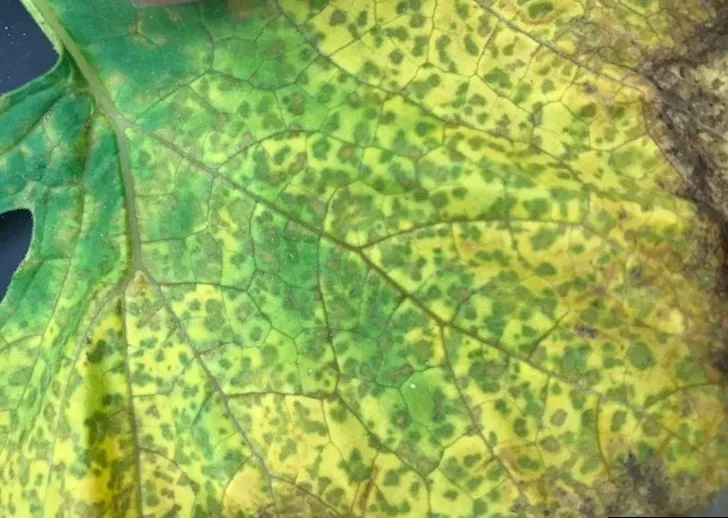
Cucurbit downy mildew is a rapidly developing foliar disease caused by the oomycete Pseudoperonospora cubensis. It produces pale yellow to brown, angular leaf spots that are often bounded by veins, followed by gray to purplish sporulation on the leaf underside during humid or wet conditions. Severe infections can defoliate cucumber, melon, squash, pumpkin and watermelon plants, reducing yield and fruit quality.
Typical conditions
Overview
Cucurbit downy mildew affects many cultivated and wild cucurbits, but cucumber and melons are often especially vulnerable. The causal organism is an oomycete, sometimes called a water mold, rather than a true fungus. Disease severity varies with the pathogen population, host species, cultivar resistance and local weather.
In the United States, outbreaks may enter production areas on windborne spores and can intensify quickly once established. Early confirmation is important because symptoms can resemble angular leaf spot, nutrient injury, sunscald or other leaf disorders.
Symptoms and identification
Initial symptoms are small, pale green to yellow spots on older leaves. On cucumber, spots are commonly angular because leaf veins restrict their expansion. Lesions later turn tan or brown, enlarge and merge, producing extensive blighted areas.
During extended dew, rain or high humidity, gray, violet-gray or purplish sporulation may develop on the underside of lesions. Infected leaves may dry, curl upward and fall prematurely. Severe defoliation exposes fruit to sun injury and reduces photosynthetic capacity, yield and market quality.
- Upper leaf surface: angular yellow, pale-green or brown lesions.
- Lower leaf surface: water-soaked areas and downy sporulation when humidity is high.
- Advanced disease: coalescing lesions, rapid browning, leaf curling and defoliation.
Causes and spread
The pathogen produces sporangia and is commonly introduced into new areas by air currents. Rain splash, sprinkler irrigation, wet tools, hands and movement through infected foliage can aid local spread. It requires living host tissue and favorable leaf moisture for infection and sporulation.
Host preference differs among pathogen populations or clades. Some populations preferentially infect cucumber and cantaloupe, while others more readily infect squash, pumpkin or watermelon; therefore, a resistant or unaffected cucurbit nearby does not rule out disease on another species.
Life cycle and persistence
Pseudoperonospora cubensis is an obligate biotroph and normally develops on living cucurbit tissue. Sporangia landing on wet foliage can release motile zoospores or germinate, depending on conditions. The pathogen penetrates through natural openings, grows between leaf cells and forms nutrient-absorbing structures inside host tissue.
Sporangiophores emerge through stomata, usually on the leaf underside, and produce new sporangia. These are moved by wind or water and can initiate repeated secondary infection cycles. The relative importance of sexual oospores remains uncertain in U.S. field conditions: they have been demonstrated under controlled conditions, but field overwintering is not considered a dependable explanation in many U.S. production regions.
Treatment and control
Once widespread symptoms and sporulation are present, cultural measures alone may not stop the epidemic, but they can slow canopy decline. Remove severely affected foliage where feasible, improve airflow, keep irrigation off the leaves and harvest mature fruit promptly.
For commercial or high-value plantings, disease management is most effective when protective applications begin before or very soon after infection risk and are integrated with scouting, resistant varieties and weather-based advisories. Product performance varies by pathogen population and resistance can develop quickly, so treatment decisions should be based on current U.S. extension recommendations for the crop and state.
Do not compost heavily diseased vines unless the composting process is reliably hot and complete. At the end of the season, remove cucurbit residues and volunteer plants that could provide living tissue for continued disease development.
Low-impact and biological control
There is no consistently reliable organic treatment that eradicates established cucurbit downy mildew. The most useful nonchemical measures are resistant or moderately resistant cultivars, drip irrigation, trellising, wider spacing, removal of infected tissue and vigilant scouting.
In certified-organic production, use only disease-control products approved for organic production and legally registered for the specific crop and disease in the United States. Such products are generally preventive and must be applied before disease becomes extensive; they should supplement, not replace, sanitation and canopy management.
Prevention
Use an integrated prevention program:
- Choose cucumber, melon, squash, pumpkin or watermelon cultivars with the best locally available downy mildew resistance, recognizing that resistance may be incomplete or population-specific.
- Monitor susceptible cucurbits at least weekly, giving special attention to older leaves and leaf undersides during humid weather and late-season risk periods.
- Use drip or furrow irrigation where practical and avoid routinely wetting foliage with sprinklers.
- Space and trellis plants to improve air movement and speed leaf drying.
- Remove heavily infected leaves or plants when practical, bagging diseased material rather than moving it through the garden.
- Control volunteer cucurbits and investigate nearby wild or weedy cucurbits that may maintain inoculum.
- Use regional university or extension disease-alert systems when available, because windborne arrival can precede visible symptoms.
Interesting facts
- The pathogen is an oomycete, not a true fungus, despite the disease’s common use of the word mildew.
- It is an obligate biotroph, meaning it depends primarily on living host tissue for growth.
- Approximately 60 cucurbit species have been reported as hosts, although practical susceptibility varies by pathogen population and host genotype.
- Two broad host-adapted pathogen clades are widely discussed in U.S. cucurbit pathology: one associated more strongly with cucumber and cantaloupe, and another with squash, pumpkin and watermelon.
- Under humid conditions, sporulation may be visible on the leaf underside before the foliage is completely blighted.
Use only products legally authorized in the United States for cucurbit downy mildew on the specific crop and in the state where treatment occurs. Follow the current EPA-approved label, crop restrictions, preharvest interval, personal-protective-equipment requirements and application directions; the label is the law. Because Pseudoperonospora cubensis populations can differ in sensitivity, do not rely repeatedly on one mode of action, and consult current state university extension guidance for resistance-management recommendations.
Affected plants
The plants below are linked to this problem by structured host-plant data. The list updates automatically as new plant profiles are added.
 Benincasa fistulosa care guideBenincasa fistulosa
 White gourd (Benincasa hispida) care guideBenincasa hispida
 Maroon cucumbe (Cucumis anguria) care guideCucumis anguria
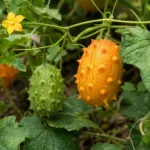 Horned Melon (Cucumis metuliferus) care guideCucumis metuliferus
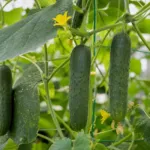 Cucumber (Cucumis sativus) care guideCucumis sativus
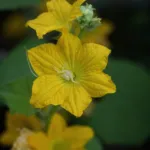 Melon or true melo (Cucumis melo) care guideCucumis melo
 Cantalupensis Group (Cucumis melo Cantalupensis Group)Cucumis melo Cantalupensis Group
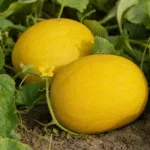 Mango melon (Cucumis melo Chito Group)Cucumis melo Chito Group
 Oriental pickling melon (Cucumis melo Conomon Group)Cucumis melo Conomon Group
 Dudaim melon (Cucumis melo Dudaim Group)Cucumis melo Dudaim Group
 Flexuosus Group (Cucumis melo Flexuosus Group)Cucumis melo Flexuosus Group
 Inodorus Group (Cucumis melo Inodorus Group)Cucumis melo Inodorus Group