
 Source:
 Apple Ermine Moth
Yponomeuta malinellusApple Ermine Moth overview
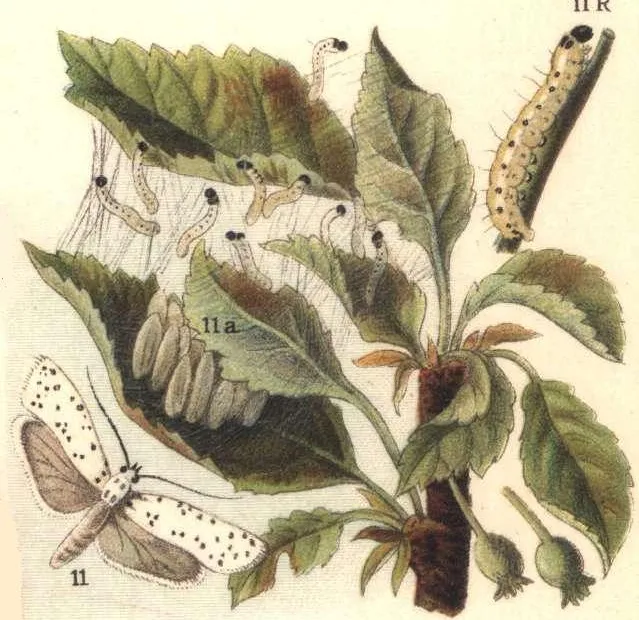
Apple ermine moth, Yponomeuta malinellus, is a foliage-feeding moth pest of apple and crabapple trees. In spring, young caterpillars mine leaves and then feed communally beneath conspicuous white silken tents. Heavy infestations can defoliate trees by early summer, although established trees often recover. Identification is best confirmed from the host plant, larval colony, webbing and seasonal timing.
Typical conditions
Overview
The apple ermine moth is primarily a pest of Malus species. Young larvae initially mine or scrape developing leaves, then construct loose white silken tents and feed in colonies. Later instars may consume most of the leaf tissue except larger veins and petioles. Several colonies may occur in one tree, and neglected or abandoned apple trees are especially vulnerable.
Adult moths are small and white with dark spotting, but adult identification can be difficult because related Yponomeuta species are similar. Confirmation should consider the host plant, larval appearance, web structure, seasonal timing and, when necessary, specialist identification.
Symptoms and identification
- Small mines or translucent feeding areas appear in young apple leaves during spring.
- Larvae gather beneath conspicuous white silk tents on shoots and leaf clusters.
- Leaves become skeletonized, browned or completely consumed as larvae mature.
- Multiple tents may spread through the canopy, causing localized or severe defoliation by early summer.
- White, closely arranged cocoons may be visible beneath leaves or within the webbing.
Webbing and communal feeding help distinguish this pest from many solitary leaf-chewing caterpillars. Tent caterpillars can produce similar webs, so the host, larval colony structure and timing should be checked.
Causes and spread
Females lay egg masses on young branches, twigs or near buds during mid- to late summer. The eggs are covered with a protective secretion that hardens and becomes less conspicuous as it ages. Infestations spread locally when larvae leave depleted leaf clusters and establish additional tents elsewhere in the tree.
Long-distance movement is most likely through infested nursery stock, cut branches or other plant material bearing egg masses. In the United States, documented concern has focused particularly on apple and crabapple material in the Pacific Northwest.
Life cycle and persistence
- Egg: Egg masses are laid in summer, often numbering roughly 50 eggs per mass in the introduced Pacific Northwest range. Fresh masses are pale yellow, become reddish and later fade gray.
- Overwintering: Eggs hatch after several days to a few weeks, and first-instar larvae remain beneath the egg-mass covering through winter.
- Larva: At bud break in spring, young larvae enter nearby developing leaves. Older larvae feed communally under silk, progressing through several instars and sometimes migrating to fresh foliage.
- Pupa and adult: Mature larvae spin white cocoons in compact groups, usually in early summer. Adults emerge after approximately one to two weeks and fly mainly in summer, when females lay the next generation of eggs.
Treatment and control
For home gardens and small trees, hand removal is often effective when colonies are localized. Cut or pull out silk tents while larvae are still concentrated, place them in a sealed bag and discard them; do not compost live infested material. Prune heavily infested shoots when this can be done without compromising the tree’s structure.
For larger trees or recurring infestations, monitor from bud break through early summer and target young larvae before they are protected by extensive webbing. Preserve flowering plants and avoid unnecessary broad-spectrum applications that can kill parasitoids and other beneficial insects. Severe, repeated defoliation in young or stressed trees warrants consultation with a local Extension office or certified arborist.
Low-impact and biological control
Physical removal of egg-bearing twigs, early larval colonies and silk tents is the most dependable low-risk tactic in small plantings. Natural enemies, including parasitoid wasps and other predators, can contribute to suppression; avoid broad-spectrum insecticides during their activity period and retain habitat that supports beneficial arthropods.
Microbial products based on Bacillus thuringiensis subsp. kurstaki may be considered only when a product is registered and labeled for the crop, site and target caterpillar in the United States. Such treatments work best against young, exposed larvae and are less effective once larvae are deep inside dense webbing.
Prevention
- Inspect apple and crabapple trees in late winter and early spring for gray egg-mass coverings near buds and on young branches.
- Prune out and destroy accessible egg-bearing twigs during dormancy where practical.
- Beginning at bud break, inspect new foliage weekly for mines, small colonies and early silk tents.
- Remove isolated tents and infested shoots promptly before larvae mature and spread.
- Maintain tree vigor with appropriate irrigation, pruning and site care, but avoid excessive nitrogen that produces overly lush foliage.
- Inspect incoming nursery stock and do not move infested branches or plants.
Interesting facts
- The species is a univoltine defoliator, meaning it normally produces one generation per year.
- Larvae from one egg mass commonly remain together as a sibling-like colony inside a shared web.
- Older colonies may consume nearly all leaf tissue in localized areas, creating conspicuous white tents and bare shoots.
- Adult moths are less reliable for field identification than the combination of host plant, larval colony and seasonal biology.
- Classical biological-control work in the Pacific Northwest introduced parasitoids associated with apple ermine moth, although natural-enemy impact can vary by location.
Use only pesticide products legally authorized and currently labeled in the United States for apple or crabapple and for the target pest or caterpillar group. Follow the current label exactly, including crop/site, application timing, personal protective equipment, pollinator precautions, reentry interval and preharvest interval. Product registrations and labels vary by state and may change; contact your state Extension service or pesticide regulatory agency before treatment.