
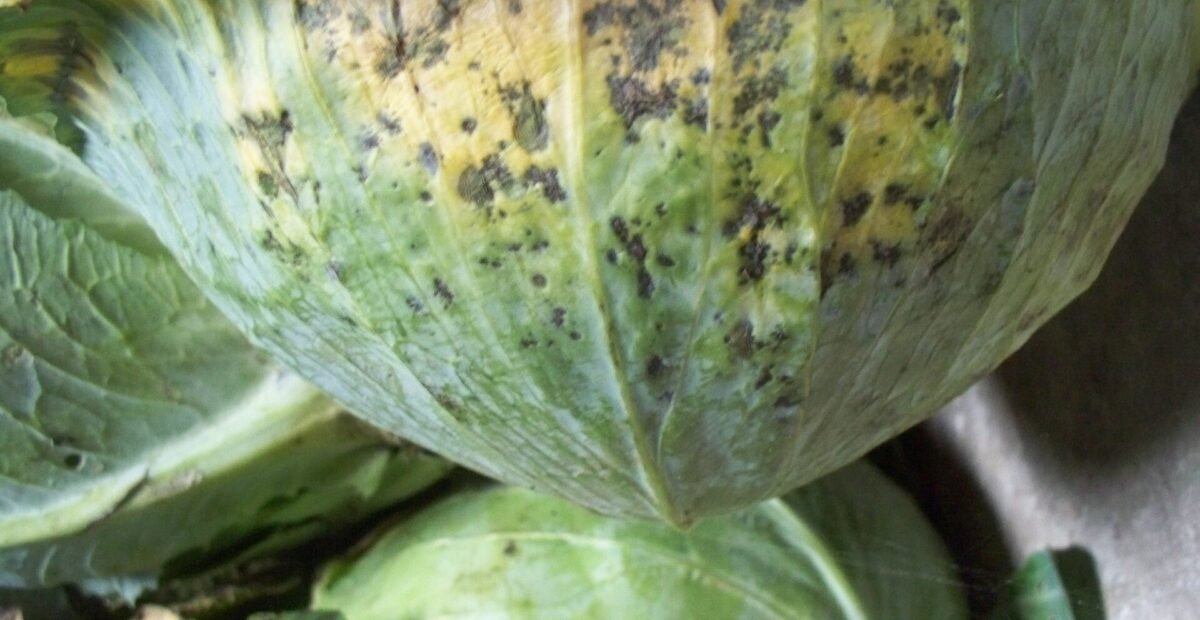
Alternaria leaf spot of brassicas
Alternaria brassicae (Berk.) Sacc.Alternaria leaf spot of brassicas overview
Alternaria brassicae is a fungal pathogen associated with Alternaria leaf spot, also called black spot or gray leaf spot, on brassica crops. It produces expanding brown to black lesions with concentric rings, often beginning on older leaves and sometimes spreading to broccoli, cauliflower, cabbage or seed crops. Diagnosis should be cautious because closely related Alternaria species cause nearly identical symptoms.
Typical conditions
Overview
Alternaria brassicae causes a foliar disease of plants in the mustard family. Initial lesions are usually small, dark brown to black spots that enlarge into roughly circular or irregular necrotic areas. Concentric rings may give mature lesions a target-like appearance, and a yellow-green halo can develop around them.
The disease commonly begins on older leaves and may progress upward during prolonged wet weather. Severe infection can reduce photosynthetic leaf area, weaken transplants, cause premature leaf drop and contribute to browning or rot of broccoli and cauliflower heads. In seed crops, pods, flowers and developing seed may also be affected.
Visual diagnosis is useful but not definitive. Alternaria brassicae lesions overlap with those caused by A. brassicicola, A. raphani and other fungi, while bacterial leaf spots, frost injury, insect feeding and nutrient-related chlorosis can look similar in early stages.
Symptoms and identification
- Small tan, brown or black flecks that enlarge into circular or irregular leaf spots.
- Concentric rings or banding within mature lesions, sometimes with a yellow halo.
- Dry, brittle tissue that may crack or fall out, producing a shot-hole appearance.
- Dark streaks or lesions on cotyledons, hypocotyls, petioles and stems of young plants.
- Coalescing lesions that form large dead areas and cause premature yellowing or leaf loss.
- Brown or black spots on broccoli and cauliflower heads, followed by rapid deterioration when wet conditions persist.
- In seed crops, lesions on flowers, pods or siliques and shriveled or poorly germinating seed.
Alternaria lesions usually lack the distinctly water-soaked, V-shaped marginal pattern associated with black rot. A laboratory diagnosis is recommended when the crop is valuable or the pathogen species matters for management.
Causes and spread
The pathogen is commonly introduced on contaminated seed or infected transplants and survives between crops in infected brassica residue. Cruciferous weeds and volunteer plants can provide additional inoculum. Spores are moved by wind-driven rain, irrigation splash, workers, tools and farm equipment.
New infections are favored by extended leaf wetness, high humidity and moderate temperatures. Dense foliage, overhead irrigation, poor airflow, heavy dew, frequent rainfall and poorly drained sites increase risk. Excessive nitrogen can promote lush growth and may worsen disease severity in some production systems.
Life cycle and persistence
Alternaria brassicae survives on or in seed and in infected crop debris. When moisture and temperature are favorable, the fungus produces conidia on infected tissue. These spores are released and carried by air currents, splashing water, equipment or handling to nearby leaves.
Spores germinate on wet plant surfaces and penetrate susceptible tissue. Lesions generally become visible after several days, then produce additional spores that drive secondary spread during the same crop cycle. The disease may appear early from infected seed or later in the season when humidity, dew and rainfall increase. The exact survival period varies with residue, climate and environmental conditions.
Treatment and control
Begin by confirming that the symptoms are consistent with Alternaria rather than black rot, downy mildew, bacterial spot, insect injury or abiotic damage. If only a few plants are affected, remove the entire plant and dispose of it away from the garden. If infection is widespread, remove the most heavily infected leaves without spreading spores and reduce leaf wetness.
Fungicides protect healthy tissue but do not restore dead leaf area or cure advanced lesions. They are most useful as part of an integrated program when disease risk is high, symptoms are first detected and the crop label permits use. Commercial growers should combine scouting, weather-based risk assessment, sanitation, rotation and cultivar selection rather than relying on repeated sprays.
Low-impact and biological control
- Use clean, tested seed and healthy transplants; do not propagate from visibly infected stock.
- Improve airflow with adequate spacing, weed control and pruning or removal of badly infected lower leaves.
- Use drip or directed irrigation instead of overhead watering and irrigate early enough for foliage to dry.
- Remove diseased plants and crop debris promptly; do not compost infected material unless the composting system reliably reaches pathogen-destroying temperatures.
- Rotate away from brassicas and eliminate volunteer brassicas and susceptible weeds between crops.
- Biological or microbial seed and foliar products may be useful in some systems, but performance is product-, crop- and environment-dependent; use only products registered or allowed for the intended crop and disease.
Prevention
- Purchase tested, high-quality seed from reputable suppliers and inspect transplants before planting.
- Do not save seed from diseased plants. Use seed treatment only when appropriate for the crop and according to current product directions.
- Rotate brassica crops for at least three years where practical, and avoid brassica cover crops in fields with a history of severe disease.
- Remove, bury or thoroughly incorporate infected crop residue promptly after harvest; remove volunteer brassicas and susceptible cruciferous weeds.
- Space plants to improve air circulation. For broccoli, a practical home-garden spacing range is about 10–18 inches between plants and 18–36 inches between rows, adjusted for cultivar and site.
- Water at the soil line when possible and avoid handling or cultivating plants while foliage is wet.
- Clean and sanitize seed-starting trays, tools, harvest containers and equipment that contact infected plants.
- Select cultivars with documented tolerance where available, recognizing that resistance may differ among Alternaria species and brassica crops.
Interesting facts
- Alternaria brassicae is one member of a disease complex; nearly identical brassica leaf-spot symptoms may be caused by A. brassicicola, A. raphani, A. alternata or other Alternaria species.
- A 2024 plant-disease report documented A. brassicae causing Alternaria leaf spot on broccoli in North Carolina, indicating that this species occurs in the eastern United States even though other Alternaria species may be more common locally.
- On broccoli, lesions can expand in concentric rings and produce visible sporulation, while susceptible hosts or cultivars may show smaller lesions without obvious sporulation.
- Broccoli and cauliflower heads can become infected after foliage is diseased, and secondary bacterial soft rot may accelerate deterioration under wet conditions.
- Large, beaked, multicellular conidia are useful microscopic characters for distinguishing A. brassicae from some other Alternaria species, but morphology can overlap and molecular confirmation may be needed.
Use only fungicides legally authorized in the United States for Alternaria diseases on the specific crop being treated. Confirm that the crop and disease are listed on the current label, follow all label directions, observe preharvest intervals and worker-protection requirements, and rotate fungicide modes of action when a labeled program calls for it. Product registrations and labels vary by crop and state; do not infer legality from recommendations for another brassica or another country.