Shothole Borer
Scolytus rugulosusShothole Borer overview
The shothole borer, also called the fruit-tree bark beetle, is a tiny bark beetle that tunnels beneath the bark of weakened or dying fruit and ornamental trees. Larval galleries can girdle twigs, branches, or trunks, causing dieback, wilted fruit clusters, gumming, boring dust, and numerous small round holes that make the bark look as though it has been struck by birdshot.
Typical conditions
Overview
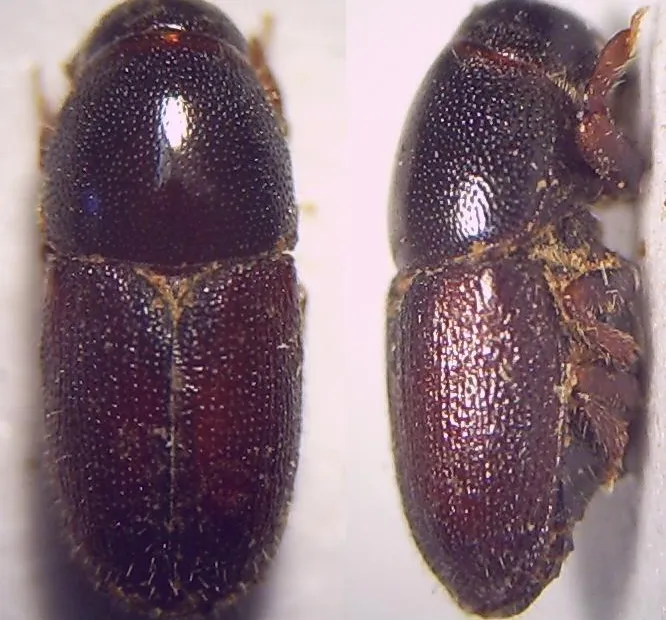
Shothole borer is the common U.S. name for Scolytus rugulosus, also known as the fruit-tree bark beetle. It is a member of the bark beetle group in the weevil family, Curculionidae. The beetle is about 0.08–0.1 inch long, dark brown to black, and easily overlooked without magnification.
It most often becomes a serious problem in trees already weakened by drought, winter injury, disease, poor site conditions, mechanical damage, sunscald, old age, or other pests. Healthy trees can sometimes resist attacks through resin production, but trees near heavily infested wood may also be colonized.
Symptoms and identification
- Numerous small, round entrance or exit holes in twigs, branches, or trunks, producing a shot-bird or buckshot appearance.
- Fine boring dust, frass, or gum and resin around holes, especially on stone fruits.
- Wilting or browning leaves, dead twigs, dying branch sections, and wilted fruit clusters when galleries disrupt water and nutrient movement.
- Larval galleries just beneath the bark; a branching or centipede-like pattern may be visible when bark is removed.
- Progressive branch or trunk girdling, with complete girdling capable of killing the affected part.
Small holes alone are not diagnostic because several bark beetles and wood-boring insects produce similar damage. Confirm the beetle, gallery pattern, host, and condition of the wood when possible.
Causes and spread
Adults are attracted mainly to stressed, injured, dying, or dead wood. Common predisposing factors include drought, inadequate irrigation, root or trunk injury, sunburn, winter damage, disease, poor drainage or unsuitable soil, severe pruning, and nearby infested branches or firewood.
Females bore through the bark and establish egg galleries in the cambium. Larvae then extend feeding galleries from the parental gallery. Infested pruning debris, dead limbs, stacked firewood, neglected orchard trees, and wild or ornamental host trees can maintain local populations and provide sources for reinfestation.
Life cycle and persistence
Shothole borers overwinter mainly as larvae in galleries beneath the bark or partly into the outer wood. Pupation occurs in spring, followed by adult emergence commonly in April or May in temperate parts of the United States; exact timing varies with climate and elevation.
After mating, females excavate a longitudinal egg gallery parallel to the grain, usually in the cambium. Eggs are placed along the gallery, and larvae feed outward in side galleries for roughly a month under favorable conditions. Mature larvae pupate, become adults, and chew round holes through the bark. One to three generations are commonly reported, although the number varies by region and season.
Treatment and control
Once larvae are established beneath the bark, treatment is difficult because they are protected inside the tree. On lightly affected trees, promptly prune out infested twigs and branches back to healthy wood, then remove and destroy or dispose of the material. Do not leave cut limbs in piles near the host.
For trunk or scaffold-limb infestations, consult a certified arborist or county Extension specialist. Removing severely declining trees may be more effective than repeated spraying, particularly when much of the cambium is girdled. Correct drought, root, soil, disease, or mechanical stresses that made the tree attractive to beetles. Insecticides, where appropriate, are generally aimed at exposed adults before they bore into the bark and are rarely a substitute for sanitation and tree-care improvements.
Low-impact and biological control
There is no dependable organic treatment that eradicates larvae protected inside bark galleries. The most effective nonchemical approach is integrated prevention: maintain tree vigor, remove and destroy infested wood, eliminate nearby breeding material, and prune during appropriate dry-weather conditions using clean tools.
Natural enemies may attack bark beetles, but commercially released biological controls are not a consistently established management solution for home fruit trees. Avoid unnecessary broad-spectrum insecticide use that can harm predators and parasitoids. Monitor trees closely after stress events and seek professional confirmation before treating.
Prevention
- Maintain vigorous trees with irrigation during drought, appropriate fertility based on soil or leaf testing, good sunlight, and suitable drainage.
- Protect trunks and major limbs from mower, string-trimmer, staking, and pruning injuries; reduce sunscald risk where appropriate.
- Prune out dead, dying, or heavily infested branches before beetle emergence. Make proper pruning cuts rather than leaving stubs.
- Remove infested limbs, fallen branches, and bark-covered wood from the orchard or landscape promptly; chip, burn where legal, or dispose of material according to local rules.
- Do not store fresh prunings or infested firewood near susceptible trees, and do not move potentially infested wood between locations.
- Inspect fruit trees regularly, especially after drought, freeze injury, severe storms, or disease outbreaks.
Interesting facts
- The common name refers to the many small, round bark holes that resemble damage from birdshot.
- The beetle is not the same insect as the invasive shothole borers associated with certain ambrosia beetle complexes in California.
- Larval galleries can form a branching, centipede-like pattern beneath the bark.
- Healthy trees often defend themselves with resin, which can kill or repel invading beetles; weakened trees may fail to produce enough resin.
- The pest is native to Europe but is now established across much of the United States and southern Canada.
Use only pesticide products legally authorized for shothole borer on the specific crop or ornamental plant in the United States and in your state. Follow the current product label exactly, including crop site, timing, application method, protective equipment, pollinator precautions, reentry interval, and preharvest interval. Do not apply a pesticide based only on shot-like holes, because other borers and bark injuries can look similar; consult state Extension guidance or a licensed pesticide professional for product and timing decisions.
Affected plants
The plants below are linked to this problem by structured host-plant data. The list updates automatically as new plant profiles are added.