Late Spring Frost Injury
Late Spring Frost Injury overview
Late spring frost injury is a noninfectious environmental disorder caused when actively growing buds, leaves, flowers, shoots, or young fruit are exposed to freezing temperatures after dormancy has ended. Damage ranges from slight leaf-tip browning to killed blossoms, blackened shoots, cambium injury, and crop loss. Severity depends on plant species, growth stage, temperature, exposure duration, site elevation, and cold-air drainage.
Typical conditions
Overview
Plants become more vulnerable as buds swell, leaves expand, flowers open, and shoots elongate. Ice formation and associated cellular dehydration injure exposed tissues. A light frost may damage only flowers or leaf margins, while a harder or longer freeze can kill growing points, young stems, cambium, or developing fruit.
Damage may appear immediately or develop over several days or weeks. Uneven injury among plants is common because bud stage, cultivar, elevation, wind exposure, canopy position, and cold-air drainage differ across a site.
Symptoms and identification
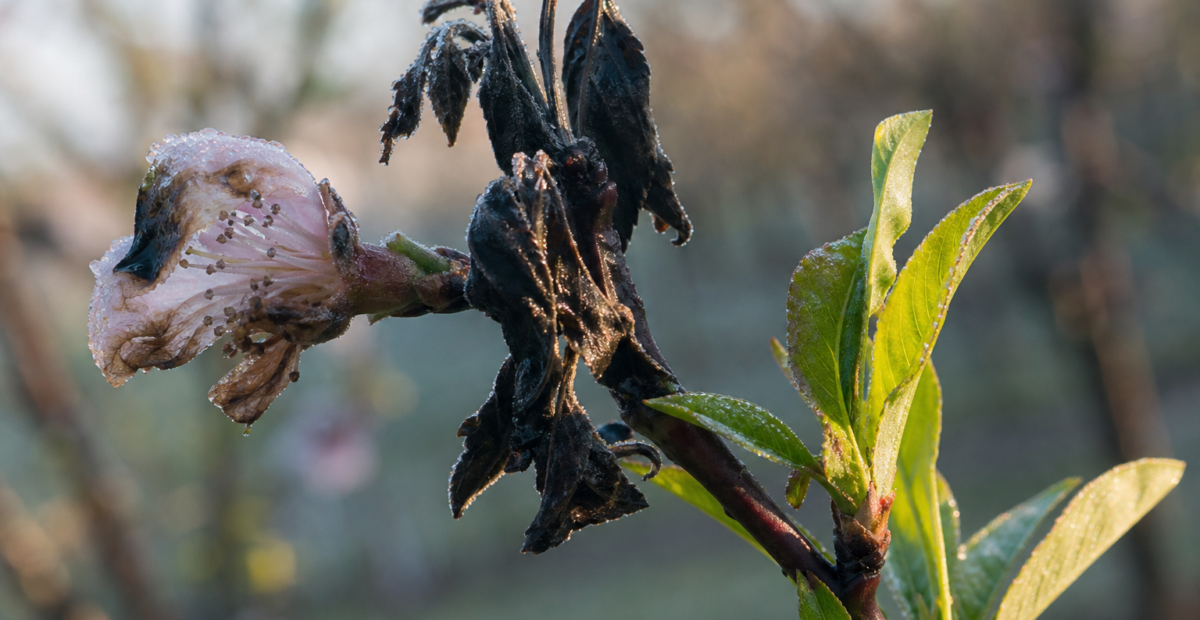
- Wilted, water-soaked, translucent, or darkened young leaves that later turn brown or black.
- Dead shoot tips, curled foliage, split or collapsed tender stems, and delayed bud development.
- Flowers with brown or black centers, killed pistils, poor fruit set, or misshapen young fruit.
- In grapes and fruit trees, damaged growing points may fail while lower or secondary buds later grow.
- Evergreens may show pale, reddish, or brown current-season needles, often several days after the freeze.
- In severe cases, bark or cambium injury, branch dieback, or delayed canopy recovery can occur.
Frost injury is often fairly uniform across exposed portions of a planting and may be confused with disease, herbicide injury, or sunscald. A history of a freezing event and a sharp boundary between healthy older tissue and damaged new growth are useful diagnostic clues.
Causes and spread
The immediate cause is exposure of dehardened, actively growing tissue to freezing temperatures. Risk increases after unusually early spring warmth, during rapid budbreak or flowering, and when temperatures remain below freezing long enough for ice formation and tissue dehydration.
This disorder does not spread biologically from plant to plant. Apparent patterns usually reflect topography and microclimate: cold air settles in low areas, frost pockets, sheltered depressions, and poorly ventilated sites, while wind-exposed edges may suffer additional drying. Damage can be amplified by drought stress, bright sun, and rapid warming after the freeze.
Life cycle and persistence
There is no pathogen lifecycle. The injury sequence begins with dormancy release and loss of cold hardiness, followed by a frost or freeze during active growth. Ice forms in or around susceptible tissues, cells lose water and membrane integrity, and damaged tissue collapses. Symptoms may be delayed as injured cells desiccate and secondary infections colonize dead material.
Surviving buds, roots, or cambium may resume growth after temperatures moderate. Many woody plants produce secondary shoots, but flower and fruit losses cannot be reversed for that season.
Treatment and control
- Wait several days before major pruning; living and dead tissue can be difficult to distinguish immediately after a freeze.
- Inspect buds, shoots, and cambium by gently scratching or cutting into tissue. Living tissue is generally moist and green to light-colored; dead tissue is brown, black, dry, or water-soaked.
- Remove collapsed or clearly dead portions with clean, sharp tools once the extent of injury is evident. Cut back to healthy tissue without removing living wood unnecessarily.
- Allow surviving buds and secondary shoots to develop before deciding whether a tree or shrub needs structural pruning.
- Water during extended dry periods, apply a 2- to 4-inch layer of mulch without piling it against trunks, and avoid heavy nitrogen fertilization while plants recover.
- Remove dead leaves, flowers, and fruit that are rotting, but avoid unnecessary handling of marginally injured tissue.
- Monitor for secondary bacterial or fungal decay in damaged tissue. Submit a representative sample to a state or university plant diagnostic laboratory if symptoms continue spreading without a corresponding weather explanation.
Low-impact and biological control
There is no curative organic pesticide for freeze-killed tissue. The most effective low-input measures are preventive: frost cloth or row covers, temporary shelter for containers, adequate pre-freeze soil moisture, mulch for root-zone insulation, wind protection where appropriate, and planting in well-drained sites with good cold-air movement. For small fruit crops, correctly installed row covers can reduce exposure; remove or ventilate them promptly after the danger passes to limit overheating and disease-conducive humidity. Prune only after damage is clearly defined.
Prevention
- Use local frost dates and weather forecasts, but protect plants whenever a freeze threatens rather than relying only on average dates.
- Select cultivars and species adapted to the site, and avoid early-budding types in frost-prone locations when practical.
- Do not plant tender crops or newly hardened transplants in low spots where cold air collects.
- Maintain even soil moisture before a forecast freeze; avoid waterlogged soil and avoid fertilizing with high nitrogen immediately before rapid spring growth.
- Cover small plants with breathable frost cloth, row cover, or overturned containers before temperatures fall. Support covers so they do not rest directly on foliage, and remove or vent them after the threat passes.
- For commercial orchards, vineyards, and berry plantings, use only well-managed, crop-appropriate systems such as wind machines, sprinklers, or other validated frost-protection equipment.
- Keep weeds and tall vegetation managed around low crops when this improves air drainage, while preserving beneficial habitat elsewhere.
Interesting facts
- Air temperature near the ground can be several degrees colder than a thermometer placed at typical eye level, especially in a low site.
- Flowers and newly opened buds are often more vulnerable than dormant buds, while roots may remain comparatively protected by soil.
- Two plants of the same species can show different injury because their buds opened at different times or occupied different canopy positions.
- Symptoms may be delayed, so a plant can look healthy immediately after the freeze and brown later.
- Frost injury can reduce fruit set even when leaves and shoots recover completely.
- Many trees and shrubs recover through secondary budbreak, although the lost flowers, shoots, or crop yield may not be replaceable that year.
Pesticides do not repair freeze-injured tissue and are generally not a treatment for this environmental disorder. Use a product only when a separately confirmed secondary pest or disease is present, and only if that product is legally authorized for the specific crop and problem in the United States. Follow the current label, including crop, rate, timing, personal-protective equipment, reentry, and harvest restrictions.
Affected plants
The plants below are linked to this problem by structured host-plant data. The list updates automatically as new plant profiles are added.