
Photoinhibition
Photoinhibition overview
Photoinhibition is a physiological light-stress disorder in which excess or rapidly fluctuating light temporarily or persistently reduces photosynthetic performance. It is most often associated with intense sunlight, heat, drought, cold roots or leaves, salinity, and other conditions that limit carbon dioxide use or repair of damaged photosynthetic machinery. Symptoms may resemble sunscald, heat stress, drought injury, or nutrient problems.
Typical conditions
Overview
Photoinhibition occurs when absorbed light energy exceeds the plant’s ability to use, dissipate, or safely store it. Excess light can damage or temporarily deactivate photosystem II and, under some stress combinations, photosystem I. Plants normally protect themselves through energy dissipation, antioxidant systems, leaf movement, pigment changes, and repair of damaged reaction-center proteins.
The condition is common across many plant species, but sensitivity varies with species, cultivar, leaf age, acclimation history, canopy position, and whether the plant is C3 or C4. A reduction in photosynthesis can occur before obvious leaf injury is visible.
Symptoms and identification
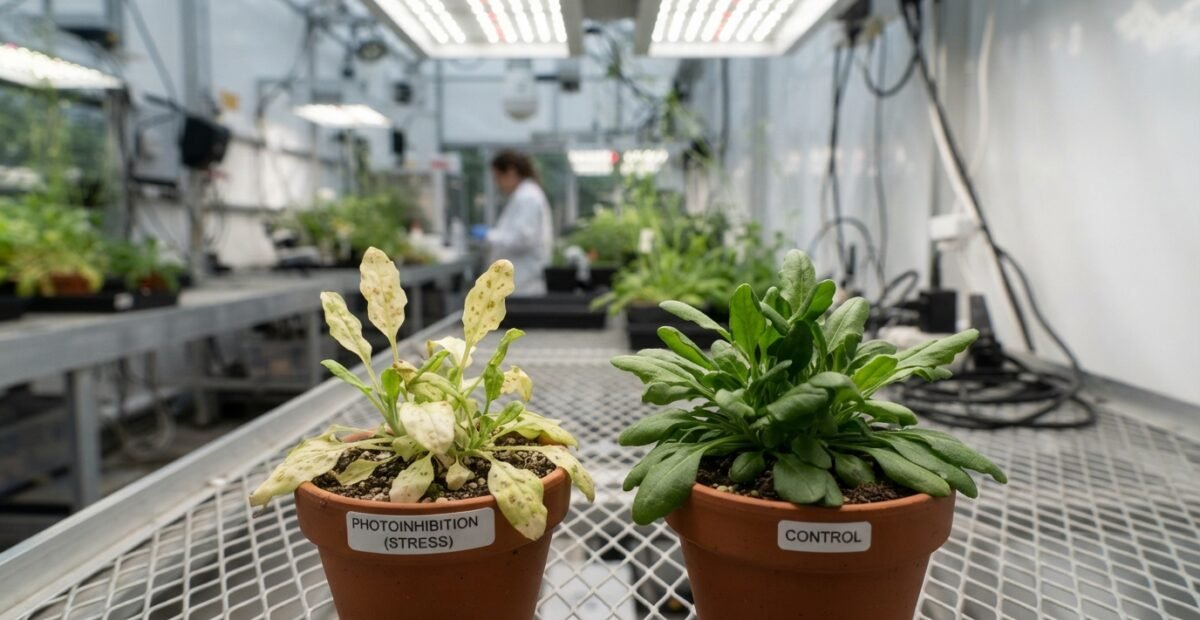
Visible symptoms are variable and are not diagnostic by themselves. Possible signs include:
- midday drooping or temporary loss of leaf turgor despite adequate soil moisture;
- pale green, yellow-green, bronze, bleached, or finely mottled foliage on the most exposed leaves;
- leaf curling, scorched margins, premature aging, or reduced expansion of new leaves;
- slower growth, reduced flowering or fruit fill, and delayed recovery after hot, bright weather.
Photoinhibition may occur without permanent necrosis. Persistent brown patches, sharply defined sunscald, disease lesions, or symptoms restricted to particular nutrient-patterns suggest that another disorder may also be present.
Causes and spread
Typical triggers include intense direct sunlight, reflective surfaces, sudden movement of shade-grown plants into full sun, heat, drought, low humidity, salinity, root damage, and low temperatures that slow carbon fixation or repair. Rapid alternation between shade and bright sun can be especially stressful. Water limitation closes stomata, restricts carbon dioxide entry, and increases the risk that absorbed light energy will exceed the leaf’s processing capacity.
This disorder does not spread biologically from plant to plant. Apparent spread usually reflects a shared exposure, such as a heat wave, reflective wall, greenhouse lighting pattern, dry root zone, or cold snap.
Life cycle and persistence
Photoinhibition develops when the rate of light-related damage exceeds the rate at which the plant can dissipate excess energy and repair its photosynthetic machinery. Protective responses can begin within minutes to hours of excessive light. If the stress is relieved, photosynthetic activity may recover over hours or days; repeated or severe exposure can produce oxidative injury, leaf bleaching, tissue death, and longer-lasting loss of productivity.
Recovery depends on the species, duration and intensity of exposure, leaf age, temperature, hydration, and whether photosystem I or photosystem II has been damaged. Chlorophyll fluorescence measurements, especially changes in the maximum quantum efficiency of photosystem II, can detect stress before visible symptoms.
Treatment and control
First confirm the exposure pattern and check soil moisture, roots, pests, diseases, and nutrient status. Move container plants to bright shade or filtered light, or install temporary shade cloth over affected beds. Water the root zone thoroughly when dry, improve irrigation uniformity, and correct root damage or compaction. Do not repeatedly mist foliage as a substitute for root-zone irrigation, particularly where fungal disease is favored.
Remove only tissue that is fully dead. Partially green leaves can continue photosynthesis and should usually remain attached. Reduce additional stress by postponing heavy pruning, transplanting, fertilizing, or pesticide applications until plants have recovered. New growth should be evaluated after several days of milder conditions; permanent bleaching or necrosis will not reverse, although replacement foliage may develop normally.
Low-impact and biological control
There is no biological control agent for photoinhibition. Organic and low-input management focuses on the environment: use woven shade cloth, plant-based or compost mulches, wind protection where appropriate, and drip or soaker irrigation to maintain even soil moisture. Harden off transplants gradually, use afternoon shade for sensitive crops, and select locally adapted varieties. Compost or fertilizer should be used only when soil or tissue testing supports a genuine nutritional need; excess nitrogen does not correct light damage and can increase other stress problems.
Prevention
- Acclimate seedlings, houseplants, and greenhouse-grown plants gradually to stronger outdoor light over about 7–14 days, adjusting for species sensitivity and local weather.
- Provide afternoon shade or adjustable shade cloth during heat waves, especially for recently transplanted plants and cool-season crops.
- Maintain consistent root-zone moisture with deep watering and organic mulch, while avoiding waterlogged soil.
- Protect roots from overheating and reduce reflective heat from pavement, south-facing walls, and light-colored surfaces where practical.
- Use species and cultivars suited to the site’s light and USDA hardiness or heat conditions; avoid sudden changes in light intensity.
- Manage greenhouse lighting, ventilation, humidity, and temperature together rather than increasing light without ensuring adequate carbon dioxide uptake and water supply.
Interesting facts
- Photoinhibition is not always permanent injury: it can represent a regulated protective reduction in photosynthetic activity during excess light.
- Plants dissipate surplus excitation energy as heat through nonphotochemical quenching, while antioxidant systems limit reactive oxygen damage.
- Photosystem II generally has a faster repair cycle than photosystem I; stress that suppresses protein synthesis or carbon fixation can therefore prolong injury.
- “Midday depression” of photosynthesis can occur even when leaves do not look severely damaged.
- Leaf position, previous light history, temperature, water status, and plant metabolism can make neighboring leaves respond very differently to the same sunlight.
No pesticide treatment corrects photoinhibition. Do not apply a pesticide, foliar nutrient, antitranspirant, or plant growth regulator solely on the basis of suspected photoinhibition. In the United States, use only products legally authorized and currently labeled for the specific crop and problem in your state, and follow the current label exactly; cultural and environmental correction is the primary management approach.