
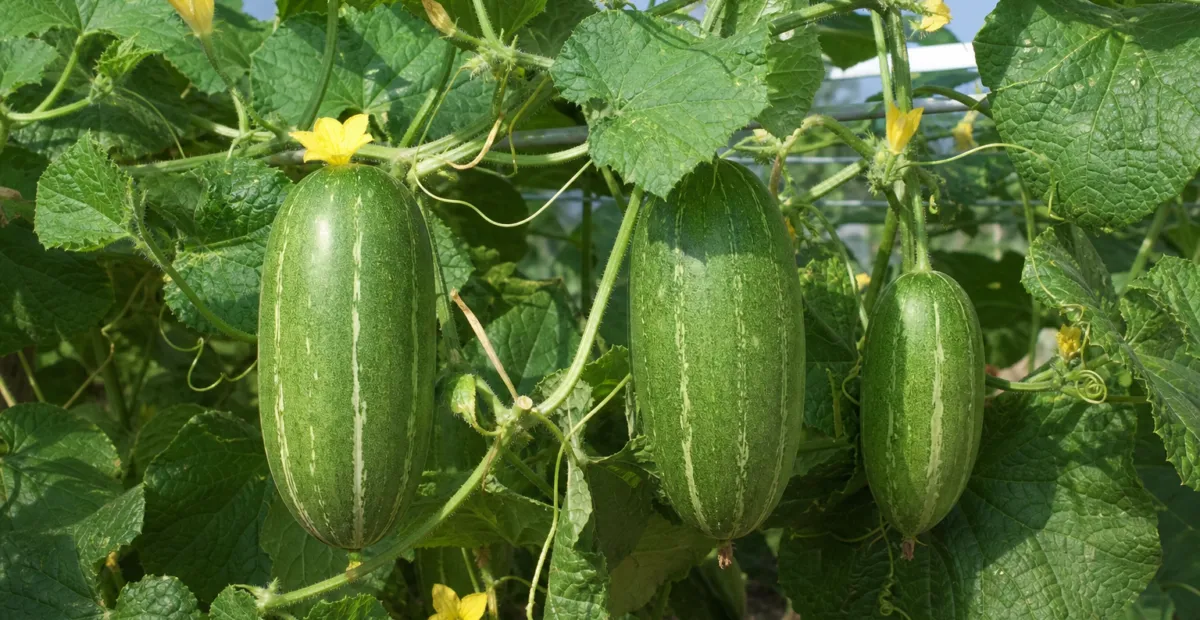
 AI-generated illustration
Oriental pickling melon (Cucumis melo Conomon Group) short overview
Cucumis melo Conomon Group is a warm-season melon group traditionally associated with East Asian pickling and fresh-use melons. Its vigorous annual vines produce yellow flowers followed by smooth, often elongated fruits that can be harvested immature for a cucumber-like texture or allowed to mature further. In U.S. gardens, grow it in full sun after frost in fertile, well-drained soil and maintain even moisture while fruits develop.
Taxonomic classification
Oriental pickling melon (Cucumis melo Conomon Group) care guide
Light and placement
Give full sun, ideally with at least 8 hours of direct light and a warm south- or southwest-facing position. Trellised plants need unobstructed light from above and good air movement. Insufficient light produces lanky vines and weak fruiting; severe midday heat combined with drought can cause temporary wilting or leaf scorch, so maintain soil moisture.
Watering and humidity
Water deeply when the top inch of soil begins to dry, keeping moisture steady rather than alternating drought and saturation. Apply water at the base, preferably in the morning, and mulch to reduce evaporation. Increase frequency during flowering and fruit expansion; reduce only slightly as fruit approaches the desired harvest stage, without allowing severe wilt.
Soil and growing medium
Use fertile, loose soil with good drainage and dependable moisture retention. A sandy loam or loam amended with compost is suitable. Slightly acidic to neutral soil is generally appropriate; avoid persistently waterlogged beds, which reduce root health and can increase vine disease pressure.
Feeding
Mix finished compost into the bed before planting. Once vines begin active growth, apply a balanced vegetable fertilizer according to its label, avoiding excessive nitrogen that produces leaves at the expense of flowers and fruit. A light side-dressing can be used after fruit set if growth is pale or weak; do not fertilize drought-stressed plants.
Growth and habit
This is a vigorous, twining annual vine that uses tendrils to climb or spreads across the ground. Trellising improves air movement and keeps fruit cleaner but requires strong support and fruit slings for heavy crops. Ground-grown vines benefit from mulch beneath developing fruit and from consistent access to water.
Planting and repotting
Sow indoors about 3–4 weeks before the last spring frost or direct-sow once soil is reliably warm, roughly 65°F or higher. Plant seeds about 1 inch deep, place several seeds per hill, then thin to the strongest plant. Give each vine ample room or train it onto a sturdy trellis.
Usually grown directly in the ground. If started in containers, transplant while young and before roots become crowded, using a container at least 5 gallons with drainage holes and a stable support or space for the vine to trail.
Propagation and pruning
Propagation
Propagate by seed. Sow after soil warms, or start indoors in biodegradable pots to minimize root disturbance. Save seed only from open-pollinated plants isolated from other Cucumis melo types if maintaining a line, because melon groups can cross.
Pruning
Pruning is optional. Remove damaged or diseased leaves promptly and guide young vines onto their support. Excessive cutting can reduce leaf area needed for fruit development, so limit pruning to sanitation, access, and reasonable vine management.
Overwintering
Do not overwinter outdoors as a perennial. Remove vines after frost or crop completion. In cold climates, save seed from a suitable open-pollinated line or grow new plants the following season; indoor overwintering is generally impractical because mature vines require substantial light and space.
Uses
Use young fruits for pickling or fresh preparations where the accession is traditionally used that way; mature fruits may be eaten fresh depending on type. The vines are also suitable for educational vegetable gardens and trellis displays. Culinary use should be limited to correctly identified, sound fruit with no pronounced bitterness.
Appearance
The plant has rough, lobed to heart-shaped green leaves, angular succulent stems, curling tendrils, and yellow cucurbit flowers. Fruits within the group are commonly smooth and elongated or cylindrical, but shape, skin color, size, and maturity characteristics vary among accessions. The small swollen ovary below a female flower is a useful identification feature.
Flowering
The vines produce separate male and female yellow flowers, with female flowers identifiable by the small swollen ovary beneath the bloom. Flowers open during warm weather and fruit set depends on pollen transfer between flowers. Harvest timing varies with the selected accession, since the group includes forms used young for pickling and forms allowed to mature.
Pollination and visitors
Separate male and female flowers are pollinated primarily by flower-visiting bees and bumblebees, with hoverflies and other insects potentially contributing visits. Poor fruit set can occur during cool, rainy, or insect-poor weather; hand-pollination in the morning can help when necessary.
Cucumis melo Conomon Group photos
Click any photo for a larger view. Source, author and license are shown separately.
Diseases and pests
Diseases
Watch for powdery mildew, downy mildew, gummy stem blight, anthracnose, and damping-off. Improve air circulation, water at the soil surface, rotate cucurbit crops, remove badly affected foliage, and avoid working among wet vines. Use disease-resistant seed when available and follow the product label for any fungicide.
Pests
Common pests include cucumber beetles, squash bugs, aphids, spider mites, and melon fruit flies in affected regions. Inspect leaf undersides and young stems frequently, use row cover over young plants until flowering, remove pests by hand where practical, and use labeled controls only when monitoring shows treatment is justified.
Related diseases and pests
Only Plant Doctor profiles whose host data indicate this plant may be affected are shown here.
 DiseaseCucurbit Downy MildewPseudoperonospora cubensis (Berk. & M.A. Curtis) Rostovzev
 DiseaseCucurbit Powdery MildewPodosphaera xanthii (Castagne) U. Braun & Shishkoff
 DiseaseCucurbit AnthracnoseColletotrichum orbiculare
 DiseasePythium damping-off, root rot and blightPythium aphanidermatum
 PestMelon aphid (cotton aphid)Aphis gossypii Glover
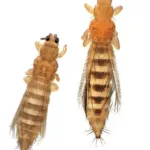 PestOnion thripsThrips tabaci Lindeman
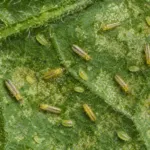 PestMelon thripsThrips palmi Karny
 PestTwo-spotted spider miteTetranychus urticae
Toxicity and pollen
The species is cultivated as an edible melon, and the fruits of Conomon types are used as food when properly identified and prepared. Evidence does not support treating the group as inherently poisonous. Do not eat unidentified volunteer fruit, and discard fruit or seed tissue that is unusually bitter, spoiled, or contaminated; bitter cucurbits can contain elevated cucurbitacins.
- Typical season
- Typically June–August in much of the United States
- Pollination / pollen
- Insect-dispersed pollen
Melon pollen is mainly transferred within flowers or between flowers by insects rather than carried long distances on the wind. Airborne exposure is therefore generally limited compared with wind-pollinated plants, but sensitive individuals may still react to garden pollen or contact with flowers. This is not a substitute for personal medical advice.
Native habitat
Conomon materials belong to the cultivated East and South Asian melon diversity associated with warm seasonal climates, open fields, home gardens, and fertile disturbed soils. In cultivation, the plants perform best in long, frost-free periods with high light, warm nights, and soil that drains freely after irrigation or rain.
Interesting fact
Conomon is a horticultural group within Cucumis melo rather than a currently accepted separate species. Some forms are harvested very young for pickling, while others are allowed to mature as melons. The group is associated with East Asian cultivated melon diversity and is not commonly grown in the United States.
Frequently asked questions (FAQ)
The most relevant questions about this plant, with short and direct answers.
🌱Quick care
What is Cucumis melo Conomon Group?⌄
Cucumis melo Conomon Group is a frost-tender annual melon group grown primarily for vegetable use, especially immature fruits used in pickles and cooked dishes. It is commonly documented in English as oriental pickling melon or pickling melon.
Is oriental pickling melon a cucumber or a melon?⌄
Oriental pickling melon is a melon, not a true cucumber; it belongs to Cucumis melo in the Cucurbitaceae family. Its immature fruits can resemble and be used like cucumbers, which causes occasional confusion.
Does oriental pickling melon come back every year?⌄
No, it is a frost-tender annual and normally dies when exposed to freezing temperatures. In warm climates it may produce volunteer seedlings from dropped fruit, but those plants are not guaranteed to match the parent.
🌤️Environment and placement
How much sunlight does Cucumis melo Conomon Group need?⌄
Give Cucumis melo Conomon Group full sun, meaning at least 6–8 hours of direct sunlight daily. Strong light supports vigorous vines, flowering, pollination, and better fruit quality.
What temperature is best for growing oriental pickling melon?⌄
Oriental pickling melon grows best in warm conditions, with soil temperatures around 65°F or higher for reliable establishment. Protect it from cool nights and plant only after the danger of frost has passed.
What type of soil does Cucumis melo Conomon Group prefer?⌄
Use fertile, well-drained loam or sandy loam enriched with mature compost. Avoid heavy, waterlogged soil because poor drainage can contribute to weak growth and root diseases.
How can I protect oriental pickling melon from frost?⌄
Cover young plants with a frost cloth or low tunnel during brief cool spells, but bring the crop to harvest before a hard freeze. Frost protection is only temporary because the plant is not cold-hardy.
💧Care and problems
How often should I water oriental pickling melon?⌄
Water deeply whenever the soil begins to dry, keeping it evenly moist but never saturated. Consistent moisture is especially important during flowering and fruit enlargement; drip irrigation or watering at the soil surface helps keep foliage dry.
Can oriental pickling melon be grown on a trellis?⌄
Yes, oriental pickling melon can be trained on a sturdy trellis, especially when the fruits are relatively small. Support developing fruits with fabric slings so their weight does not damage the vines or pull them from the support.
Why are oriental pickling melon fruits small or misshapen?⌄
Small or misshapen fruits commonly result from incomplete pollination or irregular moisture. Keep the soil evenly moist, avoid damaging flowers, and provide conditions that attract bees during the short flowering window.
What pests commonly attack oriental pickling melon?⌄
Cucumber beetles, aphids, squash bugs, spider mites, and other cucurbit pests may attack the vines. Inspect young plants frequently, use row covers before flowering when appropriate, and remove covers during bloom so pollinators can reach the flowers.
Why are the leaves of my oriental pickling melon turning white?⌄
White powdery patches on the leaves are commonly a sign of powdery mildew. Improve airflow, avoid overhead watering, remove badly affected foliage, and monitor early because severe infection can reduce vigor and yield.
Why are oriental pickling melon leaves wilting suddenly?⌄
Sudden wilting can result from drought, root damage, cucumber beetle feeding, or a wilt disease. Check soil moisture, inspect stems and leaf undersides for insects, and remove severely diseased plants rather than composting them.
🪴Planting and repotting
Can oriental pickling melon grow in containers?⌄
Yes, but use a large container with fertile, well-drained potting mix and provide strong support for the vine. A container holding at least 10–15 gallons is more practical than a small pot, and consistent watering is essential.
How much space does oriental pickling melon need?⌄
Allow about 18–24 inches between plants and approximately 5–6 feet between rows when vines are grown on the ground. Compact or trellised plants may need less horizontal space, but the vines still require room for airflow and fruit development.
When should I plant Cucumis melo Conomon Group in the United States?⌄
Plant outdoors after the local last frost date, once the soil has warmed to at least 65°F and nighttime temperatures are reliably mild. In short-season areas, start seeds indoors about 3–4 weeks before outdoor planting.
Should oriental pickling melon be direct-sown or transplanted?⌄
Direct sowing is usually simplest because melons dislike root disturbance, but careful transplanting can extend the season. If starting indoors, use individual biodegradable pots and move seedlings while they are still young.
How deep should oriental pickling melon seeds be planted?⌄
Plant seeds about ½–1 inch deep in warm soil. Keep the seedbed evenly moist until emergence, then thin crowded seedlings so the strongest plant remains at each planting spot.
✂️Propagation and pruning
Should I prune Cucumis melo Conomon Group vines?⌄
Routine pruning is usually unnecessary for oriental pickling melon. Guide or gently redirect vines, remove severely diseased leaves, and limit pruning because excessive cutting can reduce photosynthesis and fruit production.
Can I save seeds from oriental pickling melon?⌄
Yes, seeds can be saved from fully mature, healthy fruit, but Cucumis melo varieties cross readily with other melons. For seed that remains true to type, isolate flowering plants from compatible melons or hand-pollinate and protect the flowers.
How do I save oriental pickling melon seeds?⌄
Allow a selected fruit to mature fully, remove the seeds, rinse away the pulp, and dry them thoroughly in a cool, well-ventilated place. Store completely dry seeds in a labeled airtight container in a cool, dark location.
Can oriental pickling melon be propagated from cuttings?⌄
Propagation from seed is the standard and dependable method for oriental pickling melon. Stem cuttings are not a practical home-gardening method for preserving this annual crop.
⚠️Toxicity and safety
Can mature oriental pickling melon be eaten fresh?⌄
Some Conomon Group types can be eaten fresh when mature, but many are mild, bland, or specifically selected for use as immature vegetables. Because cultivar traits vary, follow the seed supplier’s harvest guidance rather than assuming every plant produces a sweet dessert melon.
How can I tell whether an oriental pickling melon is safe to eat?⌄
Eat only fruit from a positively identified, intentionally grown plant that is sound and free of rot or contamination. Discard any fruit that tastes unusually bitter, smells fermented, or shows spoilage, and do not rely on a common name alone for identification.
Is Cucumis melo Conomon Group toxic to people or pets?⌄
Cucumis melo Conomon Group is generally considered a low-concern edible crop when correctly identified and harvested in good condition. Do not eat unidentified volunteer plants or unusually bitter fruit, because bitterness can indicate unwanted cucurbit compounds.
🌸Flowering and special interest
Does oriental pickling melon need pollinators?⌄
Yes, Cucumis melo Conomon Group relies on insect pollination for fruit set. Bees must transfer pollen from male flowers to female flowers, so avoid insecticides during bloom and encourage pollinator activity.
Why is my oriental pickling melon flowering but not producing fruit?⌄
The most common cause is inadequate pollination, especially during cool, rainy, or low-pollinator weather. Poor watering, excessive nitrogen, plant stress, or flowers that have not yet reached the female stage can also delay fruit set.
When should oriental pickling melon be harvested for pickling?⌄
Harvest the fruits while they are young and still firm, before the seeds and flesh become fully mature. The ideal stage varies by cultivar, but immature fruits are generally preferred for a crisp texture and better pickling quality.
Why is my oriental pickling melon growing vines but no flowers?⌄
Vigorous vines without flowers are often caused by cool weather, insufficient sunlight, excessive nitrogen, or immature plants. Provide full sun, avoid high-nitrogen feeding, and give the vine time to reach flowering maturity.
Similar plants
 Azure Monkshood (Aconitum carmichaelii) care guideAconitum carmichaelii
 Monkshood (Aconitum ‘Stainless Steel’)Aconitum 'Stainless Steel'
 Monkshood (Aconitum ‘Bressingham Spire’)Aconitum 'Bressingham Spire'
 Golden full moon maple (Acer shirasawanum ‘Aureum’)Acer shirasawanum 'Aureum'
 Globosum (Acer platanoides ‘Globosum’)Acer platanoides 'Globosum'
 Striped maple (Acer pensylvanicum) care guideAcer pensylvanicum