 Source:
 Peach weevil
Rhynchites bacchusPeach weevil overview
Peach weevil, Rhynchites bacchus, is a fruit-infesting snout beetle associated mainly with pome and stone fruits in Europe and parts of Asia. Adults feed on buds, flowers, leaves and young fruit, while females puncture fruitlets and lay eggs inside. Larval feeding, fruit drop and secondary fruit rots can cause significant crop loss. In the United States, a suspected find should be reported to plant-health authorities.
Typical conditions
Overview
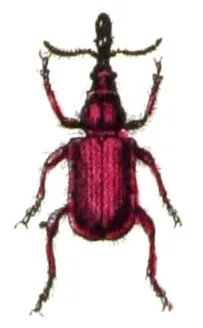
Peach weevil is a small, usually metallic purple to reddish fruit weevil with a conspicuous snout. Adults may attack buds, flowers, leaves and young fruit on rosaceous fruit trees. Females puncture fruitlets, deposit eggs in the injured tissue and may partially girdle the fruit stalk, causing premature fruit drop.
The species has been recorded mainly on apple, pear, plum, cherry, peach, apricot, nectarine, almond and related hosts, but published host lists vary by region and source. In the United States, it is best treated as a potential exotic or regulated pest rather than assumed to be established. Report an unfamiliar suspected infestation to your state department of agriculture or USDA APHIS before moving infested plant material.
Symptoms and identification
- Adults make small feeding holes, pits or ragged scars in buds, flowers, leaves and young fruit.
- Oviposition sites appear as small punctures or crater-like wounds in fruitlets, sometimes with a surrounding scar.
- Fruit stalks may be partially severed, leading to premature fruit drop.
- Larvae tunnel through fruit flesh and may damage developing seeds or the stone area.
- Wounded fruit can shrivel, become distorted, rot or remain as brown, mummified fruit.
These symptoms are not diagnostic by themselves. Apple fruit weevils, plum curculio and other Rhynchites species can produce similar injury.
Causes and spread
Damage is caused directly by adult feeding and female oviposition. The female uses her snout to make a cavity in a young fruit, lays an egg and may injure the peduncle. Larvae then feed within the fruit, where they are protected from many contact treatments. Wounds may also facilitate secondary fungal rots, especially in wet weather.
Spread occurs principally through movement of infested nursery stock, fruitlets, fallen fruit or other plant debris. Adults can also disperse locally from nearby orchards, hedgerows and wild rosaceous vegetation. The species is associated with orchards and warm, relatively dry shrub habitats in its documented range.
Life cycle and persistence
Reports generally describe one generation per year, with an occasional two-year cycle. Adults overwinter in the soil, under leaf litter, beneath loose bark or in other sheltered sites; some accounts also report overwintering larvae in fruit or soil. Adults emerge in spring as fruit trees resume growth and feed first on buds, then flowers, foliage and young fruit.
Mating and egg laying occur after flowering, commonly during the early fruit-growth period. Eggs are placed inside fruitlets. Larvae develop internally, often causing fruit to drop before harvest, and mature larvae leave the fruit and enter the soil or another protected site to pupate. Timing varies substantially with climate, host phenology and local population biology.
Treatment and control
Begin with confirmation and monitoring because the common name can be applied inconsistently and similar fruit-weevil species are common. In a home orchard, hand-pick adults when populations are low or gently shake branches over a collection sheet during cool periods when beetles are less active. Remove dropped and visibly infested fruit immediately.
For larger plantings, use repeated inspection from bud break through early fruit set and record adult activity, fruit punctures and fruit drop. Coordinate any intervention with local extension or crop advisers, especially if the insect may be regulated. Because larvae are protected inside fruit, late treatments aimed only at internal stages are unlikely to provide reliable control.
Low-impact and biological control
- Use hand collection, branch shaking and prompt removal of fallen or infested fruit.
- Reduce overwintering sites by removing orchard debris and mummified fruit, while avoiding unnecessary destruction of beneficial habitat elsewhere.
- Preserve predators, parasitoids and other natural enemies by avoiding broad-spectrum sprays when monitoring shows little risk.
- Use physical exclusion or fine insect netting on small trees where practical, installing it before adult activity and ensuring pollination needs are met.
- Biological control research on microbial agents and associated insects exists, but species-specific products and field reliability should not be assumed without local validation.
Prevention
- Inspect fruit trees and nursery stock carefully for unusual purple-red snout beetles, punctured fruitlets and premature fruit drop.
- Remove and destroy dropped, rotting and mummified fruit promptly; do not compost suspect infested fruit in a cold backyard pile.
- Keep the tree base and orchard floor clean, while recognizing that some adults may overwinter in soil or protected bark sites.
- Monitor during spring bud break, flowering and early fruit set by inspecting foliage and gently shaking branches over a white sheet.
- Maintain good pruning, airflow and fruit thinning practices to reduce dense, humid canopies and secondary fruit rot.
- If the insect is suspected in the United States, photograph it, preserve a specimen if safe to do so, and contact the state plant regulatory agency or USDA APHIS before transporting plant material.
Interesting facts
The species name bacchus refers to Bacchus, the Roman god of wine. The beetle is notable for its metallic purple-red coloration and elongated snout, features that make it visually distinctive but not sufficient for reliable identification from a casual photograph.
Peach weevil is considered important in some foreign fruit-production and plant-health assessments because larvae develop in fruitlets and may be moved with planting material or fruit pathways. U.S. records and regulatory status should be checked with current state and federal authorities rather than inferred from overseas reports.
Do not apply a pesticide solely from this entry or from a photograph. In the United States, use only a product legally authorized and specifically labeled for the crop, site and target pest in your state; follow the current label for rate, timing, protective equipment, reentry, harvest interval and pollinator precautions. Contact your county extension office or state pesticide regulator for current, crop-specific options. Chemical control may be limited by the beetle’s protected larval stage inside fruit and by the possibility that the specimen is a different species.
Affected plants
The plants below are linked to this problem by structured host-plant data. The list updates automatically as new plant profiles are added.