
 Source:
 Cereal Powdery Mildew
Blumeria graminisCereal Powdery Mildew overview
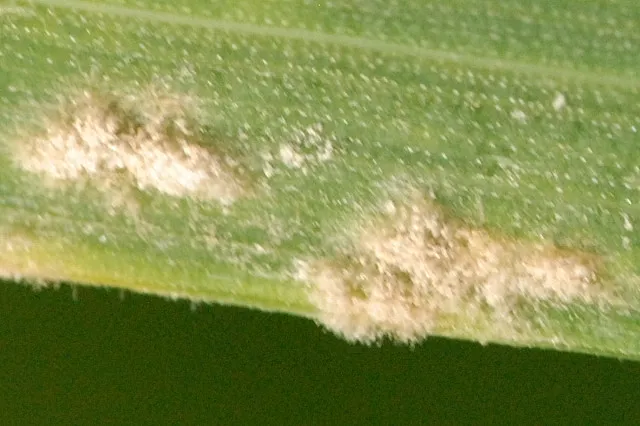
Cereal powdery mildew is a fungal disease complex caused by host-specialized forms of Blumeria graminis. It produces distinctive white to gray, flour-like colonies on leaves, leaf sheaths and sometimes cereal heads. Wheat, barley, rye, oats and related grasses may be affected, but individual pathogen forms usually have narrow host ranges. Resistant cultivars and balanced crop management are the foundation of control.
Typical conditions
Overview
Blumeria graminis is an obligate biotrophic fungus causing powdery mildew of cereals and grasses. The name represents a group of host-specialized forms, often treated as formae speciales or closely differentiated lineages. The wheat form is commonly referred to as B. graminis f. sp. tritici, while barley powdery mildew is associated with the barley-specialized form traditionally called f. sp. hordei. These forms should not be assumed to infect every grass equally.
The disease is most important where susceptible cultivars, dense stands and cool-to-moderate, humid conditions occur. Infection is usually visible as superficial white fungal growth on green tissues, but severe disease can reduce photosynthetic area, weaken plants and contribute to yield loss.
Symptoms and identification
- White, gray-white or buff, flour-like patches develop on leaves and leaf sheaths.
- Colonies may enlarge and merge, covering substantial portions of foliage.
- Older colonies commonly become dull gray or brown as they age.
- Heavily infected leaves may yellow, brown, dry prematurely and die.
- Barley and some other cereals may show colonies on spikes or heads as well as foliage.
- Small dark fruiting bodies may form within aging colonies late in the season, although they are not always conspicuous.
Powdery mildew is distinguished from many leaf-spot diseases because the fungal growth is largely superficial and can often be rubbed from the leaf surface, while the pathogen sends feeding structures into epidermal cells.
Causes and spread
The pathogen survives and reproduces only on living host tissue. Short-distance spread is primarily by airborne conidia produced in chains or on conidiophores within active colonies. Wind, crop adjacency, volunteer cereals and susceptible grass hosts can maintain inoculum.
Dense, lush or excessively nitrogen-fertilized growth creates a humid canopy and increases disease risk. Unlike many leaf pathogens, powdery mildew infection is generally favored by high relative humidity without prolonged free water on the leaf surface. Excessively wet foliage can interfere with spore germination, while shaded, poorly ventilated stands remain favorable because they dry slowly and maintain high humidity.
Life cycle and persistence
Conidia land on a susceptible leaf, germinate and produce a specialized penetration structure that enters an epidermal cell. The fungus forms a haustorium inside the host cell for nutrient uptake, while superficial hyphae spread across the leaf surface and produce new conidia. Under favorable conditions, this repeating asexual cycle can produce successive infections during the growing season.
At the end of the season, some populations form dark sexual fruiting bodies called chasmothecia, formerly called cleistothecia. These structures can persist on crop residue or plant surfaces. Moist conditions stimulate ascospore development and release; ascospores may initiate infection on emerging or autumn-sown cereals. In some regions, the pathogen also persists as dormant mycelium on living volunteer cereals or winter crops.
Treatment and control
Begin management when colonies are first detected and before substantial upper-canopy or flag-leaf infection develops. In small plantings, remove and dispose of heavily affected leaves or plants when practical, avoiding handling that disperses spores through the crop.
For field cereals, prioritize resistant varieties and timely, locally recommended integrated disease management. Fungicides are most useful when disease risk, crop value and label directions justify treatment; applications made after extensive tissue death generally cannot restore lost photosynthetic area. Recheck fields after treatment because resistance in local Blumeria populations can reduce performance of some fungicide groups.
Low-impact and biological control
Use resistant cultivars, balanced fertility, canopy ventilation, volunteer-host control and early scouting as the main nonchemical measures. In gardens or small plots, improve spacing and sunlight, avoid overhead irrigation late in the day, and remove severely infected foliage where this can be done without spreading spores.
Products marketed for organic production, such as certain sulfur, mineral or biological formulations, may suppress powdery mildew in some situations, but performance depends on the crop, formulation, timing and disease pressure. Use only products allowed for organic production and legally registered for the specific crop and disease in the United States, following the current label. Do not apply sulfur during heat or under conditions that may injure the crop.
Prevention
- Plant cultivars with documented resistance to the relevant cereal powdery mildew population and crop.
- Use certified seed and select varieties recommended for the local production region.
- Avoid excessive nitrogen and overly lush growth; base fertility on soil tests and crop needs.
- Control volunteer wheat, barley, rye and susceptible grass hosts where practical.
- Rotate crops when agronomically suitable and manage infected residue, especially where local recommendations identify residue or volunteer plants as important inoculum sources.
- Maintain good field airflow through appropriate seeding rates and avoid unnecessary canopy density.
- Scout lower leaves, leaf sheaths and developing heads regularly during cool, humid periods.
Interesting facts
- Blumeria graminis is an obligate biotroph and cannot normally be grown and maintained like a typical saprophytic fungus on ordinary dead plant material.
- Individual host-specialized forms can have very narrow host ranges, so powdery mildew from barley should not automatically be treated as the same biological population that infects wheat.
- The fungus feeds through haustoria inside epidermal cells while most of its visible colony remains on the plant surface.
- Barley powdery mildew resistance associated with MLO-based resistance is an important example of durable host resistance research.
- Chasmothecia may remain inconspicuous until older colonies darken late in the season.
Use only fungicides legally authorized for the specific crop and powdery mildew problem in the United States, and follow the current product label for rate, timing, personal protective equipment, re-entry interval, preharvest interval and resistance-management requirements. Confirm that the label covers the intended cereal, site and disease. Rotate fungicide modes of action according to current extension recommendations and the label; never rely on an unverified pesticide program.