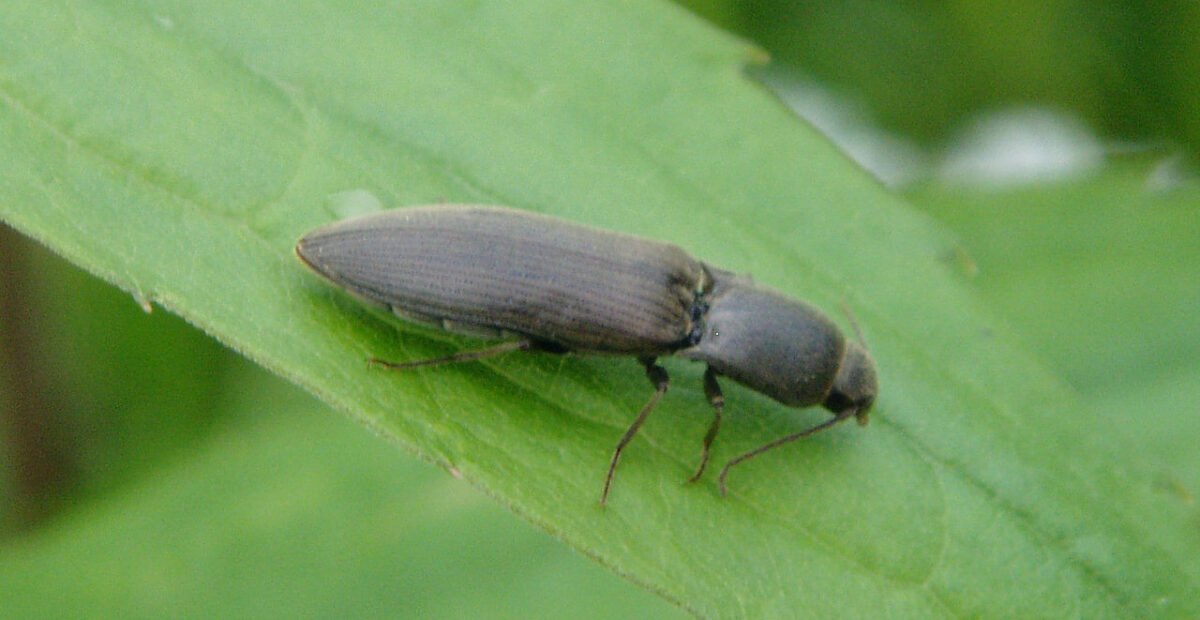
Lined click beetle (wireworm)
Agriotes lineatusLined click beetle (wireworm) overview
Agriotes lineatus is a European click beetle whose soil-dwelling larva is called a wireworm. The larvae feed on germinating seeds, roots, crowns, underground stems and tubers, causing poor stands, wilting, stunting and narrow tunnels in crops such as potatoes, corn and cereals. In the United States, established populations are especially documented in parts of the Pacific Northwest, where species-level confirmation is important because several wireworms look alike.
Typical conditions
Overview
The lined click beetle is an introduced European pest documented in parts of the Pacific Northwest, including western Washington and northwestern Oregon. Adults are slender, hard-bodied beetles; they generally cause little crop injury. The larva is cylindrical, yellow-brown to reddish brown, shiny and relatively rigid, with three pairs of legs near the head.
In gardens and farms, the most conspicuous injury is to potatoes and establishing crops. Larvae can kill seeds and seedlings, reduce plant stands, and tunnel into tubers. Other wireworm species may produce identical symptoms, so collect larvae and seek expert identification when management or regulatory decisions depend on the species.
Symptoms and identification
- Missing plants, uneven emergence or weak stands after planting.
- Seed injury that prevents germination, or seedlings with severed roots and underground stem damage.
- Wilting, stunting, yellowing or distorted young plants despite adequate water.
- Small round entry holes and narrow brown tunnels in potato tubers and other underground plant parts.
- Damage concentrated in grassy margins, former pasture, recently broken sod, cereal ground or moist portions of a field.
Adults are usually found on or near the soil surface and are not a reliable indicator of current larval density. Several wireworm species can be present in the same field.
Causes and spread
Damage is caused by the larvae feeding below ground. Females favor moist soil and often lay eggs in grassy areas. Populations can build where pasture, sod, grassy set-aside or cereal crops provide abundant roots. Movement of infested soil, rooted plants, tubers, farm equipment and other soil-bearing materials can spread larvae locally. Adult beetles may fly short distances, but many remain near the area where they developed.
Risk is often greater in moist, poorly drained or high-organic-matter areas. The presence of a click beetle adult does not by itself prove that A. lineatus larvae are responsible.
Life cycle and persistence
Adults overwinter as adults or larvae and commonly become active in spring. After mating, females lay eggs singly or in small clusters about 1–6 inches deep, often in moist grassy soil. Eggs may hatch in roughly 3–4 weeks under favorable conditions.
The larval stage is the long damaging phase and commonly lasts about 2–5 years in Pacific Northwest wireworm systems, although duration varies with species and environmental conditions. Larvae move vertically in the soil in response to temperature and moisture and may occur several feet deep. Mature larvae form soil cells and pupate during spring through midsummer; the pupal stage lasts about three weeks, followed by adult emergence from late spring through summer.
Treatment and control
There is no dependable rescue treatment for larvae already tunneling inside tubers or established below-ground plant tissues. First confirm the pest with soil sampling and, where possible, specialist identification. Remove and destroy severely damaged plants and cull tubers, and improve drainage if excess moisture is contributing to injury.
For future plantings, combine preplant monitoring, crop and site selection, weed and volunteer-grass control, cultivation timed to expose vulnerable stages, and carefully selected legal treatments where justified. In small gardens, baiting with pieces of carrot or germinating grain can help locate and remove wireworms, but trapping is labor-intensive and should not be treated as a guaranteed population-control method.
Low-impact and biological control
- Use carrot or germinating-grain bait stations before planting to detect hotspots and remove larvae; replace bait every few days while monitoring.
- Use trap crops such as wheat only when they can be removed or terminated before they increase food resources or allow larvae to remain in the bed.
- Maintain good drainage and avoid establishing potatoes or other susceptible crops immediately after infested grass or pasture.
- Timely cultivation during the local pupal period may expose pupae and larvae to desiccation and predators, but repeated tillage can also redistribute or protect surviving larvae, so use it strategically.
- Entomopathogenic fungi and nematodes, including research involving Metarhizium and entomopathogenic nematodes, may be useful in some systems, but field performance is variable and products, strains and application methods differ.
- Encourage ground-active predators by reducing unnecessary soil disturbance and maintaining appropriate habitat around, but not within, production beds.
Prevention
- Sample soil before planting, especially after pasture, sod, grass cover or cereal production. Use bait stations or germinating-grain bait, then inspect the soil and bait for larvae.
- Do not plant a highly susceptible crop immediately after heavily infested sod or cereal ground without a tested management plan.
- Control volunteer cereals and persistent grassy weeds, while avoiding unnecessary movement of soil between infested and clean beds.
- Improve drainage and avoid planting susceptible crops in known wet wireworm hotspots when practical.
- Rotate crops, but recognize that ordinary short rotations may not eliminate larvae because they can persist for several years.
- Use healthy, vigorous seed and promptly remove cull potatoes and other infested plant material after harvest.
- Where suitable, choose less susceptible cultivars and harvest potatoes as early as practical to reduce the period available for tuber injury.
Interesting facts
- The name click beetle refers to the adult's ability to snap a thoracic mechanism and spring into the air.
- The wireworm larva, not the adult beetle, is responsible for most crop damage.
- Larvae from the same egg batch may mature at different rates, allowing a population to persist for several years.
- Agriotes lineatus and A. obscurus are introduced European species documented as established in western Washington; neighboring detections have also been reported in northwestern Oregon.
- Wireworm damage is frequently attributed to a species complex, so accurate identification requires examining the larva or adult rather than relying only on crop symptoms.
Use chemical control only when monitoring shows a justified risk and only with a product legally authorized for the specific crop, site and wireworm problem in the United States. Product registrations, labeled crops, rates, application timing, worker protections and state restrictions can change. Follow the current EPA-approved label exactly; do not use products registered only for another crop, pest or country, and do not assume that a treatment aimed at one wireworm species will control Agriotes lineatus.
Affected plants
The plants below are linked to this problem by structured host-plant data. The list updates automatically as new plant profiles are added.