
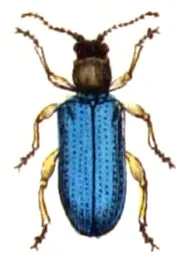
Cereal leaf beetle
Oulema melanopusCereal leaf beetle overview
Cereal leaf beetle, Oulema melanopus, is an occasional-to-serious pest of wheat, oats, barley, rye and other grasses in many regions of the United States. Adults make narrow leaf scars, while the larvae scrape away the green tissue between veins, leaving pale windowpanes that may make heavily infested grain fields look frosted. Early scouting and protection of the flag leaf are central to IPM.
Typical conditions
Overview
The cereal leaf beetle is an introduced Eurasian beetle now established across much of the United States. It is most important in wheat, oats, barley and rye, but adults and larvae may also use corn, forage grasses, grass seed crops and several wild grasses.
Adults are about 1/4 inch long, with metallic blue-black wing covers and head, and a reddish thorax and legs. Larvae are yellowish with a brown head and legs and commonly carry a shiny black or brown coating of mucus and fecal material, giving them a slug-like appearance.
Damage is usually most consequential when larvae feed on upper leaves during boot, heading or grain-filling stages. Identification should be confirmed from the insect, eggs or characteristic feeding pattern because other leaf-chewing insects can produce superficially similar injury.
Symptoms and identification
Adults scrape narrow, elongated strips from the upper leaf surface, often leaving parallel whitish or translucent scars. Larvae remove the green tissue between veins while leaving the lower epidermis intact, producing elongated pale “windowpanes.” As the damaged tissue dries, it may peel, tear or become brown.
- White to translucent longitudinal streaks on leaves
- Windowpane patches between veins caused by larvae
- Frosted or bleached-looking foliage in severe infestations
- Black, slimy-looking larvae on leaf surfaces
- Possible reduced grain fill or yield when the flag leaf is heavily damaged
Causes and spread
Spread occurs when overwintered adults fly or move from wooded borders, shelterbelts, grasslands, volunteer cereals and other protected sites into developing grain fields. Later-season adults can move into corn, forage grasses and newly planted or late-maturing cereals.
Thin stands, delayed crop development, cool wet springs and plentiful young host foliage can favor establishment and increase the chance that larvae reach economically important upper leaves. Movement of infested plant material may also contribute locally, although adult dispersal is the principal field-to-field pathway.
Life cycle and persistence
Cereal leaf beetle generally has one generation per year in the United States. Adults overwinter in leaf litter, wooded margins, shelterbelts and other protected vegetation. They become active in spring as temperatures rise, move into small-grain fields, feed and mate, and then lay eggs singly or in small groups on the upper leaf surface, often near the midrib.
Eggs darken as they mature and hatch after a temperature-dependent period. Larvae feed for roughly 10–14 days, although development is variable with weather. Mature larvae enter the soil and pupate. New adults emerge in late spring or early summer, feed briefly on cereals, corn or grasses, then enter a summer resting period before moving to overwintering sites in late summer or fall.
Treatment and control
When larvae are found, determine their average number per plant or stem and consider crop stage, stand condition, expected yield and natural-enemy activity. Protecting the flag leaf is generally more important than treating minor injury on older lower leaves. In many production systems, extension thresholds are based on eggs and larvae rather than adult feeding alone; thresholds differ among wheat, oats, barley, rye and regions.
If treatment is warranted, target young larvae before extensive windowpane injury develops and use only a currently labeled product for the crop and pest in the applicable state. Apply according to the label and integrated resistance-management guidance. Re-scout after treatment because uneven infestations, reinvasion from field margins and surviving natural enemies can affect results.
Low-impact and biological control
Begin with positive identification and regular scouting rather than routine spraying. Preserve parasitic wasps, lady beetles and other predators by avoiding unnecessary broad-spectrum insecticides and by maintaining unsprayed refuge vegetation where appropriate.
- Inspect cereal leaves for eggs and larvae, especially from spring green-up through heading.
- Use a sweep net and examine plants at multiple locations because infestations are often uneven.
- Support biological control; Tetrastichus julis and other parasitoids can substantially reduce larvae in some regions, but their effectiveness is local and should not be assumed.
- Remove volunteer cereal plants and manage grass weeds where practical, while avoiding unnecessary destruction of habitat supporting beneficial insects.
- For small plantings, hand-pick visible adults and larvae or remove heavily infested leaves when feasible.
Prevention
Use integrated crop management to reduce the likelihood and impact of outbreaks. Establish vigorous, uniform stands with appropriate fertility, seeding depth and planting date for the region. Avoid unnecessary delays that leave young, attractive cereal foliage exposed during peak adult activity.
- Scout field edges and thin areas first, then sample the whole field.
- Track volunteer wheat, oats and other grasses near production fields.
- Manage weeds and volunteer cereals without eliminating all noncrop vegetation that may support parasitoids.
- Maintain balanced fertility and reduce drought stress where irrigation is available.
- Choose locally adapted cultivars; some wheat lines with leaf pubescence show partial resistance, but commercially available resistance is inconsistent and region-dependent.
Interesting facts
- The larval black coating is made largely of mucus and fecal material and can rub onto clothing during field scouting.
- The flag leaf is especially important because injury there can reduce photosynthetic capacity during grain filling.
- Several parasitoids, including the egg parasitoid Anaphes flavipes and larval parasitoid Tetrastichus julis, have been used or established for biological control in parts of the United States.
- Adult feeding on corn is often temporary and may be largely cosmetic because cereal leaf beetles generally do not reproduce in corn.
- Populations can be highly localized and sporadic rather than uniformly damaging every year.
Use insecticides only when scouting shows that treatment is justified and only products legally authorized for cereal leaf beetle on the specific crop in your state and country. Follow the current product label exactly, including crop, target pest, rate, timing, pollinator precautions, reentry interval, preharvest interval and resistance-management directions. Do not treat adults automatically; larvae are usually the damaging stage and local economic thresholds vary by crop and growth stage.
Affected plants
The plants below are linked to this problem by structured host-plant data. The list updates automatically as new plant profiles are added.
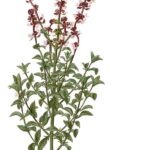 Basil (Ocimum basilicum) care guideOcimum basilicum
 Camphor basil (Ocimum kilimandscharicum) care guideOcimum kilimandscharicum
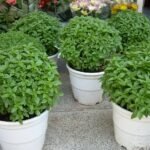 Ocimum basilicum minimum care guideOcimum basilicum minimum
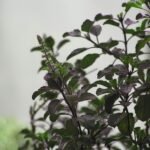 Holy Basil (Ocimum tenuiflorum) care guideOcimum tenuiflorum
 Sugar maple (Acer saccharum) care guideAcer saccharum
 Arrowwood (Viburnum carlesii) care guideViburnum carlesii
 Fragrant viburnum (Viburnum farreri) care guideViburnum farreri
 Wayfaring-tree (Viburnum lantana) care guideViburnum lantana
 Okra (Abelmoschus esculentus) care guideAbelmoschus esculentus
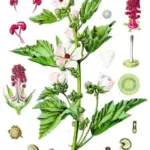 Marsh mallow (Althaea officinalis) care guideAlthaea officinalis
 Edible amaranth (Amaranthus tricolor) care guideAmaranthus tricolor
 Dill (Anethum graveolens) care guideAnethum graveolens