
Camphor basil (Ocimum kilimandscharicum) short overview
Camphor basil is an aromatic East African basil species grown as a tender perennial or short-lived shrub in warm climates. Its gray-green leaves carry a pronounced camphor fragrance, while summer spikes bear small pale pinkish-white flowers. In most of the United States, it is best grown as a summer herb, container plant, or overwintered indoors, where strong light, warmth, and sharply drained soil help maintain compact, healthy growth.
Taxonomic classification
Camphor basil (Ocimum kilimandscharicum) care guide
Light and placement
Give camphor basil at least 6–8 hours of direct sun, ideally with a south- or west-facing orientation. In very hot climates, light afternoon shade can reduce leaf scorch, but deep shade produces stretched stems, sparse foliage, and weaker fragrance. Pale growth and long internodes suggest insufficient light; bleached or crisp leaf margins suggest excessive heat, reflected light, or drought.
Watering and humidity
Water deeply when the top inch of soil feels dry, then allow excess water to drain fully. Container plants may need watering every few days during hot weather, while established garden plants need less frequent irrigation. Reduce watering in cool weather and indoors, but do not allow the root ball to remain bone-dry for extended periods. Good airflow matters more than unusually high humidity.
Soil and growing medium
Use fertile, sharply drained soil or a high-quality container mix amended with perlite or coarse material. A loam-based structure is suitable, but prolonged saturation can cause root problems. Slightly acidic to neutral soil is appropriate; avoid heavy, compacted beds and containers without drainage holes.
Feeding
Feed every 3–4 weeks during active outdoor growth with a balanced liquid fertilizer diluted to about half the label strength, or use a modest amount of finished compost at planting. Avoid heavy nitrogen feeding, which can produce soft, lush growth with weaker stems and fewer flowers. Stop regular feeding when growth slows indoors in fall and winter.
Growth and habit
Camphor basil grows quickly in heat and develops an upright, branching, somewhat shrubby habit. Pinching young shoots encourages branching and keeps container plants fuller. In frost-free climates it may persist for more than one season and become partially woody; elsewhere it is commonly managed as a summer annual or brought indoors before cold weather.
Planting and repotting
Plant outdoors only after frost danger has passed and nighttime temperatures are reliably warm. Set plants at the same depth as they were growing in their pots, firm the soil gently, and water deeply during establishment. Allow enough room for a broad, branching shrub form and provide excellent air circulation.
Repot container plants in spring when roots fill the pot or growth becomes crowded. Move up only one pot size, refresh the drainage-focused mix, and water thoroughly once after transplanting. Avoid repotting into an oversized container, which stays wet longer and can slow establishment.
Propagation and pruning
Propagation
Sow seed in warmth after the final frost, barely covering it because basil seed requires light or shallow placement for reliable emergence. Stem cuttings can root readily from healthy, non-flowering shoots in water or a clean, moist propagation medium. Keep young plants warm and bright until roots and new growth are established.
Pruning
Pinch stem tips regularly during the growing season to encourage branching and harvestable foliage. Remove weak, damaged, or congested stems and cut back spent flowering shoots if maintaining a leafy form. In frost-free climates, a harder shaping cut can be made after flowering, but avoid severe pruning during cold or drought stress.
Overwintering
Before temperatures fall below about 50°F, move container plants indoors or into a heated greenhouse. Place them in the brightest available window or under a grow light, reduce watering as growth slows, and inspect carefully for pests. In Zones 10–11, protect roots from occasional cool spells and avoid cold, waterlogged soil.
Uses
Useful as an aromatic ornamental herb, warm-season container plant, fragrant foliage plant, and flowering addition to pollinator-oriented gardens. Young leaves may be used cautiously as an herb where the plant has been correctly identified, but the strong camphor character is unlike sweet basil. Do not make medicinal or essential-oil preparations without qualified guidance.
Appearance
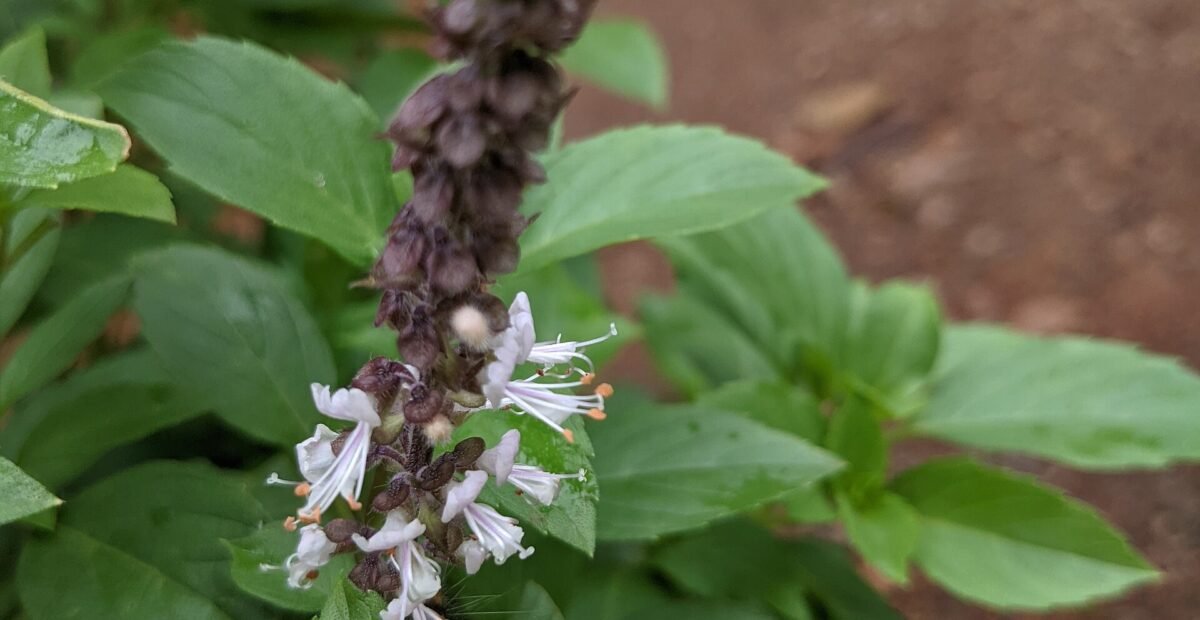
The plant has aromatic, gray-green to light green leaves on branching stems that may become somewhat woody with age. The foliage is visually softer and grayer than many common sweet basils, while the intense camphor odor is a useful identification clue. Small pale pinkish-white flowers are borne in upright terminal spikes.
Flowering
This true flowering basil produces upright terminal spikes of tiny, pale pinkish-white flowers during warm-season growth. Flowering is favored by long, warm days and mature stems. Regular harvesting may delay bloom, while allowing stems to flower creates a useful display for visiting insects.
Pollination and visitors
The small bilabiate flowers provide nectar and pollen for generalist flower visitors. Bees, bumblebees, hoverflies, and other insects are plausible and characteristic visitors of flowering basils, but a specific pollinator species was not established for this exact taxon in the reviewed sources.
Ocimum kilimandscharicum photos
Click any photo for a larger view. Source, author and license are shown separately.
Diseases and pests
Diseases
Prevent disease by using clean soil, avoiding overhead watering, and providing strong air movement. Watch for basil downy mildew, which can cause yellowing above and gray-brown to purplish growth beneath leaves, especially in humid conditions. Remove affected foliage promptly and avoid saving seed from badly diseased plants.
Pests
Inspect new growth for aphids, whiteflies, spider mites, and Japanese beetles. Strong plants with good airflow usually tolerate light damage. Rinse foliage, remove heavily infested shoots, and use insecticidal soap only as directed, testing first because aromatic leaves can be sensitive. Avoid broad-spectrum insecticides while flowers are open.
Toxicity and pollen
Reliable species-specific veterinary and human toxicity data are limited. The plant is an aromatic basil, but the strong camphor scent does not establish that every preparation is safe to ingest. Avoid concentrated essential oils and unverified medicinal use; prevent pets and children from consuming large amounts of foliage, and seek professional advice after significant exposure.
- Typical season
- Typically summer to early fall when flowering outdoors in the United States
- Pollination / pollen
- Primarily insect-carried pollen; limited airborne dispersal
As an insect-pollinated flowering herb, its pollen is not typically dispersed in large windborne clouds. However, airborne pollen exposure is not necessarily zero, especially near mass flowering or during handling of flowering stems. People with known basil or Lamiaceae sensitivities should use personal judgment and avoid contact if symptoms occur.
Native habitat
The species is native to Ethiopia, Kenya, Sudan and South Sudan, Tanzania, and Uganda. It occurs in seasonally dry tropical regions, where warmth, seasonal moisture, and good drainage support growth. Garden plants need protection from prolonged cold and wet winter soil rather than conditions resembling a cool temperate perennial border.
Interesting fact
The species is native from Ethiopia through eastern tropical Africa and is especially associated with seasonally dry tropical habitats. Its strong camphor aroma distinguishes it from many culinary basils. The accepted species is a parent of the commonly sold African blue basil hybrid, but the hybrid is not the same taxon.
Frequently asked questions (FAQ)
The most relevant questions about this plant, with short and direct answers.
🌱Quick care
What is Ocimum kilimandscharicum?⌄
Ocimum kilimandscharicum is camphor basil, an aromatic perennial herb or subshrub in the mint family, Lamiaceae. It is native to East Africa and is valued for its strong camphor-scented foliage.
How much light does camphor basil need?⌄
Camphor basil grows best in full sun, ideally with at least 6 hours of direct light daily. In very hot climates, light afternoon shade can reduce leaf scorch without seriously reducing growth.
How often should I water camphor basil?⌄
Water camphor basil when the top inch of soil begins to dry, keeping the root zone moderately and evenly moist. Avoid waterlogged soil, especially in containers, because poor drainage can cause root problems.
Is camphor basil annual or perennial?⌄
Camphor basil is a frost-tender perennial in warm climates but is often grown as an annual in colder parts of the United States. It may overwinter outdoors only where freezing temperatures are uncommon or brief.
How large does Ocimum kilimandscharicum get?⌄
Camphor basil commonly grows several feet tall and can become a branching shrub in warm conditions. Published descriptions vary, with mature plants ranging from about 3 feet to 6 feet or more depending on climate and cultivation.
🌤️Environment and placement
What USDA hardiness zones are suitable for camphor basil?⌄
Camphor basil is best suited to warm, frost-free USDA zones, approximately Zones 10–11, although the exact outdoor survival limit is not firmly standardized. In colder zones, grow it as a summer annual or bring it indoors before frost.
Can camphor basil grow indoors?⌄
Camphor basil can grow indoors in a bright, warm location, preferably beside a south- or west-facing window or under a grow light. Good air circulation and a container with drainage are especially important indoors.
What temperature is too cold for camphor basil?⌄
Camphor basil is frost tender and should be protected before the first frost or prolonged temperatures near freezing. Move container plants indoors when nighttime temperatures regularly approach the low 40s°F.
What soil is best for Ocimum kilimandscharicum?⌄
Use fertile, well-drained loam or a high-quality container mix that holds some moisture without staying wet. Adding compost can improve fertility, while perlite or coarse material can improve drainage in containers.
Can camphor basil grow in a container?⌄
Yes, camphor basil grows well in a container with drainage holes and a fertile, well-drained potting mix. Choose a sturdy container that can support a tall, branching plant and expect to water more often during hot weather.
💧Care and problems
Why are the leaves of my camphor basil turning yellow?⌄
Yellow leaves are often caused by overwatering, poor drainage, insufficient light, or depleted soil. Check that the container drains freely, let the surface dry slightly between waterings, and provide stronger light before adding fertilizer.
How do I prune camphor basil?⌄
Prune camphor basil by cutting stems just above a pair of leaves or a branching node. Regular tip pruning encourages a fuller shape, while removing damaged or weak growth improves airflow.
Should I pinch the flowers off camphor basil?⌄
Pinch off some flower spikes if you want to keep the plant focused on leafy growth. Leave some flowers if you want ornamental interest or resources for pollinators, because flowering does not automatically kill this perennial species.
What pests commonly affect camphor basil?⌄
Aphids, leafhoppers, spider mites, whiteflies, slugs, and snails can affect camphor basil. Inspect the undersides of leaves, improve air circulation, and use a strong water spray or an appropriately labeled insecticidal soap when needed.
Why is my camphor basil wilting even though the soil is wet?⌄
Wilting in wet soil can indicate root stress caused by poor drainage, root rot, or cool conditions. Check the roots and drainage holes, remove severely damaged roots if necessary, and replant into fresh, well-drained mix.
🪴Planting and repotting
When should I plant camphor basil outdoors in the United States?⌄
Plant camphor basil outdoors after the danger of frost has passed and the soil has warmed. In colder regions, start it indoors or buy a plant so it has a long warm growing season before fall temperatures return.
How deep should camphor basil seeds be planted?⌄
Sow camphor basil seeds shallowly, about one-quarter inch deep, in warm, moist seed-starting mix. Keep the medium consistently moist but not saturated until germination and early growth are established.
Does camphor basil need fertilizer?⌄
Camphor basil benefits from moderate fertilization during active growth, especially in containers. Use a balanced fertilizer according to the label directions, because excessive nitrogen can produce soft, lush growth with weaker structure.
Should camphor basil be repotted?⌄
Repot camphor basil when roots circle the container, emerge from drainage holes, or the plant dries out unusually quickly. Move it into a container only one or two sizes larger and use fresh, well-drained potting mix.
✂️Propagation and pruning
Can camphor basil be grown from seed?⌄
Yes, Ocimum kilimandscharicum can produce small black seeds, and seed propagation is possible. Seed availability and germination may be inconsistent, so use fresh seed and provide warm conditions.
Can camphor basil be propagated from cuttings?⌄
Yes, stem cuttings are a practical way to propagate camphor basil. Take a healthy nonflowering cutting, remove the lower leaves, and root it in water or a sterile, lightly moist rooting medium in warm, bright conditions.
How long do camphor basil cuttings take to root?⌄
Camphor basil cuttings commonly begin forming roots within a few weeks under warm, bright conditions. Pot them up once the roots are established, avoiding a long period in water because delicate roots can adapt poorly after transplanting.
Can camphor basil survive winter indoors?⌄
Camphor basil can survive winter indoors if kept warm, bright, and on the slightly dry side compared with summer care. Cut back weak growth, inspect for pests before bringing it inside, and avoid placing it near cold drafts.
How do I collect camphor basil seeds?⌄
Allow some flower spikes to remain until the seed capsules dry and turn brown, then collect and dry them further in a paper bag. Store the cleaned seeds in a cool, dry, labeled container until sowing.
⚠️Toxicity and safety
Is camphor basil safe to eat?⌄
The species-specific safety profile of camphor basil is not well established, and its strongly camphoraceous essential oils make routine medicinal or large culinary use inappropriate without expert guidance. Do not assume it has the same food-safety profile as common sweet basil.
Is camphor basil toxic to pets?⌄
Species-specific toxicity information for Ocimum kilimandscharicum is limited, so treat the plant and especially concentrated oils as potentially unsafe for pets. Prevent animals from chewing it and contact a veterinarian or poison-control service if ingestion occurs.
Can camphor basil essential oil be used medicinally?⌄
Do not use camphor basil essential oil internally or apply it medicinally without advice from a qualified healthcare professional. Essential oils are concentrated, and the plant’s camphor content makes casual home dosing inappropriate.
🌸Flowering and special interest
What do camphor basil flowers look like?⌄
Camphor basil produces small pale pinkish-white to mauve flowers in terminal spikes during warm-weather growth. The flowers are often attractive to pollinators and rise above aromatic, hairy foliage.
When does camphor basil bloom?⌄
Camphor basil generally blooms in summer when it receives adequate warmth and light. In frost-free climates or bright indoor conditions, flowering may continue beyond the typical outdoor season.
Does camphor basil attract pollinators?⌄
Yes, the flowers can attract bees and other pollinators, particularly when the plant is grown in full sun and allowed to flower. Leaving several flower spikes intact provides more value for pollinators than removing every bud.
Is camphor basil the same plant as African blue basil?⌄
No, camphor basil is the species Ocimum kilimandscharicum, whereas African blue basil is a separate hybrid involving camphor basil and Ocimum basilicum ‘Dark Opal’. They may share camphor fragrance, but they are not taxonomically identical.
Similar plants
 Wild basil (Ocimum gratissimum) care guideOcimum gratissimum
 Basil (Ocimum basilicum) care guideOcimum basilicum
 Holy Basil (Ocimum tenuiflorum) care guideOcimum tenuiflorum
 Ocimum basilicum minimum care guideOcimum basilicum minimum
 Xkakaltun (Ocimum campechianum) care guideOcimum campechianum
 Hairy basil (Ocimum americanum) care guideOcimum americanum