
 Source:
 Canker Stain of Sycamore
Ceratocystis plataniCanker Stain of Sycamore overview
Canker stain is a lethal vascular disease of sycamores and plane trees caused by the fungus Ceratocystis platani. It commonly begins with thinning foliage, wilting or dieback in one branch system, and inconspicuous bark lesions. Beneath the bark, reddish, purple, blue-black or brown discoloration develops in the sapwood. Infected trees generally decline and die, so laboratory confirmation and prompt sanitation are important.
Typical conditions
Overview
Canker stain of sycamore is caused by the ascomycete fungus Ceratocystis platani, formerly treated as Ceratocystis fimbriata f. sp. platani. In the United States, the disease is associated with American sycamore, Oriental planetree and London plane trees. It is a serious tree-health concern because infected trees can die within months to several years, depending on tree size, vigor, infection site and environmental conditions.
Early symptoms can resemble drought stress, scorch, root injury or other causes of crown decline. A suspected diagnosis should be confirmed by an appropriately equipped plant diagnostic laboratory or qualified forest-health professional; visual symptoms alone are not definitive.
Symptoms and identification
- Thinning crowns, smaller or sparse leaves, chlorosis, branch wilt and progressive twig or branch dieback.
- One branch system may decline first, especially when infection begins at a branch union, pruning wound or root injury.
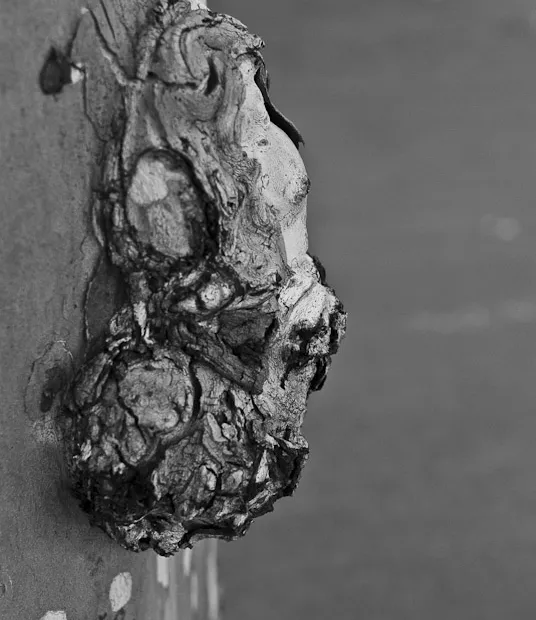
- Long, narrow, slightly sunken or lens-shaped cankers may develop on the trunk or large branches. The bark can become pale brown, reddish or purple-brown, crack longitudinally, and remain attached for some time.
- Small shoots may arise below a trunk canker, but callus formation at the lesion margin is often absent or limited.
- Removing bark around a suspected lesion may reveal orange, reddish, purple or bluish staining. Cross-sections of affected wood can show spindle-shaped or wedge-shaped blue-black to brown discoloration extending along the grain.
- Similar crown decline and cankers may result from other fungi, abiotic injury or mechanical damage, so destructive sampling should be performed carefully and only when appropriate.
Causes and spread
The pathogen enters mainly through fresh wounds in roots, trunks, branches and pruning cuts. Important movement pathways include contaminated pruning and cutting equipment, infected nursery stock, logs, firewood, wood chips, sawdust, soil and water associated with infected material. Root contact and fungal growth between neighboring roots can spread the disease locally. Construction, excavation, grading and other activities that move contaminated soil or injure roots can create additional infection opportunities.
Infected trees may produce spores in colonized wood, especially around wounds and dead tissue. Human-assisted movement is often more important for long-distance spread than natural dispersal. Do not move suspected infected wood, chips, soil or pruning debris to another site.
Life cycle and persistence
Ceratocystis platani survives and grows in infected sapwood, bark, roots, stumps and other woody tissues. After entering a wound, the fungus advances through vascular and adjacent tissues, causing cambial death and characteristic staining. As the infection expands, water transport is impaired and the crown progressively wilts and dies.
Sexual fruiting bodies called perithecia may develop on infected wood and produce ascospores; asexual spores can also be produced in colonized tissue. Spores and infected wood can contaminate tools, machinery, soil and water. Inoculum may persist in infected plant residues and soil for years under favorable conditions. The exact survival period varies with substrate and environment.
Treatment and control
There is no dependable curative treatment that restores a tree once Ceratocystis platani has become established in the trunk or major roots. Removing only visible branches or cutting out part of a canker may temporarily delay decline but can leave hidden infected wood and create additional wounds.
Have a qualified arborist and diagnostic laboratory assess the tree. Where infection is confirmed or strongly suspected, prompt removal of the entire tree, including infected stump and major roots when feasible, is generally the most effective disease-management action. Work should be planned to minimize soil, equipment and wood movement, and infected material should be handled and disposed of according to state and local requirements. Replanting another Platanus in contaminated soil may create a high-risk situation; choose a replacement species only after site-specific advice.
Low-impact and biological control
Organic and low-input management focuses on exclusion and sanitation rather than curing infected trees. Use clean, disinfected tools; avoid unnecessary pruning and root injury; prevent movement of contaminated soil and wood; remove confirmed infected trees and residues responsibly; and maintain tree vigor through appropriate irrigation, mulching and protection from compaction without burying the trunk flare.
No reliably effective organic spray, soil amendment or biological-control product should be presented as a cure for established canker stain. Biological or microbial products, if considered, should be used only where independently supported for this disease and legally labeled for the intended use.
Prevention
- Buy Platanus planting stock from reputable, inspected sources and avoid moving plants, logs, firewood, chips, sawdust or soil from areas with suspected or confirmed disease.
- Prune only when necessary, avoid unnecessary wounds, and use accepted arboricultural practices. Schedule routine pruning during relatively dry conditions when practical.
- Clean soil and plant debris from tools and machinery, then disinfect cutting surfaces between trees and between potentially contaminated cuts using a procedure recommended by your state plant-health authority or arborist.
- Prevent chainsaws, stump grinders, chippers, vehicles and excavation equipment from moving contaminated material between sites.
- Protect sycamore roots from grade changes, trenching, compaction and construction injury.
- Inspect trees regularly for one-sided crown decline, unusual cankers and stained wood. Obtain professional confirmation before removing a valuable or historic tree.
- Follow any state or local quarantine, notification, removal and disposal requirements. In the United States, suspected regulated plant-health problems should be discussed with the state department of agriculture or USDA APHIS.
Interesting facts
- The disease is also known as canker stain of plane and canker stain of sycamore.
- Platanus is the principal documented host genus, showing strong host specialization compared with many other Ceratocystis pathogens.
- Infected wood may show dramatic blue-black, reddish or brown staining even when the external bark still looks relatively normal.
- The pathogen was historically classified as Ceratocystis fimbriata f. sp. platani; modern references commonly use Ceratocystis platani.
- American sycamore is native to the United States, while the disease has caused severe losses among plane trees in parts of Europe after introduction.
- A diagnosis based only on canopy decline or a bark canker is unreliable because several diseases, injuries and environmental stresses can produce similar symptoms.
No pesticide program should be assumed to cure established Ceratocystis platani infection. Use only products legally authorized and currently labeled for the specific crop, site and disease in your state and country, and follow the current label exactly. Any chemical treatment should be considered supplemental to diagnosis, sanitation, wound prevention and regulated disease-management procedures; consult a certified arborist, state plant-health official or extension specialist before use.