
Asparagus Beetle
Crioceris asparagiAsparagus Beetle overview
The asparagus beetle, Crioceris asparagi, is a chewing leaf beetle that feeds almost exclusively on asparagus. Adults attack emerging spears, causing brown scars, hooked or distorted growth, and unmarketable produce. Adults and larvae later feed on asparagus fern, and severe defoliation can weaken crowns and reduce next season’s vigor. Regular scouting, sanitation, hand removal, and protection of beneficial insects are central to management.
Typical conditions
Overview
Crioceris asparagi, commonly called the asparagus beetle or common asparagus beetle, is a leaf beetle in the family Chrysomelidae. In the United States it is associated primarily with cultivated and wild asparagus.
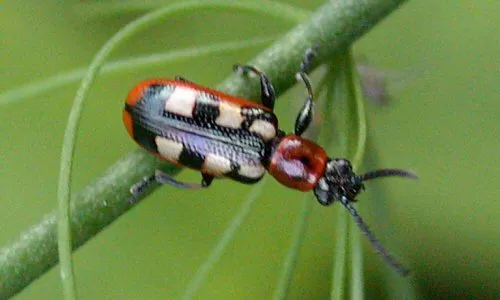
Adults are typically about 1/4 inch long, bluish black, with a reddish thorax, reddish wing margins, and pale spots on the wing covers. Larvae are soft-bodied, gray to green-gray, and have a dark head. The common asparagus beetle generally causes more damaging spear injury than the spotted asparagus beetle, Crioceris duodecimpunctata.
Symptoms and identification
- Adults chew tender emerging spears, producing brown scars, pits, and weakened or distorted growth.
- Damaged spears may bend into a characteristic shepherd’s crook or hook because one side grows more slowly than the other.
- Dark brown, oval eggs may be conspicuous on spears, stems, fern branches, or flower buds and can make harvested spears unmarketable.
- Adults and gray larvae chew asparagus fern and may cause browning, skeletonization, or partial defoliation.
- Severe fern injury reduces photosynthetic area, which can weaken crowns and reduce vigor or yield in the following season.
Distinguish this pest from the spotted asparagus beetle: the latter is usually reddish orange with black spots, and its larvae commonly feed on asparagus berries rather than causing equivalent fern damage.
Causes and spread
Damage is caused by chewing adults and larvae, not by a disease organism. Adults enter activity in spring as asparagus spears emerge, then feed and lay eggs on the crop. Larvae move onto fern growth after hatching. New beetles can fly into a planting from nearby asparagus beds, field edges, or overwintering residue.
Populations are favored when old asparagus fern, weeds, straw, leaves, or other plant debris remain near the planting and provide sheltered overwintering sites. Dense volunteer asparagus and unmanaged neighboring beds can also sustain local populations.
Life cycle and persistence
Adults overwinter in old asparagus fern, hollow stems, weeds, loose bark, and other protected debris. They commonly emerge around the time spears break through the soil in spring. Females attach dark brown eggs singly or in rows to asparagus tissue; eggs generally hatch in several days to about one week.
Larvae feed mainly on fern growth for roughly two to three weeks, then drop to the soil and pupate just below the surface. Adults emerge after pupation and continue feeding. Depending on temperature and region, two or three generations may occur during the growing season; cooler areas may support fewer complete generations.
Treatment and control
Use an integrated approach based on actual injury rather than treating every beetle observed. In small plantings, hand-pick adults and larvae and drop them into soapy water. Rub or brush eggs from spears and fern stems when practical, taking care not to injure the crop.
For larger plantings, monitor a representative number of plants during afternoon scouting. Extension thresholds commonly used in U.S. production include approximately 5–10% of spears with beetles or about 2% of spears with eggs during harvest, and roughly 50–75% of plants with larvae during the fern stage. Local recommendations may differ by region, crop value, plant age, and whether spears are being harvested.
Protect the fern after harvest because it replenishes crown reserves. If treatment is warranted, select a product legally registered for asparagus and the target pest in the state where it will be used, and verify the current label, application timing, reentry interval, pollinator precautions, and preharvest interval.
Low-impact and biological control
- Hand-picking and egg removal are often effective in home gardens and small beds.
- Remove and properly dispose of fully dormant fern residue to reduce overwintering habitat.
- Conserve the metallic green parasitoid wasp Tetrastichus asparagi, which attacks asparagus beetle eggs, as well as lady beetle larvae and other generalist predators.
- Avoid broad-spectrum insecticide applications when beetle pressure is low because they can kill egg parasitoids and predators that help suppress later generations.
- Organic products such as neem-based materials or spinosad formulations may be available for some asparagus uses, but availability, crop labeling, harvest intervals, and permitted uses vary. Confirm the current U.S. product label before application.
Prevention
- Scout asparagus beginning at spear emergence and continue through the fern season, concentrating inspections on warm, sunny afternoons when adults are most active.
- Harvest spears regularly and promptly, removing malformed or heavily infested spears from the planting.
- After fern growth has completely browned and become dormant, remove dead fern from the bed and dispose of it away from the planting according to local rules.
- Reduce nearby weeds and excess plant debris that can shelter overwintering adults, while avoiding unnecessary disturbance of beneficial insect habitat.
- Maintain adequate water, fertility, and weed control so crowns can produce vigorous fern growth after harvest.
- Check new plantings especially carefully because young asparagus stands are more vulnerable to crown weakening from repeated defoliation.
Interesting facts
- The common asparagus beetle is strongly associated with asparagus and is considered largely host-specific.
- Adults may drop from the plant and remain motionless when disturbed, a defensive behavior sometimes described as playing dead.
- Eggs of the common asparagus beetle are typically dark and conspicuous, often standing outward from the asparagus tissue.
- Spears can become hooked because localized feeding slows growth on the injured side.
- The related spotted asparagus beetle often causes less serious plant injury because its larvae commonly feed on asparagus berries.
Use only pesticides currently legally authorized and labeled for asparagus and Crioceris asparagi in the applicable U.S. state. Follow the current product label exactly, including rate, protective equipment, pollinator restrictions, reentry interval, and preharvest interval. Do not infer legality or crop safety from a product mentioned in an older extension publication, another state, or a different crop.
Affected plants
The plants below are linked to this problem by structured host-plant data. The list updates automatically as new plant profiles are added.
 Asparagus (Asparagus officinalis) care guideAsparagus officinalis
 Basil (Ocimum basilicum) care guideOcimum basilicum
 Camphor basil (Ocimum kilimandscharicum) care guideOcimum kilimandscharicum
 Ocimum basilicum minimum care guideOcimum basilicum minimum
 Holy Basil (Ocimum tenuiflorum) care guideOcimum tenuiflorum
 Sugar maple (Acer saccharum) care guideAcer saccharum
 Arrowwood (Viburnum carlesii) care guideViburnum carlesii
 Fragrant viburnum (Viburnum farreri) care guideViburnum farreri
 Wayfaring-tree (Viburnum lantana) care guideViburnum lantana
 Okra (Abelmoschus esculentus) care guideAbelmoschus esculentus
 Marsh mallow (Althaea officinalis) care guideAlthaea officinalis
 Edible amaranth (Amaranthus tricolor) care guideAmaranthus tricolor