
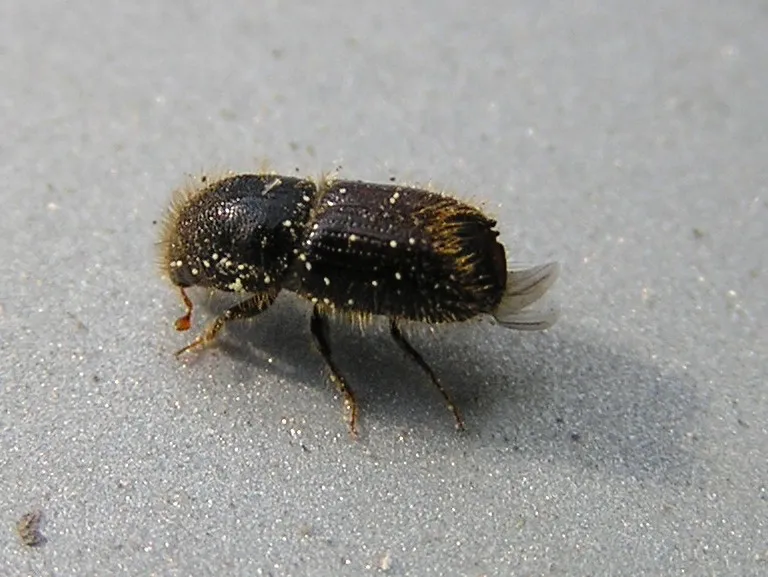
European Spruce Bark Beetle
Ips typographusEuropean Spruce Bark Beetle overview
European spruce bark beetle (Ips typographus) is a serious bark-boring pest of spruce, especially Norway spruce, that breeds beneath the bark of stressed, recently felled, windthrown, or drought-affected trees. Adults excavate galleries and larvae feed in the phloem, disrupting water movement and often carrying blue-stain fungi. The species is not established in the United States but has been repeatedly intercepted in imported wood and was detected once in Florida in 2023.
Typical conditions
Overview
This beetle attacks the phloem and inner bark of spruce trees. Initial colonization is most common in recently felled, windthrown, drought-stressed, heat-stressed, or otherwise weakened trees. During severe population increases, it can overcome healthy spruce by mass attack.
Adults bore through the bark and establish mating chambers and egg galleries. Larvae construct branching galleries beneath the bark. The beetle is also associated with blue-stain fungi, which may colonize the sapwood and intensify disruption of water transport. Early attacks can be difficult to detect and may resemble damage from native Ips and other bark beetles.
For United States landscapes and forests, a suspected specimen or infestation should be documented and reported to the state plant regulatory agency or USDA APHIS rather than assumed to be this species from symptoms alone.
Symptoms and identification
- Small, round entrance or exit holes, generally about 1/16–1/8 inch in diameter, in spruce bark.
- Light-brown boring dust or frass in bark crevices, around holes, or at the tree base; fresh resin may also be present.
- Foliage may fade from green to yellow, then reddish-brown, and eventually fall. Crown symptoms are often late and may begin in the upper crown or larger branches.
- Removing the bark can reveal a central maternal gallery with radiating egg galleries, often forming a Y- or X-like pattern, plus larval galleries.
- Blue-gray or bluish-black staining may be visible in sapwood around galleries, but staining is not diagnostic by itself.
Symptoms overlap with other bark beetles, wood-boring insects, drought injury, and root or stem diseases. Species-level confirmation requires examination of adult morphology and, when needed, specialist or molecular identification.
Causes and spread
The pest is spread primarily when adults emerge from infested spruce logs, branches, windthrow, nursery or landscape material, firewood, bark-covered lumber, and solid-wood packing material. Long-distance movement in the United States is a particular concern for untreated or improperly treated wood associated with international trade.
Local population growth is favored by abundant recently damaged spruce, drought, heat, storms, wildfire, logging residue, and dense spruce stands. Aggregation pheromones help adults concentrate attacks. Outbreak conditions can allow attacks to expand from weakened trees to living trees.
Life cycle and persistence
Adults overwinter mainly beneath the bark as adults or immature stages. In spring, temperature-dependent flight begins as conditions warm, commonly when temperatures are above approximately 50°F. Males initiate galleries and attract several females; females excavate egg galleries in the phloem.
Eggs hatch into legless larvae with brown head capsules. Larvae tunnel outward, pupate beneath the bark, and develop into new adults that chew emergence holes. Depending on latitude, elevation, temperature, host condition, and season length, one or more generations may occur annually; two generations are possible in favorable European climates. Exact timing should not be transferred directly to every United States climate.
Treatment and control
There is no practical curative treatment once a spruce is heavily colonized and the phloem has been extensively disrupted. Confirm the diagnosis before removing trees because native bark beetles and non-insect disorders can produce similar symptoms.
For infested or freshly attacked material, promptly fell and remove the material from the site, debark it completely, chip it, or use another officially approved treatment that destroys insects beneath the bark. Coordinate disposal with the state plant-health authority if I. typographus is suspected, because movement restrictions or survey actions may apply. Do not transport suspect bark-covered wood to another property.
Protective bark treatments, where legally available and appropriate, can sometimes reduce attacks on high-value, uninfested spruce when applied before beetle flight. They do not reliably eliminate beetles already beneath the bark and should be selected and applied only by a qualified professional under the current product label.
Low-impact and biological control
- Prioritize sanitation: remove and destroy breeding material before adult emergence.
- Debark or chip infested spruce logs and branches; keep processed material away from live spruce until it is no longer capable of producing beetles.
- Reduce drought stress and avoid practices that injure roots or trunks.
- Increase stand and landscape diversity where feasible rather than maintaining large, continuous plantings of susceptible spruce.
- Use monitoring traps and regular inspections to detect activity, but do not rely on traps to suppress an established outbreak.
- Biological enemies occur naturally, but commercially released biological controls are not a dependable stand-alone treatment for this pest.
Prevention
- Maintain spruce vigor with appropriate irrigation during prolonged drought, especially for newly planted or landscape trees; water deeply and infrequently according to soil and site conditions.
- Avoid trunk wounds, soil compaction, root damage, unnecessary construction disturbance, and improper pruning.
- Inspect spruce after storms and promptly remove windthrown, broken, or heavily declining material.
- Process infested logs by debarking, chipping, or an approved treatment method before beetle emergence. Do not retain bark-covered spruce logs beside live spruce.
- Use firewood locally where permitted and do not move bark-covered firewood across state or regional boundaries unless it meets applicable requirements.
- Purchase and transport only compliant, treated, or certified wood-packing material. Suspect exotic bark beetles should be reported to state agriculture officials or USDA APHIS.
- Use pheromone traps only for surveillance or delimitation; traps are not a substitute for sanitation and official detection work.
Interesting facts
- The species name typographus refers to the distinctive printing-like pattern associated with its gallery system beneath spruce bark.
- Adults have a concave rear declivity bordered by prominent teeth or spines, a useful feature for separating this species from some other bark beetles, although expert identification is recommended.
- Norway spruce (Picea abies) is the principal host in Europe, but documented susceptibility extends to several other Picea species, including North American spruces.
- The beetle has been repeatedly intercepted in United States ports in imported wood and packing material. A single adult was detected in a Florida survey trap in February 2023, but follow-up surveys found no established population.
- Blue-stain fungi associated with bark beetles can contribute to rapid wilting by colonizing conducting tissues; the fungi and beetle should be considered together in diagnosis.
Do not apply a pesticide based solely on a symptom-based identification. In the United States, use only a product legally authorized for the specific crop or site and pest in your state, and follow the current label exactly, including directions, timing, personal protective equipment, re-entry, environmental precautions, and disposal requirements. Many products protect uninfested bark only when applied before attack; they do not cure trees containing established galleries. Consult a licensed arborist or state extension specialist for high-value trees or suspected exotic infestations.