
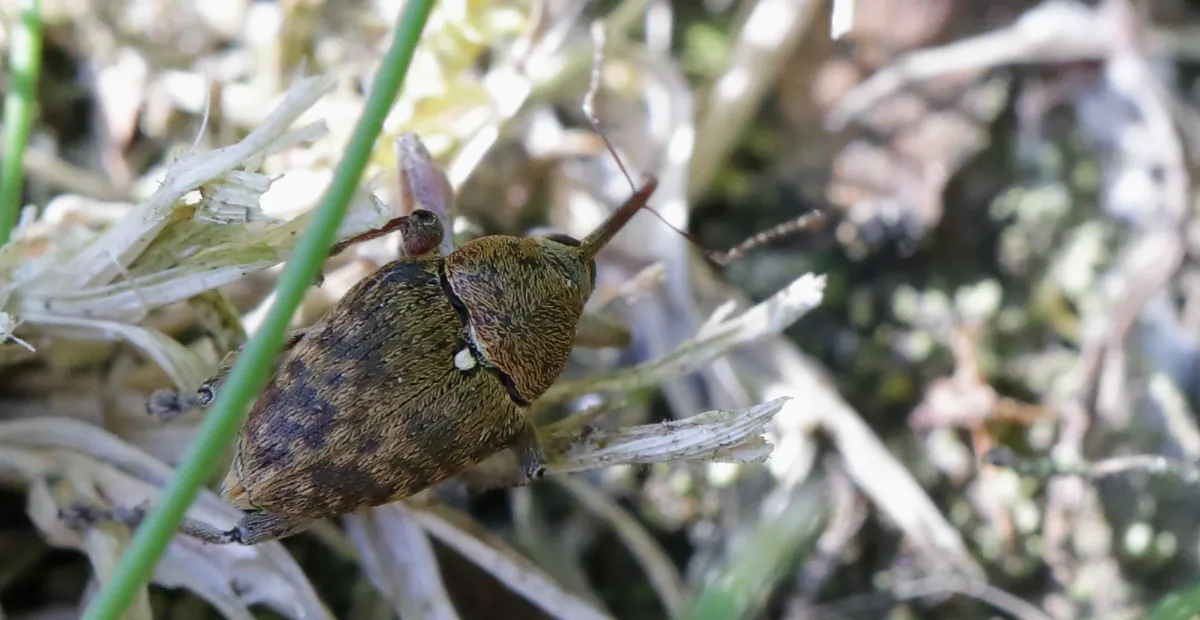
European hazelnut weevil (Curculio nucum)
Curculio nucum Linnaeus, 1758European hazelnut weevil (Curculio nucum) overview
The European hazelnut weevil, Curculio nucum, is a long-snouted beetle whose larvae develop inside hazelnuts, consuming the kernel and often causing blank nuts and premature nut drop. It is native to Europe and western Asia and is considered absent from the United States, where it is treated as a high-risk regulated plant pest. Suspected findings should be documented and reported rather than moved or released.
Typical conditions
Overview
The European hazelnut weevil is a beetle in the family Curculionidae. It is also called the nut weevil or hazelnut weevil in different regions. The pest is closely associated with hazels, especially European hazel (Corylus avellana), and can seriously reduce nut yield in unsprayed orchards.
Adults are brownish, long-snouted weevils. The damaging stage is the creamy-white, legless larva inside the nut. In the United States, this species is not considered established; similar damage may instead be caused by native or established hazel-feeding Curculio species, so identification should be confirmed by an entomologist or regulatory diagnostician.
Symptoms and identification
- Small punctures or oviposition holes in developing hazelnut shells or husks.
- Premature nut drop, shriveled nuts, blank shells or kernels that fail to develop.
- Larval feeding damage and frass inside the shell.
- A roughly 2-mm round exit hole after the mature larva leaves the nut.
- White, legless larvae may be found inside damaged nuts or in the soil beneath hazel trees.
- Adults may notch or rasp young leaves, buds, flowers and husks, although this feeding is usually less important than kernel destruction.
These symptoms are not diagnostic by themselves. Other nut-feeding weevils, moth larvae and abiotic nut-abortion problems can appear similar.
Causes and spread
Spread occurs primarily through movement of live adults, infested hazelnuts containing larvae, and contaminated soil or plant material containing overwintering larvae. Larvae normally remain within the nut until they chew an exit hole, after which they enter the soil. Adults can then disperse locally among nearby hazel trees.
Long-distance movement is most likely through infested nuts, nursery material or soil. In the United States, suspected detections should be treated as potential regulatory incidents: isolate the material, avoid transport or disposal that could release insects, and contact the state plant regulatory agency or USDA APHIS.
Life cycle and persistence
Usually one generation develops each year, although some larvae may remain dormant in the soil for one to four additional years. Adults emerge from soil cells in late March or April in much of the native range and remain on hazels into early July, with timing shifting later in northern or mountainous regions.
New adults feed on hazel flowers, buds, shoots and young leaves. Adults generally mature sexually four to eight weeks after emergence. Females use the snout to drill a hole in a developing hazelnut and usually place one egg per hole. Eggs hatch in about two to three weeks, depending on temperature.
Larvae feed inside the shell for approximately four to five weeks, consuming the kernel. Mature larvae chew an exit hole, drop to the ground and burrow about 0.4–0.8 inch into the soil, where they form an earthen cell and overwinter. Most pupate the following spring, but delayed emergence can occur.
Treatment and control
There is no general U.S. homeowner treatment recommendation for confirmed Curculio nucum. First isolate the affected material and obtain an official identification, because native North American hazel weevils can resemble this species and require different regulatory and management decisions.
For a confirmed infestation outside the United States, management is normally directed at adults before egg laying, supported by removal of dropped nuts and monitoring of adult emergence. Once larvae are inside the shell, contact treatments have limited access. Any insecticide use in the United States must be based on a current, legally approved label for the crop and pest, with timing determined by local extension or regulatory guidance.
Low-impact and biological control
Because this species is not established in the United States, the first response to a suspected find is containment and reporting, not home treatment. Do not move suspect nuts, soil, plants or insects to another location.
- Collect representative adults and damaged nuts without dispersing them; preserve specimens as directed by the state department of agriculture or diagnostic laboratory.
- Remove and destroy fallen, visibly infested nuts before larvae exit. Bagging and disposal should follow local plant-health instructions.
- Monitor developing nuts and foliage regularly from spring emergence through early summer. Shake small trees over a sheet and remove identifiable adults where practical.
- Maintain an orchard floor that permits inspection and rapid removal of dropped nuts. Avoid practices that spread contaminated soil or plant debris.
- Use physical exclusion, sanitation and trapping only when they are locally validated for the confirmed species. Pheromone or volatile-bait systems reported for other Curculio species should not be assumed to work for C. nucum.
- Biological products, entomopathogenic nematodes and microbial agents require species-specific evidence, legal registration and local efficacy data before use.
Prevention
- Purchase hazel plants and nut material from reputable, inspected sources and comply with current U.S. interstate and international plant-health requirements.
- Inspect hazelnuts for punctures, premature drop, larval damage and exit holes before moving or planting material.
- Survey hazel foliage, developing nuts and the soil surface from spring through early summer, adjusting scouting to local weather and bloom or nut-development stages.
- Remove dropped and suspect nuts promptly, especially before larvae emerge.
- Do not transport suspect insects, nuts, soil or plants. Photograph the pest and damage and submit specimens through official diagnostic channels.
- Maintain cultivar diversity and consider locally tested, less-susceptible hazel selections where available, without assuming that resistance to one weevil species protects against another.
Interesting facts
- Curculio nucum is highly host-specific in well-supported studies, with European hazel documented as its principal host.
- Infestation can produce both wormy nuts and “blank” nuts in which larval feeding or early embryo damage prevents normal kernel development.
- Most larvae leave the nut and spend the nonfeeding period in the soil, so sanitation of dropped nuts alone may not eliminate an established population.
- Some commercial hazel cultivars show partial resistance associated with shell thickness, hardness or other nut-shell traits, but resistance is cultivar- and region-dependent.
- The pest should not be confused with North American hazel-feeding weevils such as Curculio obtusus or Curculio uniformis.
No pesticide program is prescribed here because U.S. registrations and crop labels can change, and Curculio nucum is not established in the United States. Use only products legally authorized for hazelnut or filbert and this specific pest in your state and country; follow the current label exactly, including rate, timing, worker-protection requirements, pollinator precautions and preharvest interval. Do not import, apply or recommend foreign-label products.