
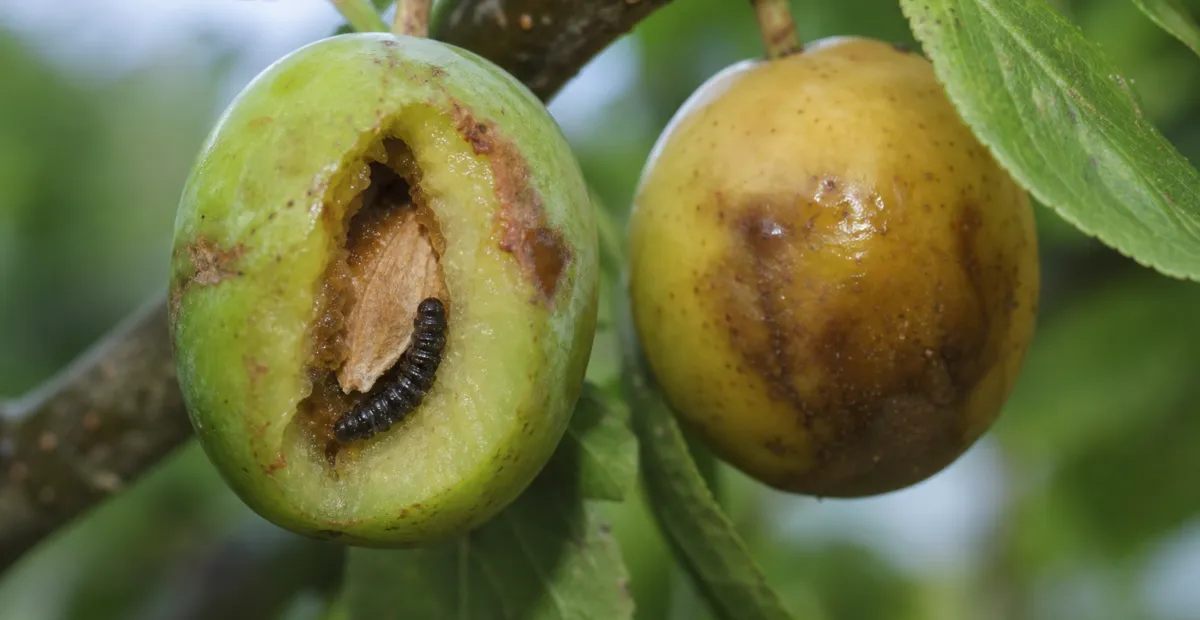
Black Plum Sawfly
Hoplocampa minutaBlack Plum Sawfly overview
The black plum sawfly, Hoplocampa minuta, is a specialized fruit-damaging sawfly associated mainly with European plum and myrobalan plum. Adults appear around plum bloom, and the larvae tunnel from young fruit into the developing seed. Infested plums often turn yellow and drop prematurely. Accurate identification matters because related plum sawflies have similar symptoms and management timing.
Typical conditions
Overview
The black plum sawfly is a small hymenopteran pest whose damaging stage is the larva, not a caterpillar. Adults are active around plum flowering and females insert eggs into open flowers, usually in the calyx or receptacle region. After hatching, larvae enter newly set fruit and feed internally.
Damage can be confused with other plum sawflies, plum curculio, frost injury or natural fruit shedding. Confirmation is strongest when a pale sawfly larva, internal gallery and feeding near the developing seed are found together.
In the United States, gardeners should have unusual or severe infestations confirmed through a Cooperative Extension diagnostic service or state plant-health authority before selecting controls, because closely related fruit sawflies have different host associations and distributions.
Symptoms and identification
- Small developing plums become yellow, wilted or misshapen and drop prematurely.
- A small entry wound or darkened area may occur near the calyx end.
- Opening an affected fruit may reveal a pale, curved sawfly larva and a brown or partially eaten developing seed.
- Larval galleries may contain dark frass, and one larva can move among several young fruits.
- Severe infestations can cause conspicuous early fruit drop shortly after bloom.
Causes and spread
Adult females spread the pest locally by flying among flowering plum trees and inserting eggs into blossoms. Larvae spread damage within the orchard as they move from fruit to fruit, while mature larvae leave fallen or damaged fruit and enter the soil. Movement of infested nursery stock, soil or fruit could assist longer-distance spread, although the importance of each pathway depends on local conditions and regulatory status.
Related species such as the yellow plum sawfly can produce similar injury, so fruit symptoms alone are not sufficient for species-level identification.
Life cycle and persistence
The species generally has one generation per year, although development may occasionally extend over two years. Adults emerge in early spring, commonly around March or April in the documented European range, with timing controlled by local temperature and plum bloom. Females mate and lay roughly several dozen eggs in open flowers.
Egg development takes about 10–14 days. Newly hatched larvae enter young fruit near petal fall and feed internally, often consuming the developing seed. Larval development commonly lasts about 25–38 days with four molts. Mature larvae leave the fruit, enter the soil and form a cocoon, where they remain in diapause before pupating and emerging the following spring.
For U.S. gardens, use local plum bloom and fruit-drop timing rather than calendar dates to guide monitoring.
Treatment and control
Begin with confirmation and monitoring. During bloom and shortly after petal fall, inspect blossoms and young fruit, and examine fallen fruit by cutting it open. If infestation is confirmed, promptly remove dropped and visibly infested fruit to interrupt larval development.
For commercial or high-value plantings, consult the local Cooperative Extension service for a treatment threshold and timing based on local monitoring. Any intervention directed at adults or newly hatched larvae must be precisely timed because larvae quickly become protected inside fruit. Avoid spraying open blossoms, when pollinators are foraging, unless the product label and local professionals specifically support a legally compliant application.
Soil-directed biological approaches may be considered where suitable products and application guidance are available, but their performance depends on larval exposure, soil moisture, temperature and correct timing.
Low-impact and biological control
- Hand-pick and remove fallen or infested young plums at least weekly during the damage period.
- Use orchard sanitation to prevent mature larvae from returning to the soil.
- Encourage beneficial insects with diverse, pesticide-sparing habitat outside the crop row, while avoiding flowering weeds that could increase spray exposure risks.
- Entomopathogenic nematodes have shown experimental potential against plum sawflies in soil, but results are formulation-, species-, soil- and timing-dependent; use only products legally registered and labeled for the intended site and purpose.
- Do not rely on home remedies, unverified microbial products or broad-spectrum sprays as substitutes for identification and monitoring.
Prevention
- Inspect plum trees during bloom and again from petal fall through early fruit development.
- Remove and destroy prematurely yellowing or fallen fruit before larvae complete development; do not compost suspect fruit unless the compost reaches reliably pathogen- and insect-killing temperatures.
- Keep orchard floors accessible for inspection and avoid moving soil, nursery material or suspect fruit from infested areas.
- Record bloom, fruit-drop and larval observations each year to improve timing.
- Use yellow monitoring traps or other locally validated monitoring methods where recommended by Extension; traps support detection but are not a stand-alone control.
- Maintain a balanced orchard IPM program that protects pollinators and naturally occurring parasitoids and predators.
Interesting facts
- Hoplocampa minuta is a sawfly, so its larva is a wasp larva rather than a true caterpillar.
- The female places the egg in flower tissue, allowing the young larva to enter fruit at a highly vulnerable stage.
- The larva commonly feeds toward the developing plum seed, making early fruit dissection useful for diagnosis.
- Mature larvae leave the fruit and spend most of the year in a soil cocoon, which explains why sanitation and soil-focused biological control can complement bloom-time monitoring.
- Black and yellow plum sawflies may occur together and can be difficult to distinguish without adult or larval characters.
Use only pesticides legally authorized for the specific crop, pest and application site in your country and state. Follow the current product label exactly, including crop restrictions, rate, preharvest interval, reentry interval, protective equipment, weather limits and pollinator precautions. Product registrations and labels change; consult the current U.S. EPA label, state requirements and Cooperative Extension recommendations before use. Never spray open plum blossoms when bees or other pollinators are actively foraging unless the label explicitly permits the application under those conditions.