
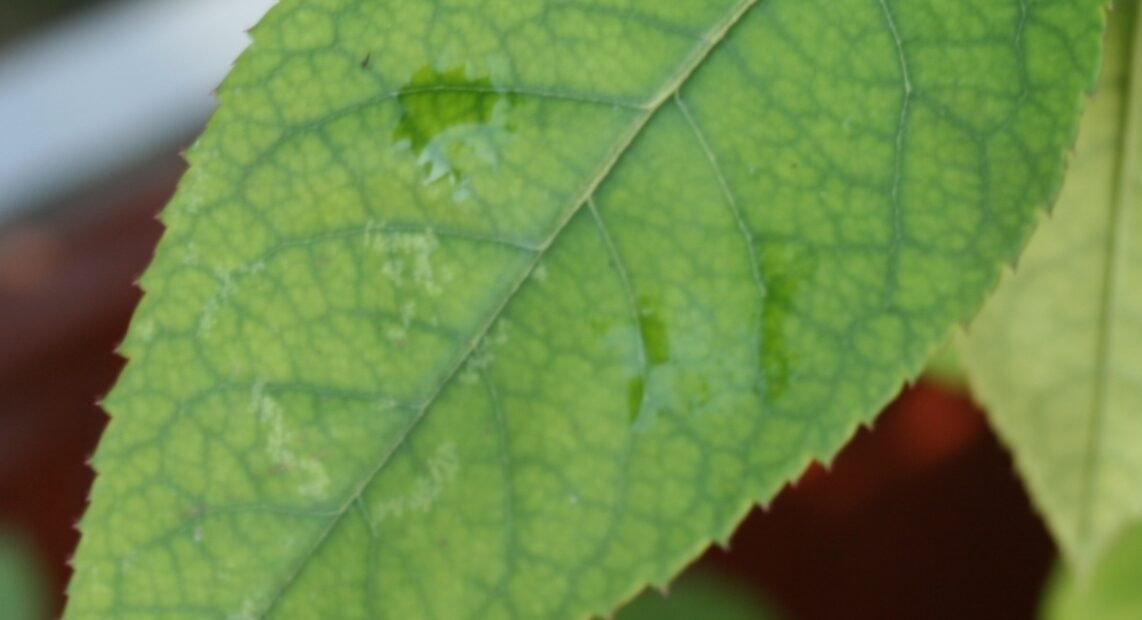
Manganese deficiency
Manganese deficiency overview
Manganese deficiency is a nutrient disorder that commonly affects young leaves, causing yellowing between the veins while the veins remain green. It is most often associated with alkaline or over-limed soil, sandy or highly leached ground, poor root activity, or wet, compacted conditions. Symptoms can resemble iron deficiency, so soil and tissue testing are useful before applying manganese.
Typical conditions
Overview
Manganese (Mn) is required in very small amounts, but plants use it in photosystem II and several enzyme systems. Because Mn is relatively immobile within the plant, deficiency usually appears first on newly expanding leaves.
The typical broadleaf symptom is diffuse interveinal chlorosis: tissue between the veins turns pale green or yellow while the veins remain green. Depending on the crop, symptoms may instead appear as fine chlorotic speckling, parallel yellow streaks, gray speck lesions, necrotic streaks or severely stunted new growth.
Visual diagnosis alone is unreliable. Compare affected and unaffected plants, inspect the newest leaves, review soil and irrigation conditions, and confirm suspected deficiency with an appropriate soil test and, where useful, plant-tissue analysis.
Symptoms and identification
- Young leaves develop yellow or pale tissue between still-green veins.
- In many dicots, the green veins are relatively broad and may form a fishbone-like pattern.
- Fine chlorotic speckling, brown flecks or dark necrotic areas may develop as symptoms worsen.
- Plants may be stunted, with small leaves, short stems, delayed bulbing or reduced canopy development.
- Wheat and barley may show yellow parallel streaks; oats may develop gray speck symptoms.
- Potato and sugar beet can develop interveinal chlorosis with gray or black freckling.
- Palms may produce chlorotic, necrotic, shortened or frizzled new leaves, sometimes progressing to severe growing-point injury.
- Symptoms can resemble iron deficiency, magnesium deficiency, herbicide injury, disease or root damage.
Causes and spread
Manganese deficiency is usually caused by low plant-available Mn rather than an absence of total manganese in the soil. High soil pH, alkaline irrigation water, excessive liming and calcareous conditions can reduce availability. Sandy or heavily leached soils, high organic-matter media that bind Mn, cool weather, waterlogged or poorly aerated soil, compaction and damaged roots can also restrict uptake.
The disorder does not have an infectious lifecycle and does not spread between plants. Its distribution often follows soil pH, drainage, compaction, irrigation patterns or areas with different fertilizer and amendment histories. Excess iron or other nutrient interactions may also contribute to Mn unavailability or produce similar symptoms.
Life cycle and persistence
There is no pest or pathogen lifecycle. Symptoms begin when expanding tissues cannot obtain enough manganese for normal chlorophyll formation and photosynthetic function. Since manganese is poorly redistributed from older tissue, newly formed leaves show the problem first. Continued deficiency can cause speckling, necrosis, shortened growth and, in palms, progressive damage to the emerging leaves and growing point.
Symptoms may improve on new growth after the root-zone problem is corrected, but already chlorotic or necrotic tissue generally will not regain normal color. The time required for recovery varies with plant species, severity, root health, soil chemistry and the manganese source used.
Treatment and control
Confirm the diagnosis with a soil test and, when practical, a properly timed tissue test before applying manganese. Correct the underlying pH, drainage or root-health problem first. If manganese is confirmed to be deficient, use a crop-appropriate, labeled manganese fertilizer or amendment such as a manganese sulfate product at the rate recommended by the soil-test laboratory, university extension guidance or the product label.
In soil, incorporate or water in the selected source only as directed and keep applications away from concentrated contact with seeds, stems and roots. Foliar manganese can provide temporary support for some crops, but coverage, timing and repeat applications must follow crop-specific guidance. Monitor newly emerging leaves rather than expecting damaged older leaves to recover. Avoid repeated untested applications because excess manganese can injure plants and may induce iron deficiency.
Low-impact and biological control
There is no biological control because this is not an infectious problem. Organic and low-input management focuses on the root zone: use compost and other amendments according to a soil test, improve drainage and aeration, reduce compaction, maintain suitable moisture, and avoid excessive lime or alkaline irrigation inputs.
Where an input is allowed under the grower’s organic certification and is labeled or approved for the intended use, a permitted manganese-containing fertilizer may be considered after testing. Organic matter alone is not a dependable manganese treatment and, in some systems, can bind manganese and worsen availability. Do not use manure or compost as a substitute for diagnosis, especially around palms with known sensitivity to certain composted materials.
Prevention
- Test soil pH and fertility before planting and avoid routine liming unless a soil test indicates it is needed.
- Maintain the crop-appropriate pH rather than aiming for an unnecessarily alkaline soil.
- Improve drainage, reduce compaction and avoid prolonged saturation so roots can absorb nutrients effectively.
- Use a complete fertilizer appropriate for the crop and growing medium; do not apply manganese routinely without evidence of need.
- For containers and high-value plants, test irrigation-water pH and alkalinity when recurring micronutrient problems occur.
- Use well-decomposed amendments cautiously around palms and other plants known to be sensitive to manganese binding by certain composted materials.
- Inspect new growth regularly and correct root-zone conditions early, before necrosis or growing-point damage develops.
Interesting facts
- Manganese is needed in trace amounts but is directly involved in the light reactions of photosynthesis.
- Symptoms often appear on young leaves because manganese is relatively immobile inside the plant.
- High soil pH can make manganese unavailable even when total soil manganese is adequate.
- Very acidic soils can create the opposite problem: manganese becomes more soluble and may reach toxic levels.
- Some crops have distinctive patterns, including gray speck in oats, yellow streaking in wheat and barley, and frizzled new leaves in palms.
- Manganese deficiency and iron deficiency are visually similar, making soil or tissue testing especially valuable.
Manganese deficiency is not treated with pesticides. Use only manganese fertilizers or micronutrient products legally authorized for the intended crop and use in the United States, and follow the current product label, state requirements, personal-protection directions and application limits. Do not apply manganese or acidifying materials without testing or crop-specific guidance; excessive manganese can cause toxicity and induce iron deficiency.
Affected plants
The plants below are linked to this problem by structured host-plant data. The list updates automatically as new plant profiles are added.
 Onion (Allium cepa) care guideAllium cepa
 Allium christophii care guideAllium christophii
 Bunching onion (Allium fistulosum) care guideAllium fistulosum
 Giant Allium (Allium giganteum) care guideAllium giganteum
 Ornamental onion (Allium) care guideAllium
 Garlic (Allium sativum) care guideAllium sativum
 Chives (Allium schoenoprasum) care guideAllium schoenoprasum
 Ransoms (Allium ursinum) care guideAllium ursinum
 Field maple (Acer campestre) care guideAcer campestre
 Paperbark Maple (Acer griseum) care guideAcer griseum
 Downy Japanese Maple (Acer japonicum) care guideAcer japonicum
 Boxelder (Acer negundo) care guideAcer negundo