Summer apple psyllid
Cacopsylla picta (Förster)Summer apple psyllid overview
Cacopsylla picta is a small, sap-feeding psyllid associated mainly with apple trees in Europe. Direct feeding injury is usually minor, but the insect is important because it can acquire and transmit ‘Candidatus Phytoplasma mali’, the bacterium that causes apple proliferation disease. In the United States, confirmed identification and regulatory advice are especially important because this species is not a routine domestic apple-pest diagnosis.
Typical conditions
Overview
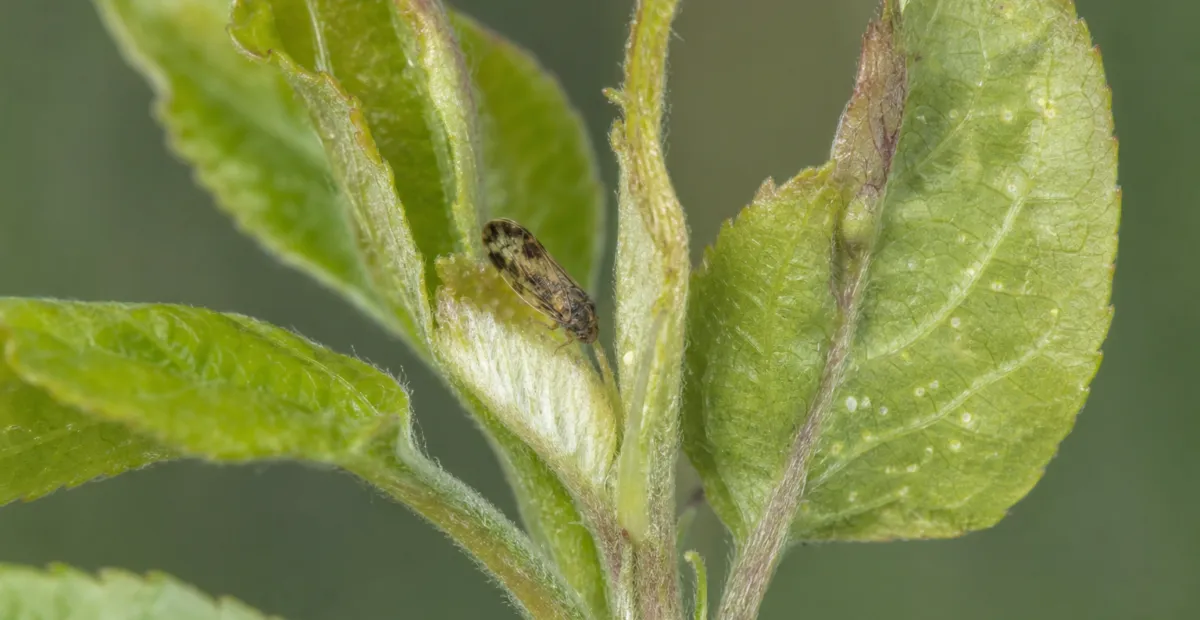
Cacopsylla picta is a jumping plant louse in the family Psyllidae. It is closely associated with apple trees and is reported mainly from Europe. Adults and nymphs feed by inserting their mouthparts into vascular tissues of young apple growth.
The species is significant less because of routine feeding injury than because infected individuals can transmit ‘Candidatus Phytoplasma mali’ during feeding. Apple proliferation phytoplasma is a separate disease issue; finding this psyllid alone does not prove that a tree is infected.
Because reliable field separation from related psyllids can require microscopic characters or specialist confirmation, unusual detections in the United States should be documented and reported to the state plant regulatory official or USDA APHIS as appropriate.
Symptoms and identification
Low populations may cause little visible injury. Feeding on tender apple growth can produce slight leaf distortion, reduced vigor, localized yellowing or curling, and honeydew or small pale feeding areas, although these symptoms are not diagnostic.
When the insect is associated with apple proliferation phytoplasma, affected trees may show witches’-brooms, unusually crowded shoots, rosettes of small leaves, enlarged stipules, shortened petioles, delayed flowering, premature leaf drop, reduced fruit size and poor fruit quality. These are symptoms of the phytoplasma disease, not reliable proof of C. picta infestation.
Do not diagnose the insect from yellow leaves or shoot proliferation alone. Examine young shoots and leaves for the insect and obtain laboratory testing for suspected phytoplasma infection.
Causes and spread
Adults and nymphs acquire the phytoplasma while feeding on infected apple tissue and may transmit it later during phloem feeding. Transmission is persistent and propagative: the pathogen can remain in the vector and replicate within it for an extended period, potentially including after overwintering.
Long-distance spread is more commonly associated with infected propagation material such as scionwood, budwood or rootstock than with local insect movement. Local spread can occur when vectors move between infected and healthy apple trees.
Host relationships are reported somewhat differently among references. The best-supported developmental host is Malus; some sources list cultivated and wild apple, while broader records should be treated cautiously.
Life cycle and persistence
Cacopsylla picta is generally described as having one generation annually in its principal range. Adults overwinter away from actively growing apple tissue, commonly on conifers or evergreen shelter plants, and return to apple in spring.
Eggs are laid on or near young apple leaves and shoots. Nymphs pass through several stages while feeding on tender growth. Adults develop on apple, feed during the growing season and later migrate to overwintering sites.
Timing varies with latitude, elevation and weather. In European accounts, migration to apple and egg-laying occur in spring, nymphal development follows in spring to early summer, and adults leave apple later in the season. These timings should not be transferred directly to every U.S. climate zone.
Treatment and control
There is no curative treatment for a tree infected with apple proliferation phytoplasma. Management focuses on preventing introduction, confirming the diagnosis, removing infected trees when advised and reducing vector-mediated spread.
For the insect itself, treat only when monitoring confirms a meaningful population or when directed by a regulatory or crop adviser. Begin with removal of heavily infested soft shoots where practical, sanitation of discarded material and protection of beneficial insects. Broad, poorly timed sprays can disrupt natural enemies and may not prevent pathogen transmission if feeding has already occurred.
Suspect trees should be sampled and tested by an appropriate plant diagnostic laboratory. Because symptoms overlap with nutrient imbalance, herbicide injury and other diseases, laboratory confirmation is preferable before removing valuable trees.
Low-impact and biological control
Use integrated and biological measures first: conserve lady beetles, lacewings, minute pirate bugs, predatory bugs and spiders; avoid unnecessary broad-spectrum insecticides; and maintain flowering and refuge plants that support natural enemies without creating unmanaged apple hosts.
For small plantings, periodically hose tender shoots with a firm water spray and remove localized colonies when this can be done without spreading infested plant material. Horticultural oils or insecticidal soaps may suppress exposed psyllids when legally labeled for the crop and used with thorough coverage, but they are contact materials and may not reach protected eggs or nymphs.
Organic production should rely on certified-organic products and cultural controls permitted by the applicable certification program. No organic treatment can cure apple proliferation phytoplasma once established in a tree.
Prevention
- Purchase apple trees, rootstocks and scionwood from reputable sources with appropriate phytosanitary documentation.
- Inspect incoming nursery stock for psyllids, eggs, unusual shoot growth and suspicious apple-proliferation symptoms; isolate questionable material.
- Monitor young apple shoots during spring flushes with visual inspections and tapping over a white card. Use a hand lens because adults are only a few millimeters long.
- Remove and destroy trees confirmed with apple proliferation phytoplasma according to local plant-health advice. Pruning alone does not eradicate a systemic phytoplasma infection.
- Control neglected or abandoned apple hosts near commercial or high-value plantings where they can serve as reservoirs.
- Keep records of detections, photographs and sample locations, and contact the state plant regulatory agency if this species or apple-proliferation symptoms are suspected in the United States.
Interesting facts
- Cacopsylla picta is also known under the synonym Cacopsylla costalis.
- The species is considered a particularly efficient vector of ‘Candidatus Phytoplasma mali’ in areas where apple proliferation occurs.
- Adults and nymphs feed on apple, but the species’ host range is described conservatively because some records conflict between narrow oligophagy on Malus and near-monophagy on cultivated apple.
- Apple-proliferation symptoms may disappear temporarily and reappear later, so a tree that looks normal in one season is not necessarily free of infection.
- The insect should not be confused with North American pear psyllids or other apple-associated psyllids; species-level identification may require an expert.
Use only products legally authorized and currently labeled in the United States for psyllids on the specific crop and site. Follow the current label exactly, including rate, timing, personal protective equipment, re-entry interval, preharvest interval and pollinator precautions. Do not apply a pesticide solely on the basis of suspected Cacopsylla picta identification; confirm the pest and consult state extension or regulatory guidance before treatment.
Affected plants
The plants below are linked to this problem by structured host-plant data. The list updates automatically as new plant profiles are added.