
 Source:
 Red Palm Weevil
Rhynchophorus ferrugineusRed Palm Weevil overview
The red palm weevil, Rhynchophorus ferrugineus, is a highly destructive, quarantine-significant beetle whose larvae tunnel inside palm crowns and trunks. Infestations may remain hidden until fronds wilt, the crown collapses, or the trunk becomes structurally unsafe. Because early symptoms resemble drought stress and several palm pests cause similar damage, suspected finds in the United States require prompt confirmation by state or federal plant-health authorities.
Typical conditions
Overview
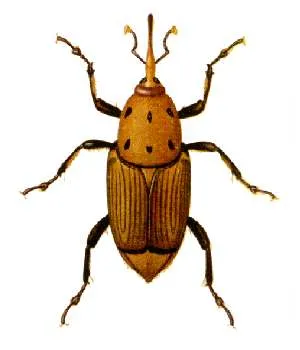
Red palm weevil adults are typically reddish brown to dark brown beetles with a conspicuous elongated snout. The damaging stage is the larva, which feeds within soft, succulent tissues of the palm. Multiple overlapping generations can occur when temperatures are favorable.
Early infestations are difficult to diagnose from outside because entrance holes may be hidden by palm fibers, leaf bases or offshoots. Visible decline may not occur until internal galleries have disrupted water movement and destroyed the growing point. Severe infestations can kill the palm and make the trunk liable to break or collapse.
Do not confuse this pest with the native or established palm weevils found in parts of the United States, including the South American palm weevil. Confirmatory identification is important because management and regulatory actions differ among species.
Symptoms and identification
Common symptoms include:
- Wilting, yellowing, desiccation or necrosis of fronds resembling drought stress.
- An eccentric, distorted or thinning crown and abnormal emergence of new leaves.
- Young leaves that fail to open, bend, break or become shredded.
- Brown, sticky sap or fermented-smelling ooze from wounds, leaf bases or trunk openings.
- Chewed fibers, frass, moist galleries, audible larval feeding or fibrous cocoons.
- Egg-laying notches or small cavities near the bases of fronds and offshoots.
- Umbrella-like drooping of older leaves, crown dieback, crown rot and eventual trunk collapse.
External symptoms alone cannot reliably confirm or exclude an infestation because larvae may be deep inside the crown or trunk. Acoustic tools, trained inspection and laboratory identification may be needed.
Causes and spread
Adults are attracted to stressed, wounded, recently pruned, declining or dying palms. Males produce an aggregation pheromone that works with odors released by damaged or fermenting palm tissue. Females lay eggs in separate holes or cavities, often near the base of living fronds, in wounds or around offshoots.
Larvae bore inward and feed on soft tissues. Adults can remain inside an infested palm or fly to other palms, allowing movement between nearby hosts. The most important long-distance pathway is movement of infested palms, offshoots, trunks, logs or other untreated palm material. Unnecessary trunk wounds and poor pruning practices increase risk and concealment.
Reports of development in non-palm plants such as agave or sugarcane are considered uncertain or of limited practical importance compared with the well-documented palm host range.
Life cycle and persistence
Females may lay approximately 200–300 eggs during their lifetime, placing them individually in protected cavities. Eggs can hatch in about 2–5 days under suitable conditions. The legless or short-legged larvae then tunnel through the crown and trunk, feeding on soft palm tissue for roughly 36–78 days, with duration influenced by temperature and host species.
Mature larvae construct fibrous cocoons, usually from palm fibers, and pupate inside or near the host. Adults commonly emerge after about 2–3 weeks of pupation. Under favorable warm conditions, a generation may be completed in approximately four months, and several life stages can be present in one palm at the same time.
Treatment and control
Successful treatment depends strongly on detection stage. A palm with localized infestation may sometimes be treated by a qualified palm-care professional using an officially approved, site-specific protocol that combines inspection, removal of accessible infested tissue, monitoring and an appropriate registered treatment. Because larvae are concealed, surface sprays alone are unreliable.
Severely infested, structurally weakened or crown-destroyed palms may not be salvageable. Removal should be planned by a qualified arborist, with the site kept secure because hollow trunks and collapsing crowns are hazardous. Infested material must be contained, chipped or otherwise disposed of according to instructions from the relevant plant-health authority; moving it can spread the pest.
Where the pest is suspected in the United States, do not begin an eradication or pesticide program before confirmation. Regulatory officials may require delimiting surveys, quarantine, destruction, treatment or other measures.
Low-impact and biological control
Organic and lower-impact measures are most useful as components of an integrated program rather than as stand-alone cures for advanced internal infestations. These may include:
- Strict sanitation and immediate containment of infested palm material.
- Pheromone trapping for detection and, where supported by local programs, mass trapping or attract-and-kill strategies.
- Acoustic or other non-destructive detection to locate hidden larvae before deciding whether a palm can be saved.
- Biological products based on entomopathogenic nematodes or fungi where they are legally registered, locally available and applied by trained personnel.
- Removal of damaged tissues and reduction of breeding sites, performed without spreading chips or contaminated debris.
Biological control performance varies with formulation, humidity, temperature, application access and larval location. No organic product should be assumed effective merely because it is labeled natural.
Prevention
Prevention in the United States should emphasize exclusion, inspection and rapid reporting:
- Buy palms only from reputable sources and inspect trunks, crowns, leaf bases and offshoots before planting.
- Quarantine newly acquired palms when practical, especially material originating from regions where the pest occurs.
- Avoid unnecessary pruning. Make clean cuts, avoid cutting into living trunk tissue, and do not remove green fronds unless horticulturally necessary.
- Disinfect pruning tools between palms and remove or treat cut palm material promptly.
- Do not move suspicious palms, offshoots, logs, chips or green fronds from the site.
- Maintain adequate irrigation and nutrition appropriate for the palm, while correcting drainage or root problems that cause chronic stress.
- Use species-appropriate pheromone trapping and regular crown inspections in nurseries, collections and high-risk landscapes where advised by plant-health officials.
- If the beetle or characteristic internal damage is suspected, photograph the symptoms, preserve a specimen if safe, and contact the state plant regulatory agency or USDA APHIS before disposal or transport.
Interesting facts
The red palm weevil is difficult to detect because most immature stages are hidden inside the host rather than exposed on leaves. A female may place eggs in many separate cavities, allowing infestations to begin at several points on one palm.
Internal larval galleries can severely reduce the mechanical strength of the trunk before the crown visibly collapses. This is why a suspected infested palm is both a plant-health concern and a public-safety concern.
The pest has been reported from more than 20 palm genera, but host importance varies by region. EPPO identifies coconut palm, date palm and Canary Island date palm among the major hosts, while records for some additional plants represent experimental, incidental or geographically variable susceptibility.
In the United States, red palm weevil should be distinguished from the South American palm weevil, Rhynchophorus palmarum, which is a different species with different distribution and response considerations.
Use only pesticide products legally authorized for red palm weevil on the specific palm crop and application site in the United States, and follow the current label exactly. Product registrations, permitted application methods, reentry intervals and state restrictions can change. Do not inject or apply an insecticide to a palm unless the label permits that use and the work is performed by a properly trained professional. Chemical treatment should support, not replace, official confirmation, sanitation, monitoring and safe disposal.