
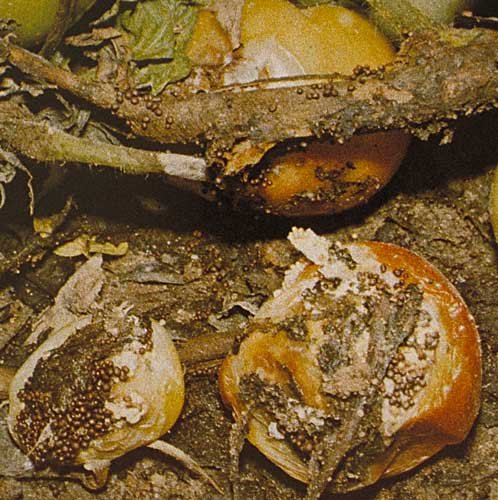
Southern blight
Athelia rolfsiiSouthern blight overview
Southern blight, caused by the soilborne fungus Athelia rolfsii, can rapidly kill tomatoes, peppers, beans, peanuts, onions, ornamentals and many other plants during hot, humid weather. Look for a water-soaked or reddish-brown lesion at the soil line, sudden yellowing and wilt, white fungal growth, and tiny tan-to-brown sclerotia resembling mustard seeds. Sanitation and preventing soil movement are central to management.
Typical conditions
Overview
Southern blight is a destructive disease of vegetables, field crops, ornamentals and turfgrass, especially in the southern and southeastern United States. The pathogen is a necrotrophic, soilborne basidiomycete that commonly infects lower stems, crowns, roots, bulbs, pegs, pods and fruit touching the soil.
Diagnosis is strongest when the characteristic combination of a basal lesion, abundant white mycelium and numerous round tan-to-reddish-brown sclerotia is present. Because crown rots and wilts can have several causes, laboratory confirmation is advisable when symptoms are atypical or the crop is valuable.
Symptoms and identification
Early symptoms often include sudden yellowing, browning, loss of vigor and wilt, followed by rapid collapse and death. A water-soaked, reddish-brown or dark brown lesion develops at the lower stem or crown near the soil line and may extend several inches upward.
Under warm, humid conditions, coarse white mycelium forms on the lesion, surrounding soil, mulch and dead plant material. Small, round sclerotia—initially white, then tan, reddish brown or brown—develop in the mycelium and resemble mustard or millet seeds. Bulbs, roots, pods and fruit may develop a soft, wet rot.
In turfgrass, symptoms may appear as expanding reddish-brown, bronze or tan rings, arcs or patches, sometimes with white mycelium and sclerotia in thatch or dying foliage.
Causes and spread
The disease is caused by Athelia rolfsii, a soilborne fungus that survives in sclerotia and infested debris. Spread commonly occurs when contaminated soil is moved by tools, footwear, machinery, transplants, bulbs, animals, wind-driven erosion or runoff. Irrigation water and soil splash can distribute sclerotia and mycelium within a bed or field.
Infection is favored when susceptible plant tissue remains close to warm, wet soil. Weeds and volunteer plants may maintain the pathogen because of its broad host range. Infected plant debris left on the soil surface can support growth and produce additional sclerotia.
Life cycle and persistence
Athelia rolfsii primarily survives as sclerotia, compact resting structures in soil, crop residue, mulch, thatch and diseased tissue. They may persist for several years. When soil is warm and moist, sclerotia germinate and produce white mycelium.
The mycelium grows through soil and debris, colonizes weakened or dead organic matter, and infects plant tissue at or below the soil line. It can move from an infected plant to neighboring plants where tissues touch or where soil remains wet. Sclerotia form on the surface of infected tissue and mycelium, replenishing the soil inoculum. Sexual basidiospores are uncommon and are not considered important for most field spread.
Treatment and control
Remove and discard plants that have collapsed or have extensive crown rot. Carefully remove the plant, root ball, and visibly infested soil or mulch; replacing contaminated soil in small beds can reduce immediate reinfection. Do not replant another highly susceptible host in the same spot during the same season.
For valuable crops, combine sanitation with improved drainage, reduced soil splash, clean propagation material and a crop-specific disease-management program. In commercial production, labeled fungicides, grafting with appropriate rootstocks in tomato, resistant or less-susceptible cultivars where available, and directed soil-line applications may reduce losses. Efficacy varies substantially by crop and timing, and no treatment reliably restores a plant after severe basal infection.
When symptoms are uncertain, submit fresh symptomatic tissue and nearby soil to a university or state plant diagnostic laboratory. Southern blight can resemble white rot, Rhizoctonia crown rot, Fusarium wilt, bacterial wilt and other root or crown disorders.
Low-impact and biological control
There is no dependable organic cure for plants already showing advanced crown rot. Remove infected plants promptly, taking surrounding soil and mulch with them. Do not compost diseased material or place it in areas where garden soil, runoff or finished compost may be contaminated.
- Use clean, disease-free seed, transplants, bulbs and divisions.
- Disinfect tools, gloves, containers and footwear after working in an affected bed.
- Reduce soil splash with drip irrigation, adequate spacing and mulch that keeps plant tissue from contacting contaminated soil; avoid excessive organic mulch around susceptible crowns.
- Improve drainage and avoid prolonged saturation, while recognizing that moisture reduction alone will not remove established sclerotia.
- Use soil solarization during the hottest part of summer where practical, following local extension guidance; results are variable and treatment depth is limited.
- Biological products containing beneficial microbes may provide suppression in some crops, but performance is inconsistent and depends on the product label, timing and environmental conditions.
Prevention
Begin with exclusion and sanitation. Inspect incoming transplants, divisions, bulbs and potting materials for wilt, basal rot, white mycelium or sclerotia. Keep clean beds separate from infested areas and avoid carrying soil between them.
- Remove diseased plants as soon as symptoms are noticed, including the root ball and several inches of surrounding soil.
- Bag and dispose of infected material according to local rules; do not compost it.
- Clean soil from tools and equipment, then disinfect them before working in healthy areas.
- Use raised beds or well-drained sites, space plants for airflow, and irrigate at the root zone rather than wetting the entire bed.
- Keep fruit, lower stems and crowns off the soil where possible, and control weeds and volunteer hosts.
- Destroy or deeply incorporate crop residue after harvest where appropriate, but avoid moving infested soil to uninfested ground.
- Rotate with carefully selected less-susceptible or nonhost crops when feasible; because the host range is broad, rotation alone is not a guarantee.
Interesting facts
- The organism is widely known in older literature as Sclerotium rolfsii; Athelia rolfsii is the current name associated with its sexual stage and accepted taxonomic usage in many modern plant pathology references.
- More than 500 plant species have been reported as hosts worldwide, so rotating among unrelated susceptible garden plants may not eliminate the problem.
- Sclerotia are the most important survival structures and can be moved in contaminated soil, plant debris, tools, transplants, bulbs, equipment and irrigation water.
- Low-hanging fruit and plant parts touching the soil are particularly vulnerable.
Use only fungicides legally authorized and currently labeled in the United States for southern blight or Athelia rolfsii on the specific crop and site. Follow the current product label exactly, including crop, application method, rate, personal protective equipment, reentry interval, preharvest interval, and resistance-management instructions. Product availability and labels differ among crops, states, and use sites; fungicides generally protect healthy tissue or suppress new infections rather than cure plants that have already collapsed.
Affected plants
The plants below are linked to this problem by structured host-plant data. The list updates automatically as new plant profiles are added.
 Onion (Allium cepa) care guideAllium cepa
 Allium christophii care guideAllium christophii
 Bunching onion (Allium fistulosum) care guideAllium fistulosum
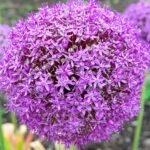 Giant Allium (Allium giganteum) care guideAllium giganteum
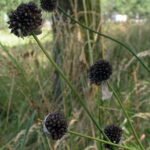 Ornamental onion (Allium) care guideAllium
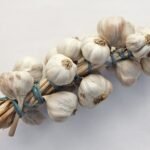 Garlic (Allium sativum) care guideAllium sativum
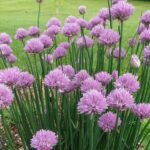 Chives (Allium schoenoprasum) care guideAllium schoenoprasum
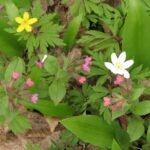 Ransoms (Allium ursinum) care guideAllium ursinum
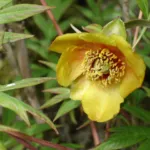 Delavay’s tree peony (Paeonia delavayi) care guidePaeonia delavayi
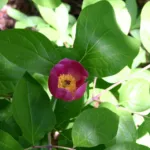 Woodland peony (Paeonia obovata) care guidePaeonia obovata
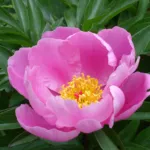 Common Garden Peony (Paeonia lactiflora) care guidePaeonia lactiflora
 Wild Peony (Paeonia mascula) care guidePaeonia mascula