
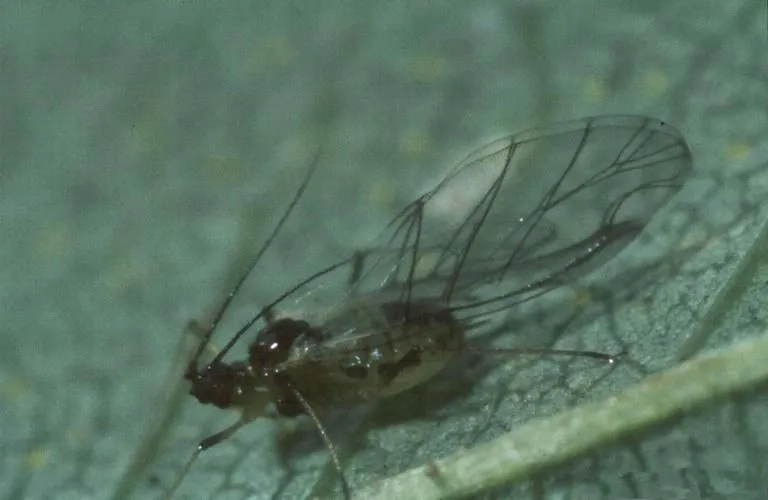
Hop aphid
Phorodon humuli (Schrank)Hop aphid overview
The hop aphid, Phorodon humuli, is a phloem-feeding pest of hops that alternates seasonally between Prunus trees and hop plants. Pale yellow-green colonies gather on leaf undersides, shoots, burrs and cones, producing honeydew that can support sooty mold and contaminate harvested cones. Early detection, conservation of beneficial insects and well-timed integrated management are especially important in cool, moist seasons.
Typical conditions
Overview
Phorodon humuli is commonly called the hop aphid or damson-hop aphid. It is a small, soft-bodied true bug with piercing-sucking mouthparts. On hop plants, wingless forms are usually pale yellow-green to yellow and occur in colonies on the undersides of leaves, tender shoots, burrs and cones. Winged forms may appear as populations increase or as the aphid disperses.
This species is often confused with other aphids found on hops. Confirmation may require an extension diagnostician or specialist examination, especially when management or regulatory decisions depend on species identification.
Symptoms and identification
Inspect the undersides of young and mid-canopy leaves, shoot tips, burrs and cones. Typical signs include:
- Clusters of pale yellow-green aphids, nymphs and shed white skins.
- Leaf curling, yellowing, reduced vigor or distorted tender growth under heavy pressure.
- Sticky honeydew on leaves, stems, burrs or cones.
- Dark sooty mold developing on honeydew-covered surfaces.
- Ant activity associated with aphid colonies.
- Contaminated cones and reduced marketable quality when aphids are abundant late in the season.
Causes and spread
The pest is spread principally by winged aphids moving from overwintering Prunus hosts into hop yards in spring and by subsequent movement within and between hop plants. Aphids can also be moved on infested planting material. Population growth is favored when natural enemies are insufficient, and ants may protect colonies in exchange for honeydew.
Because many aphid species can occur on hops, the presence of aphids alone does not prove that the species is P. humuli.
Life cycle and persistence
In the typical holocyclic cycle, eggs overwinter on Prunus twigs. They hatch in spring, and wingless stem mothers produce successive generations on the primary host. Winged females later migrate to hops, generally during late spring or early summer in U.S. hop-growing regions. Several wingless generations may develop on hops, followed by winged dispersal forms. In autumn, migrants return to Prunus, where sexual forms mate and females lay overwintering eggs.
Timing varies with latitude, temperature, cultivar, host availability and local weather. In U.S. observations, hop aphid pressure can persist into the preharvest period, and cool, moist seasons may favor larger populations.
Treatment and control
Base intervention on confirmed identity, crop stage, aphid density, cone contamination risk and the abundance of natural enemies. Begin with intensified scouting and record colonies by location, canopy level and plant stage. A strong beneficial-insect response may suppress small colonies without treatment.
- Where feasible, use a forceful water spray on small plantings to dislodge aphids, repeating as needed and avoiding prolonged leaf wetness.
- Remove and dispose of severely infested shoots or leaves when infestations are localized.
- Improve spray coverage of leaf undersides if a treatment is justified; poor coverage can leave colonies protected.
- Rotate insecticide modes of action only when a legally labeled product is needed and avoid repeated use of the same mode of action.
- Observe all crop-specific preharvest intervals, reentry requirements and pollinator precautions.
Low-impact and biological control
Integrated organic options may include conservation of naturally occurring predators and parasitoids, removal of localized colonies, water sprays on small plantings and properly labeled microbial or contact products. Beauveria bassiana products are listed for hop aphid management in some U.S. production references, but formulation legality, organic status, application directions and effectiveness depend on the current label and state registration.
Contact materials generally require thorough coverage and may need repeat applications because they do not provide durable systemic control. Apply when beneficial insects and pollinators are least exposed, and never treat flowering plants in a manner prohibited by the label.
Prevention
- Scout at least weekly from spring migration through harvest, concentrating on leaf undersides and the middle portion of the hop canopy.
- Identify aphids before treating; do not assume every aphid on hops is P. humuli.
- Use clean, pest-free crowns, rhizomes and nursery stock.
- Manage volunteer hops, neglected Prunus suckers and heavily infested host material near production areas where practical.
- Avoid excessive nitrogen that produces highly succulent growth.
- Maintain irrigation and canopy practices that support vigorous plants without creating overly dense, humid foliage.
- Protect lady beetles, lacewings, syrphid larvae, predatory bugs and parasitoids by avoiding unnecessary broad-spectrum insecticide applications.
Interesting facts
- The species has a two-host life cycle: Prunus is the usual overwintering or primary host group, while hops are an important summer host.
- Honeydew from colonies can contaminate hop cones and support sooty mold, making quality loss an important concern even when visible feeding injury is modest.
- On hops, aphid abundance is often greater in the middle canopy than near the top, which is useful when designing scouting routes.
- Lady beetles, lacewings, syrphid larvae, predatory bugs and parasitoid wasps can all contribute to suppression.
- Some hop cultivars and accessions differ in susceptibility, so cultivar choice may contribute to long-term IPM but does not replace scouting.
Use only a pesticide product currently legally authorized and labeled in your U.S. state for hop aphid or aphid control on the specific crop. Follow the current label exactly, including rate, spray interval, crop restrictions, preharvest interval, reentry interval, personal protective equipment, resistance-management language and pollinator protections. Product registrations and labels change; consult your state pesticide regulatory agency, Extension recommendations and the current product label before application.