
High-pH-induced iron deficiency
High-pH-induced iron deficiency overview
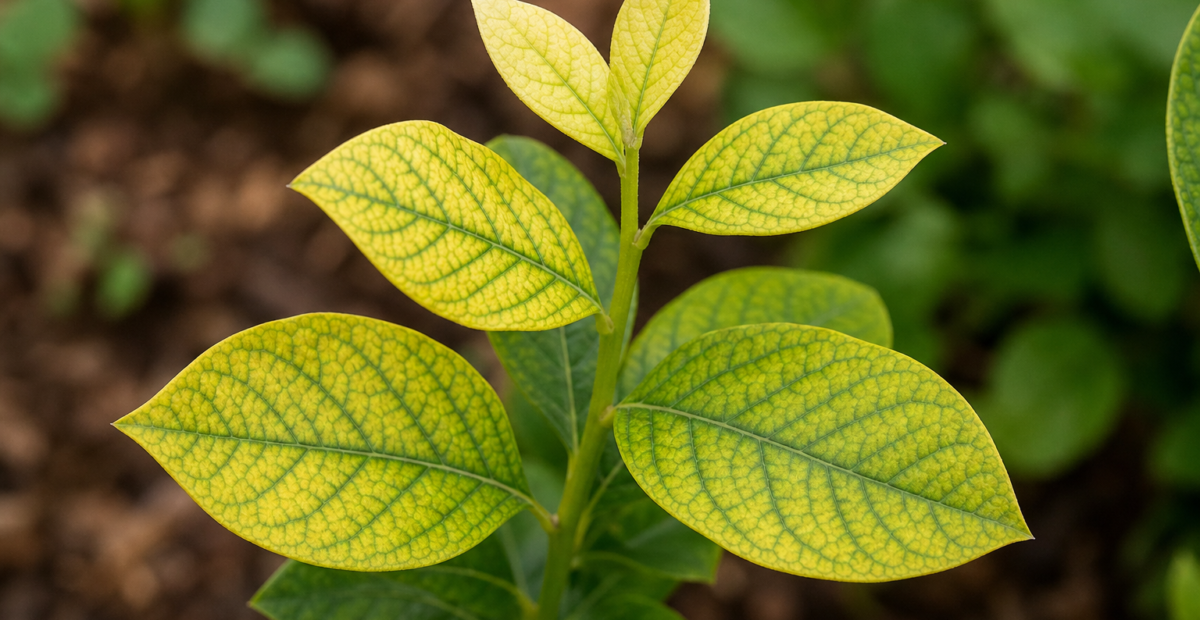
High-pH-induced iron deficiency, commonly called lime-induced iron chlorosis, is a nutrient-availability disorder rather than an infectious disease. Plants may contain ample total iron in the soil or tissue, but alkaline, calcareous conditions convert iron into forms roots cannot readily absorb or use. The classic sign is yellow to nearly white young foliage with a fine network of green veins.
Typical conditions
Overview
Iron is required for chlorophyll formation and several essential plant enzymes. In soils with elevated pH, especially where calcium carbonate or other free lime is present, iron becomes poorly soluble. Bicarbonate can also interfere with root uptake and with the plant’s ability to use absorbed iron.
The disorder is most conspicuous on acid-loving or iron-sensitive plants growing in alkaline landscapes, orchard soils, high-pH irrigation media, and calcareous fields. Susceptibility varies by species, cultivar, rootstock, root condition, and soil chemistry. A soil test and examination of irrigation, drainage, planting depth, and root health are more useful than assuming that total soil iron is low.
Symptoms and identification
Symptoms usually begin on the youngest or terminal leaves because iron is relatively immobile within the plant. The tissue between veins turns pale green, yellow, or cream while the veins remain dark green, producing a fine netted pattern.
- New leaves may be small, pale, or almost white in severe cases.
- Leaf tips or margins may scorch after chlorophyll is lost, particularly under intense sunlight or water stress.
- Shoot extension, flowering, fruit production, and overall vigor may decline.
- Severe, prolonged chlorosis can lead to premature leaf drop, dieback, and plant death.
Uniform yellowing that begins on older leaves is more consistent with nitrogen deficiency. Similar new-leaf symptoms may result from manganese or zinc deficiency, herbicide injury, root damage, viruses, phytoplasmas, or vascular disease.
Causes and spread
The primary trigger is high root-zone pH, commonly above about 7.0 and especially problematic above 7.5 in calcareous soils. Increasing pH favors conversion of soluble iron into insoluble compounds. Calcium carbonate and bicarbonate-rich irrigation water can buffer attempts to acidify the soil and maintain the problem.
Wet or waterlogged soil, excessive irrigation, poor drainage, compaction, low root-zone oxygen, high salinity, shallow or girdled roots, excessive phosphate, and damaged roots can intensify symptoms. High nitrate supply can aggravate iron-deficiency chlorosis in susceptible crops such as soybean. The disorder does not spread from plant to plant, although the same soil, irrigation, or landscape conditions can affect neighboring plants.
Life cycle and persistence
No pathogen or insect lifecycle is involved. Symptoms develop whenever roots cannot acquire or physiologically use enough iron, and they often become more visible during rapid spring growth, cool wet periods, excessive irrigation, or high-demand production stages. Newly formed leaves may improve after root-zone conditions are corrected, but already yellow tissue may recover incompletely. Foliar or chelate treatments commonly provide temporary improvement unless the underlying pH, lime, drainage, or plant-selection problem is addressed.
Treatment and control
Confirm the diagnosis with a soil test and assess drainage, irrigation water, salinity, root damage, and possible manganese or zinc deficiency. Correcting excessive irrigation, waterlogging, compaction, or planting-depth problems may relieve mild chlorosis.
If soil lacks free lime, carefully planned acidification with elemental sulfur or an appropriate acidifying fertilizer may help, but rates depend on soil texture, buffering capacity, crop, and test results. In calcareous soil, lowering the entire root zone may be impractical. Iron chelates can be applied to soil or foliage, but effectiveness depends on product chemistry, pH, timing, plant size, and root-zone conditions; products formulated for high-pH conditions are generally more suitable than ordinary iron salts. Foliar applications can green leaves quickly but are often temporary and may cause injury if misapplied. In valuable trees, professional trunk-injection options may be considered after diagnosis.
Replace or relocate chronically affected plants when the species is poorly suited to the site. For commercial crops, use locally validated tolerant cultivars or rootstocks and follow crop-specific extension recommendations.
Low-impact and biological control
Use cultural measures first: select pH-tolerant plants, correct irrigation, improve drainage, reduce compaction, protect roots with organic mulch, and maintain moderate organic matter without burying the crown or trunk. A compost-based or bark-based growing medium can support sensitive plants when used in raised beds or containers, but compost alone will not reliably overcome free lime in native soil.
Where appropriate, incorporate elemental sulfur only according to a soil test and an extension-based amendment calculation. Acidifying organic materials may have modest or temporary effects. Avoid homemade foliar mixtures and untested soil remedies, especially around edible crops or plants with sensitive roots.
Prevention
- Test soil pH, soluble salts, drainage, and—where relevant—free lime before planting sensitive species.
- Choose species, cultivars, and rootstocks adapted to the site’s pH; do not place blueberries, azaleas, rhododendrons, or other acid-loving plants in unamended calcareous soil without a realistic management plan.
- Improve drainage and soil structure without damaging established roots. Avoid planting trees too deeply and inspect mature trees for girdling roots or a buried root flare.
- Irrigate deeply but only as needed, allowing appropriate drainage and avoiding prolonged saturation. Use drip or targeted irrigation where practical.
- Use mulch to moderate soil temperature and reduce compaction, keeping mulch away from trunks and crowns.
- Do not overapply phosphate, lime, or fertilizer. Base amendments on a soil test and the crop’s documented pH range.
- For highly sensitive plants, use raised beds, containers, or an engineered acidic growing medium rather than repeatedly trying to overcome native free lime.
Interesting facts
- High-pH iron chlorosis often reflects unavailable or inactive iron rather than a complete absence of iron in the soil or leaf.
- Leaf iron analysis can be misleading because iron may accumulate in chlorotic tissue while remaining physiologically unavailable.
- Blueberries and azaleas are especially sensitive because they require more acidic root-zone conditions than many landscape plants.
- Iron chlorosis is not contagious, but an entire planting may show symptoms when it shares alkaline soil, hard irrigation water, or poor drainage.
- Iron deficiency commonly appears first on new leaves, whereas nitrogen deficiency generally begins on older leaves.
There is no pesticide treatment because this is not a pest or infectious disease. Use only iron, acidifying, fertilizer, or injection products legally authorized for the specific crop and problem in the United States, and follow the current product label, required protective equipment, reentry restrictions, and application directions. Do not assume that a product labeled for one crop or use is legal for another.
Affected plants
The plants below are linked to this problem by structured host-plant data. The list updates automatically as new plant profiles are added.
 Field maple (Acer campestre) care guideAcer campestre
 Paperbark Maple (Acer griseum) care guideAcer griseum
 Downy Japanese Maple (Acer japonicum) care guideAcer japonicum
 Boxelder (Acer negundo) care guideAcer negundo
 Acer palmatum care guideAcer palmatum
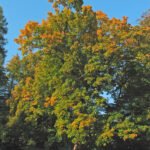 He Norway maple (Acer platanoides) care guideAcer platanoides
 Sycamore maple (Acer pseudoplatanus) care guideAcer pseudoplatanus
 Red maple (Acer rubrum) care guideAcer rubrum
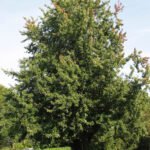 Silver maple (Acer saccharinum) care guideAcer saccharinum
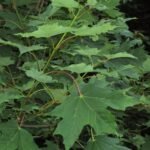 Sugar maple (Acer saccharum) care guideAcer saccharum
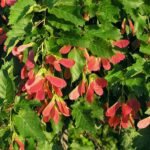 Tatar Maple (Acer tataricum) care guideAcer tataricum
 Amur Maple (Acer tataricum ginnala) care guideAcer tataricum ginnala